


A Tibetan who has waged a campaign to preserve his region’s ancestral language on Thursday was put on trial in China for inciting separatism in a case Amnesty International denounced as “ludicrously unjust.”
Tashi Wangchuk was featured in a New York Times documentary that followed him on a trip to Beijing, where he attempted to get Chinese state media and courts to address what he described as the diminishing use of the Tibetan language.
Wangchuk was put on trial at the Intermediate People’s Court in Yushu, his hometown in a Tibetan area of Qinghai Province.
The charge can carry a sentence of up to five years, but Wangchuk’s lawyer, Liang Xiaojun (梁小軍), said prosecutors were expected to seek even more jail time.
Wangchuk pleaded not guilty and the trial did not come to a verdict, but nearly every case that goes to trial in China — especially on sensitive state-security issues — ends with a guilty verdict.
“He doesn’t believe he’s incited separatism. He only wants to strengthen Tibetan language education,” Liang said.
Wangchuk has been detained in Yushu since January 2016, not long after the Times published its story and documentary video about his activism, according to the newspaper.
Liang said the short documentary was “the most important evidence” used by the prosecution.
In the video, Wangchuk complained of a “systematic slaughter of our culture.”
“In politics, it’s said that if one nation wants to eliminate another nation, first they need to eliminate their spoken and written language,” Wangchuk said.
In the Times’ stories, Wangchuk notably says he wants to use Chinese law to build his case and he praised Chinese President Xi Jinping (習近平).
Amnesty International said it was “appalling” that Wangchuk could face jail time.
“These are blatantly trumped up charges, and he should be immediately and unconditionally released,” Amnesty International East Asia research director Roseann Rife said in a statement.
Human Rights Watch Hong Kong-based researcher Maya Wang (王松蓮) said Wangchuk was merely exercising his constitutionally guaranteed rights.
“If Chinese authorities consider that ‘inciting separatism,’ it’s hard to tell what isn’t,” Wang said.

A new online voting system aimed at boosting turnout among the Philippines’ millions of overseas workers ahead of Monday’s mid-term elections has been marked by confusion and fears of disenfranchisement. Thousands of overseas Filipino workers have already cast their ballots in the race dominated by a bitter feud between President Ferdinand Marcos Jr and his impeached vice president, Sara Duterte. While official turnout figures are not yet publicly available, data from the Philippine Commission on Elections (COMELEC) showed that at least 134,000 of the 1.22 million registered overseas voters have signed up for the new online system, which opened on April 13. However,

EUROPEAN FUTURE? Albanian Prime Minister Edi Rama says only he could secure EU membership, but challenges remain in dealing with corruption and a brain drain Albanian Prime Minister Edi Rama seeks to win an unprecedented fourth term, pledging to finally take the country into the EU and turn it into a hot tourist destination with some help from the Trump family. The artist-turned-politician has been pitching Albania as a trendy coastal destination, which has helped to drive up tourism arrivals to a record 11 million last year. US President Donald Trump’s son-in-law, Jared Kushner, also joined in the rush, pledging to invest US$1.4 billion to turn a largely deserted island into a luxurious getaway. Rama is expected to win another term after yesterday’s vote. The vote would
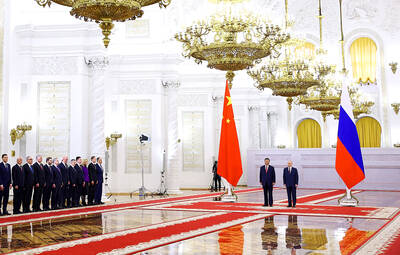
ALLIES: Calling Putin his ‘old friend,’ Xi said Beijing stood alongside Russia ‘in the face of the international counter-current of unilateralism and hegemonic bullying’ Chinese President Xi Jinping (習近平) yesterday was in Moscow for a state visit ahead of the Kremlin’s grand Victory Day celebrations, as Ukraine accused Russia’s army of launching air strikes just hours into a supposed truce. More than 20 foreign leaders were in Russia to attend a vast military parade today marking 80 years since the defeat of Nazi Germany in World War II, taking place three years into Russia’s offensive in Ukraine. Putin ordered troops into Ukraine in February 2022 and has marshaled the memory of Soviet victory against Nazi Germany to justify his campaign and rally society behind the offensive,

FRAUD ALLEGED: The leader of an opposition alliance made allegations of electoral irregularities and called for a protest in Tirana as European leaders are to meet Albanian Prime Minister Edi Rama’s Socialist Party scored a large victory in parliamentary elections, securing him his fourth term, official results showed late on Tuesday. The Socialist Party won 52.1 percent of the vote on Sunday compared with 34.2 percent for an alliance of opposition parties led by his main rival Sali Berisha, according to results released by the Albanian Central Election Commission. Diaspora votes have yet to be counted, but according to initial results, Rama was also leading there. According to projections, the Socialist Party could have more lawmakers than in 2021 elections. At the time, it won 74 seats in the


 RSS
RSS