


An estimated 40,000 people traveled from around the world to take up arms for the Islamic State (IS) group as it occupied territory in Syria and Iraq and declared a caliphate in 2014.
A few hundred are believed to still be fighting as IS struggles to survive, having lost most of its territory to campaigns by Western-backed Syrian and Iraqi coalition armies, but what happened to the rest?
Many thousands were certainly killed in the intense fighting, but US experts believe that many have survived, posing a formidable threat going forward.
“The issue is: How many have died? How many are still there and willing to fight? How many have gone elsewhere to fight?” said Seth Jones, director of the International Security and Defense Policy Center at the Rand Corporation. “How many have given up? I don’t think we have a good answer.”
International counterterror groups are putting huge efforts into answering those questions, working hard to name, count and track IS foreign fighters.
In France, officials say that about 1,700 people went to Iraq and Syria since 2013 to join IS. Of those, 400 to 450 have been killed and 250 have returned to France.
French Minister of Europe and Foreign Affairs Jean-Yves Le Drian said on Dec. 8 that about 500 are still in the Iraq-Syria theater, and for them it is very hard to return to France.
However, that leaves another 500 whose whereabouts are unknown, many with the skills of war, wielding weapons and making bombs.
Terrorism specialist Bruce Hoffman of Georgetown University on Wednesday estimated during a conference that “thousands” have escaped the war zone.
“Today, some of them are most likely in the Balkans, lying low for the time being, waiting for the opportunity to infiltrate themselves to the rest of Europe,” he said.
Some have traveled to other fronts, said Thomas Sanderson of the Center for Strategic and International Studies’ Transnational Threats Project.
For example, at least 80 IS fighters from Morocco, Russia, Saudi Arabia and Yemen have since May joined the IS-allied Abu Sayyaf insurgents battling government forces in the southern Philippines, he said.
Locals in the northern Afghanistan province of Jowzjan have said that French-speaking IS veterans — from France or northern African nations — have set up camp there.
They also have the option of other conflict zones in northern Africa, like Libya, Somalia, Yemen and elsewhere, where groups akin to IS are conducting violent insurgencies.
The defeat of IS on the battlefield in Syria in Iraq did not close off escape routes. IS fighters were able to blend in with civilian refugees or bribe their way to sneak into Turkey.
Many do not have much choice, but to continue to fight: They never had a plan to return to their home nations, where they face imprisonment in most cases, Jones said.
“For many, it was a one-way trip. They wanted to live in the caliphate, permanently — so we don’t see a major move back,” Jones added.

Le Tuan Binh keeps his Moroccan soldier father’s tombstone at his village home north of Hanoi, a treasured reminder of a man whose community in Vietnam has been largely forgotten. Mzid Ben Ali, or “Mohammed” as Binh calls him, was one of tens of thousands of North Africans who served in the French army as it battled to maintain its colonial rule of Indochina. He fought for France against the Viet Minh independence movement in the 1950s, before leaving the military — as either a defector or a captive — and making a life for himself in Vietnam. “It’s very emotional for me,”

The Chinese Communist Party’s (CCP) Central Committee is to gather in July for a key meeting known as a plenum, the third since the body of elite decisionmakers was elected in 2022, focusing on reforms amid “challenges” at home and complexities broad. Plenums are important events on China’s political calendar that require the attendance of all of the Central Committee, comprising 205 members and 171 alternate members with Chinese President Xi Jinping (習近平) at the helm. The Central Committee typically holds seven plenums between party congresses, which are held once every five years. The current central committee members were elected at the
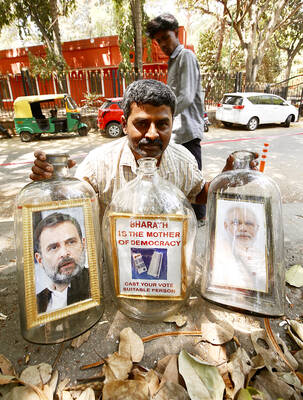
Indian Prime Minister Narendra Modi reaffirmed his pledge to replace India’s religion-based marriage and inheritance laws with a uniform civil code if he returns to office for a third term, a move that some minority groups have opposed. In an interview with the Times of India listing his agenda, Modi said his government would push for making the code a reality. “It is clear that separate laws for communities are detrimental to the health of society,” he said in the interview published yesterday. “We cannot be a nation where one community is progressing with the support of the Constitution while the other

CODIFYING DISCRIMINATION: Transgender people would be sentenced to three years in prison, while same-sex relations could land a person in jail for more than a decade Iraq’s parliament on Saturday passed a bill criminalizing same-sex relations, which would receive a sentence of up to 15 years in prison, in a move rights groups condemned as an “attack on human rights.” Transgender people would be sentenced to three years’ jail under the amendments to a 1988 anti-prostitution law, which were adopted during a session attended by 170 of 329 lawmakers. A previous draft had proposed capital punishment for same-sex relations, in what campaigners had called a “dangerous” escalation. The new amendments enable courts to sentence people engaging in same-sex relations to 10 to 15 years in prison, according to the


 RSS
RSS