


When Huynh Thi Thai Muoi left her home in rural Vietnam to begin a life in South Korea with a man she barely knew, she feared it was a gamble.
She did not speak the language, her new husband was nearly twice her age, and she knew little about her new home, but the 23-year-old high-school dropout was looking for love — and a fresh start.
“I want a new life, I want to challenge myself and see whether I can thrive or not,” Muoi said.
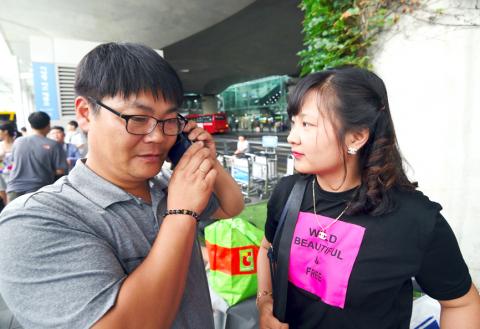
Photo: AFP
She was introduced to 43-year-old bachelor, Kim Kyeong-bok, through her cousin, who is also married to a South Korean, and the couple wed within days of meeting.
She is one of about 40,000 Vietnamese brides in South Korea, a top destination for women looking for love and a ticket out of poverty. Many know little about the country beyond K-pop bands or South Korean movies and end up marrying virtual strangers.
However, for Muoi, her new life in the city of Gwangju — and her new husband — have, so far, surpassed her hopes.
“My husband really loves me, more than I expected,” she said.
Despite the language barrier, Kim is teaching her to shop and cook, and hopes she will make friends at a nearby community center for foreign brides.
“When I first met her, I thought to myself: ‘This is the woman who will become my wife.’ I was very happy,” said Kim, who had rejected the first Vietnamese girl presented to him as a bride option.
However, Muoi is one of the lucky ones. Many other Vietnamese women have found their new lives are not what they dreamed: thousands have returned home divorced and unhappy.
“The women don’t have enough information about either their husbands or what migrating and living in [South] Korea would be like,” said Youn Sim-kim, director of the Korea Center for UN Human Rights Policy, a non-governmental organization in Vietnam’s southern Can Tho Province where many of the brides come from.
One in five Vietnamese-South Korean couples filed for divorce in 2015, according to the latest data from Statistics Korea.
“I thought life would be okay like it was in Vietnam, maybe the only difference would be the food,” said Le Thi The, a divorcee now living in Can Tho.
The honeymoon period abruptly ended days after she arrived and discovered her husband was not the man she thought he would be.
“I asked him to come home and he got mad at me, he threw all my stuff out of the house,” she said.
Most Vietnamese brides usually settle in rural areas in South Korea, a prospect that has become less attractive to eligible South Korean women who have streamed into fast-growing cities to climb the career ladder. An increasing number say that marriage is not a must.
“In some of those areas there’s a gender imbalance, whereby a lot of the South Korean women who are from the rural areas are migrating to urban centers, leaving a shortage,” said Paul Priest, acting chief of mission at the International Organization for Migration in Vietnam.
The bulk of women filling the marriage gap come from Vietnam’s Mekong Delta or rural China, largely drawn to South Korea’s dizzying pace of development of the past half-century.
Its annual per capita GDP is more than US$27,000, about 12 times that of Vietnam, and comfortably above China’s US$8,000, according to World Bank data.
The headache continues for returnees to Vietnam since their divorces are not legally recognized and their South Korean-born children are not immediately eligible to attend local schools.
Mother-of-two Nguyen Thi Kim Han married a South Korean man in 2007 to help her poor family.
However, he turned out to be a closeted gambling addict who emptied the family’s bank account — twice.
“At first he was nice with a gentle manner, we didn’t have that much money, but it wasn’t that important,” she told reporters, sobbing.
However, she later discovered he lost all their money in poor trades on the stock market.
“Not a single penny left... I was in shock,” Han said.
After he did it a second time, she took her daughters back to Vietnam, but struggled to get them into school, eventually managing with the center’s help.
Established in 2011, the center prepares brides-to-be for life in South Korea, teaching them about climate and culture, language and local food, and also supports returnees.
Most couples meet through illegal marriage brokers in Vietnam, notorious for arranging bride-viewing sessions for South Korean men in seedy backrooms.
However, police in Vietnam have cracked down on the brokers, and the South Korean government has tightened visa rules, so such foreign marriages are starting to decline.
Muoi is optimistic about her new relationship, but concedes her life in South Korea can be very lonely.
Some days, to alleviate the boredom she joins her husband at the office, sitting quietly as he works.
Muoi talks to her family daily on the smartphone Kim bought them, but is still desperately homesick.
“Every time I think about them, I always cry,” she said.

An American scientist convicted of lying to US authorities about payments from China while he was at Harvard University has rebuilt his research lab in Shenzhen, China, to pursue technology the Chinese government has identified as a national priority: embedding electronics into the human brain. Charles Lieber, 67, is among the world’s leading researchers in brain-computer interfaces. The technology has shown promise in treating conditions such as amyotrophic lateral sclerosis and restoring movement in paralyzed people. It also has potential military applications: Scientists at the Chinese People’s Liberation Army have investigated brain interfaces as a way to engineer super soldiers by boosting

Jailed media entrepreneur Jimmy Lai (黎智英) has been awarded Deutsche Welle’s (DW) freedom of speech award for his contribution to Hong Kong’s pro-democracy movement. The German public broadcaster on Thursday said Lai would be presented in absentia with the 12th iteration of the award on June 23 at the DW Global Media Forum in Bonn. Deutsche Welle director-general Barbara Massing praised the 78-year-old founder of the now-shuttered news outlet Apple Daily for standing “unwaveringly for press freedom in Hong Kong at great personal risk.” “With Apple Daily, he gave journalists a platform for free reporting and a voice to the democracy movement in
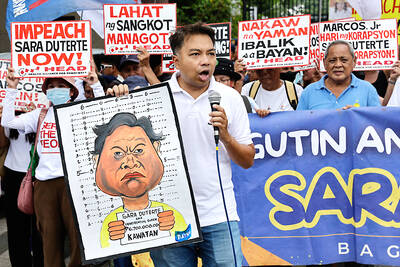
PHILIPPINE COMMITTEE: The head of the committee that made the decision said: ‘If there is nothing to hide, there is no reason to hide, there is no reason to obstruct’ A Philippine congressional committee on Wednesday ruled that there was “probable cause” to impeach Philippine Vice President Sara Duterte after hearing allegations of unexplained wealth, misuse of state funds and threats to have the president assassinated. The unanimous decision of the 53-member committee in the Philippine House of Representatives sends the two impeachment complaints to deliberations and voting by the entire lower chamber, which has more than 300 lawmakers. The complaints centered on Duterte’s alleged illegal use and mishandling of intelligence funds from the vice president’s office, and from her time as education secretary under Philippine President Ferdinand Marcos Jr. Duterte and the
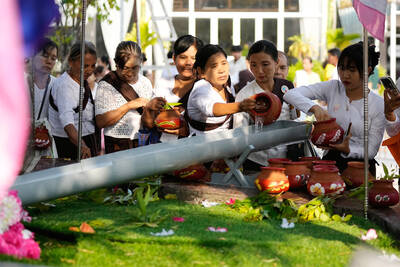
Burmese President Min Aung Hlaing yesterday cut all prisoners’ sentences by one-sixth, a blanket measure that a source close to deposed leader Aung San Suu Kyi said would further shorten her detention. Aung San Suu Kyi has been sequestered since a 2021 military coup, but the senior member of her dissolved National League for Democracy (NLD) party said that while her term had been reduced, her remaining sentence is still unclear. “We also don’t know exactly how many years she has left,” the source told reporters, speaking on condition of anonymity for security reasons. The military toppled Aung San Suu Kyi’s elected government


 RSS
RSS