


A group of Soviet mechanics slog through a muddy forest on a mission that would eventually help change the course of World War II: reaching Joseph Stalin.
Among them is an engineer who wants to convince the Kremlin leader that a new tank he has designed can transform the Soviet Union’s outdated forces a year ahead of the invasion by Nazi Germany.
Based on a little-known chapter of Soviet history from 1940, this is the scenario for a film being shot outside Moscow with state funding.
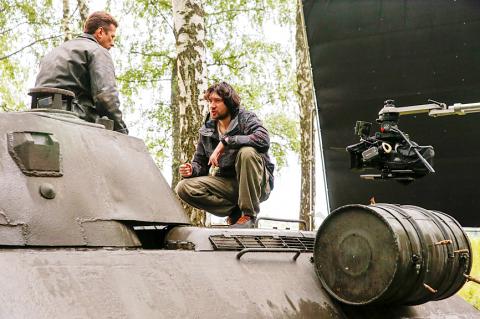
Photo: AFP
The movie, which has the working title To See Stalin, is the latest in a string of Russian government-backed productions about inspiring tales from World War II aimed at bolstering patriotic fervor that the Kremlin can tap.
Critics say the productions tend to whitewash the crimes of the Soviet leadership while downplaying the tragedies of the war, while also playing fast and loose with the truth.
“The idea came from the culture ministry, which has been actively pushing to retell the stories of the heroes from our country’s past,” 32-year-old director Kim Druzhinin told reporters as he oversaw the shoot.
Druzhinin’s latest project centers on the tale of Mikhail Koshkin, who in the spring of 1940 drove his prototype tank more than 2,000km across the Soviet Union to pitch the design to Stalin.
The journey would eventually cost Koshkin his life, as he died from pneumonia contracted along the route.
However, his T-34 tank went into mass production and eventually helped Moscow push back Nazi forces after their devastating invasion in 1941.
“It is tragic story about a designer who got his tank into production at the cost of his own life,” Druzhinin said.
The film, which the director said he wants to shoot “in the style of a Soviet adventure movie,” has raised some eyebrows over what is expected to be a positive portrayal of Stalin in a fleeting appearance at the end of the film.
Russian authorities have sought to downplay the horrors of Stalin’s rule, during which millions were executed or sent to labor camps.
Instead, officials highlight his role in winning the war against Germany, saying that the conflict — which claimed an estimated 22 million Soviet lives more than 70 years ago — is a sacrosanct rallying point for society today.
“Stalin is the culmination of the film, the destination, the reward you must receive like at the end of a fairytale,” Druzhinin said.
The film received the bulk of its financing — 60 million rubles (US$1 million) — from the Russian Ministry of Culture.
Those involved in the production have no doubt over its aim.
“When I read the script and saw that it was ordered by the culture ministry, I immediately understood that it was aimed at stirring up patriotism,” said actor Dmitry Podnozov, who plays one of Koshkin’s crew.
The authorities have “fear of young people taking to the streets to protest,” Podnozov said, so are looking to generate nationalist pride to curb any anti-Kremlin sentiment.
For Druzhinin this is not a first foray into making state-sponsored films on historical subjects.
Last year his World War II action movie called Panfilov’s 28 came out about the resistance of a group of Soviet soldiers who sacrificed their lives destroying 18 German tanks advancing on Moscow in 1941.
Despite a poor response from critics, the film drew support from the highest levels of the Kremlin — with Russian President Vladimir Putin sitting down to watch it alongside Kazakh President Nursultan Nazarbayev.
While the tale of heroism inspired generations of Soviet and Russian citizens, there was one major catch: It appears not to have been true.
Documents declassified by Russia’s state archive in 2015 showed that the incident was in fact invented by a Soviet journalist before becoming part of the Soviet war propaganda.
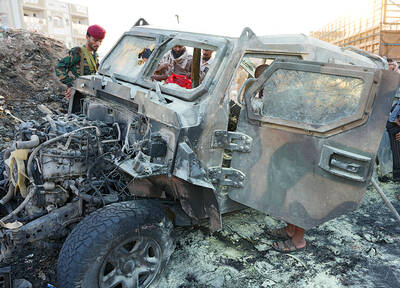
‘TERRORIST ATTACK’: The convoy of Brigadier General Hamdi Shukri resulted in the ‘martyrdom of five of our armed forces,’ the Presidential Leadership Council said A blast targeting the convoy of a Saudi Arabian-backed armed group killed five in Yemen’s southern city of Aden and injured the commander of the government-allied unit, officials said on Wednesday. “The treacherous terrorist attack targeting the convoy of Brigadier General Hamdi Shukri, commander of the Second Giants Brigade, resulted in the martyrdom of five of our armed forces heroes and the injury of three others,” Yemen’s Saudi Arabia-backed Presidential Leadership Council said in a statement published by Yemeni news agency Saba. A security source told reporters that a car bomb on the side of the road in the Ja’awla area in
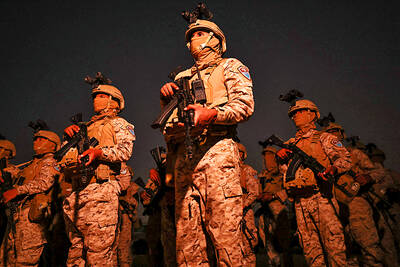
PRECARIOUS RELATIONS: Commentators in Saudi Arabia accuse the UAE of growing too bold, backing forces at odds with Saudi interests in various conflicts A Saudi Arabian media campaign targeting the United Arab Emirates (UAE) has deepened the Gulf’s worst row in years, stoking fears of a damaging fall-out in the financial heart of the Middle East. Fiery accusations of rights abuses and betrayal have circulated for weeks in state-run and social media after a brief conflict in Yemen, where Saudi airstrikes quelled an offensive by UAE-backed separatists. The United Arab Emirates is “investing in chaos and supporting secessionists” from Libya to Yemen and the Horn of Africa, Saudi Arabia’s al-Ekhbariya TV charged in a report this week. Such invective has been unheard of
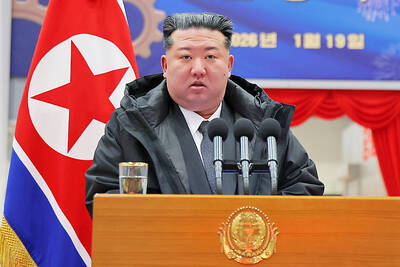
‘SHOCK TACTIC’: The dismissal of Yang mirrors past cases such as Jang Song-thaek, Kim’s uncle, who was executed after being accused of plotting to overthrow his nephew North Korean leader Kim Jong-un has fired his vice premier, compared him to a goat and railed against “incompetent” officials, state media reported yesterday, in a rare and very public broadside against apparatchiks at the opening of a critical factory. Vice Premier Yang Sung-ho was sacked “on the spot,” the state-run Korean Central News Agency said, in a speech in which Kim attacked “irresponsible, rude and incompetent leading officials.” “Please, comrade vice premier, resign by yourself when you can do it on your own before it is too late,” Kim reportedly said. “He is ineligible for an important duty. Put simply, it was
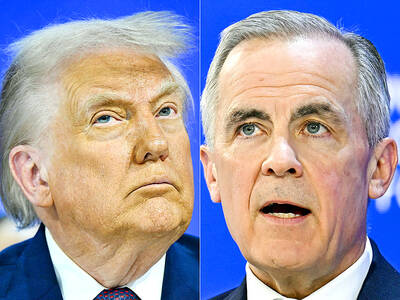
US President Donald Trump on Saturday warned Canada that if it concludes a trade deal with China, he would impose a 100 percent tariff on all goods coming over the border. Relations between the US and its northern neighbor have been rocky since Trump returned to the White House a year ago, with spats over trade and Canadian Prime Minister Mark Carney decrying a “rupture” in the US-led global order. During a visit to Beijing earlier this month, Carney hailed a “new strategic partnership” with China that resulted in a “preliminary, but landmark trade agreement” to reduce tariffs — but


 RSS
RSS