


Towering walls of concrete entomb lush forests on mountainsides in southwest China as workers toil on the dry riverbed below to build the country’s latest mega-dam.
The colossal construction site in Sichuan Province swallows three rivers, providing another display of China’s engineering prowess, but also of the trauma it inflicts on people and nature along the way.
Once completed in 2023, the 295m behemoth will be the world’s third-tallest dam, producing 3,000 megawatts of energy.
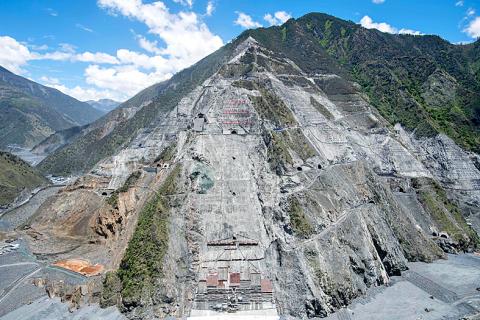
Photo: AFP
However, for the communities around the massive project — some as far as 100km upstream — the Lianghekou dam will drown ancestral homes, revered Buddhist monasteries, fertile crops and sacred mountains.
Beijing is building hydropower at a breakneck pace in ethnically Tibetan regions as part of an ambitious undertaking to reduce the nation’s dependence on coal and cut emissions that have made it the world’s top polluter.
China had just two dams in 1949, but now boasts about 22,000 — nearly half the world total — in all but one of the country’s major waterways.
Mountains and rivers are revered as sacred in Tibetan Buddhism, and the extensive construction, which began in 2014, has alarmed locals who believe they can only live peacefully if the nature around them is protected.
“Last year, people said that a big forest fire happened because they blasted a road into the holy mountain, and it took revenge,” said Tashi Yungdrung, a farmer with red thread wound through her thick braid who tends a small herd of yaks in the pastures above her stone, square-windowed home.
Most would not dare remove so much as a single stone from the mountain Palshab Drakar, an important pilgrimage site, she said.
Villagers are bracing for mass relocations, an experience that has previously caused havoc elsewhere in China.
Beginning in the 1990s, more than a million were moved for the Three Gorges Dam, the world’s largest in terms of capacity, with thousands still mired in poverty.
Plans posted at the Lianghekou construction site showed that 22 power plants will be built along the Yalong River, a Yangtze River tributary, collectively capable of generating 30 gigawatts of electricity — a fifth of China’s current total installed hydropower capacity.
Li Zhaolong, a Tibetan from Zhaba village, said he received 300,000 yuan (US$44,000) in government compensation to build a new home on higher ground, where he will move next year.
However, the 28,000 yuan moving fee his family received per person will not last long once their crops are submerged and they have no other sources of income.
“Before we were farmers, and now we have no land,” Li said. “We can’t move to a township, because we are uneducated and there will be no way to make a living there.”
About 6,000 people across four counties will be relocated, according to a state-affiliated energy Web site.
Five monasteries have been or will be rebuilt on higher ground, but their spiritual importance will be diminished as the communities they serve are displaced, a lama named Lobsang said.
“The government is very big, and the valley is very small. So much is lost, but we cannot resist or fight,” he said.
“When you say something and try to protect your place, the government gives you another name: separatist,” he said.
About 80 percent of China’s hydropower potential lies along the high-flow, glacier-fed rivers of the Tibetan plateau, but dams there bring minimal local benefits because most of the power goes to smog-choked cities in the east, according to the non-governmental organization International Rivers.
Construction worker Zeng Qingtao said that the state-owned Power Construction Corp had brought in about 10,000 employees, but none are locals.
“We can’t hire Tibetans. They aren’t reasonable,” he said.
The Hubei native lives in Zhaba, a hamlet whose unique matrilineal customs are disappearing as residents scatter.
“The dams’ negative impacts are very acutely felt at a local scale, while the positive impacts are very diffuse and broadly distributed,” said Darrin Magee, a professor who specializes in Chinese hydropower at Hobart and William Smith Colleges in the US.
Some experts question whether hydropower can cut coal dependence, as its low efficiency can spur the development of backup coal plants that operate during dry spells.
In addition, Fan Xiao, chief engineer of the provincial government’s Geology and Mineral Resources Bureau, said studies show reservoirs in this region emit huge amounts of methane and carbon dioxide derived from organic matter trapped underwater during flooding.
Engineers and environmentalists also worry that Sichuan, which will receive a third of China’s planned hydropower investment by 2020, is a hotbed of seismic activity that could damage hydropower stations.
Geologists believe the water pressure exerted by dam reservoirs can trigger earthquakes, which some suspect happened in the 2008 Wenchuan quake that claimed 87,000 lives a few hundred kilometers from Lianghekou.
However, once in motion, projects are nearly impossible to stop.
“Whether a project creates actual benefits or profit once it’s built is not a concern of current government officials,” Fan said.


Through the noise of rushing papers and whirring belts at a print factory in Kyoto, two creators watch their photo essay come to life in broadsheet form — part of an effort to win new audiences in the age of artificial intelligence (AI). Despite the decline of the publishing industry, self-publication and handmade “zine” magazines are growing in popularity in Japan, reflecting the nation’s enduring love of paper in the digital era. While speaking to Agence France-Presse at the plant, his hands black with ink, one of the creators, Kazuma Obara, said: “I think [paper] is a medium that engages all five
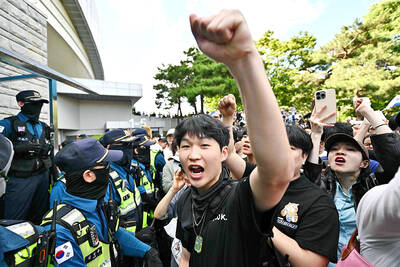
‘ABSURD MISTAKE’: The election commission said that there had been a failure to anticipate turnout after 14 polling stations ran short of ballot papers South Korean riot police yesterday cleared protesters from a Seoul polling station after a 35-hour blockade sparked by a shortage of ballot papers during local elections earlier this week. Wednesday’s election was the first nationwide vote since South Korean President Lee Jae-myung took office following the ouster of Yoon Suk-yeol over his short-lived martial law declaration. Lee’s ruling Democratic Party swept most races, but failed to flip the crucial Seoul mayoral seat. The South Korean National Election Commission apologized, blaming a failure to anticipate turnout after 14 polling stations in Seoul ran short of ballot papers. Some polling stations stayed open until 10pm to

France experienced its hottest spring on record, the French weather service said on Tuesday, after an exceptional early heat wave that also broke highs for the season in England and Wales. Meteo-France said the average nationwide temperature over March to May was 13.8°C — about 1.7°C above the norm, and surpassing records set in 2011 and 2020. “The warmest spring since records began in 1900,” it said in a bulletin. All three months were warmer than average, but the onset of an “unprecedented heatwave” late last month pushed the mercury to highs typically seen at the height of the summer. “Our country had never

A Sherpa guide was found crawling to base camp on Mount Everest a week after he went missing and was reunited with his family, who had given up hope he would return. Dawa Sherpa was last seen on Friday last week descending the mountain, but he did not reach base camp even though his client did. The pair were among the last climbers on the mountain as the climbing season came to an end and the route was dismantled. Dawa was located by a cleaning crew on Thursday morning as he was crawling down the snowy slopes around the Khumbu Icefall, just above


 RSS
RSS