


Venezuela’s opposition protests yesterday were due to be the messiest in a six-week wave of unrest as demonstrators prepared to throw feces at security forces, adding to the customary rocks, gasoline bombs and tear gas.
The new tactic has been dubbed the “Poopootov” in a play on the Molotov cocktails often seen at streets protests in Venezuela.
“They have gas; we have excrement,” reads an image floating around social media to advertise yesterday’s “Shit March.”

Photo: Reuters
With inflation in the high triple-digits, shortages of the most basic medicines and millions suffering food scarcity, the country is undergoing a major crisis.
For weeks, hundreds of thousands of people have taken to the streets, angry at the Venezuelan President Nicolas Maduro’s administration.
Some opposition sympathizers are appalled at the plans to use feces, both animal and human, calling it an unsanitary and inappropriate tactic even in the face of a government they despise.
Many note that throwing feces could increase cases of infectious diseases which are soaring due to the lack of medicine as well as basic cleaning materials such as soaps and disinfectant.
“The kids go out with just stones. That’s their weapon. Now they have another weapon — excrement,” said a 51-year-old dentist preparing containers of feces in her home for protesters to launch at authorities.
“One of my patients is collecting excrement from her child,” the dentist said, who asked not to be identified.
Messages have been going viral on Venezuelan WhatsApp groups giving step-by-step instructions and advice on putting together the Poopootov cocktails.
Some insist on avoiding glass containers to ensure that the projectiles only humiliate troops rather than injure them.
“The use of excrement is not only an act of desperation, it’s madness,” pro-government TV personality Mario Silva said on Twitter.
With opposition leaders looking to bring frontline government forces onside, given they too suffer from the country’s crisis, the strategy might backfire.
Many are thought to sympathize with protesters’ complaints about the economic situation, but do not speak out for fear of retaliation by authorities.
While the opposition coalition has remained quiet on the strategy, some lawmakers have given it tacit acceptance.
“They use their weapons against us, so people are using what they have,” said lawmaker Rafael Guzman, who on Monday was seen in the thick of tear gas throwing a canister back at security forces.

Through the noise of rushing papers and whirring belts at a print factory in Kyoto, two creators watch their photo essay come to life in broadsheet form — part of an effort to win new audiences in the age of artificial intelligence (AI). Despite the decline of the publishing industry, self-publication and handmade “zine” magazines are growing in popularity in Japan, reflecting the nation’s enduring love of paper in the digital era. While speaking to Agence France-Presse at the plant, his hands black with ink, one of the creators, Kazuma Obara, said: “I think [paper] is a medium that engages all five
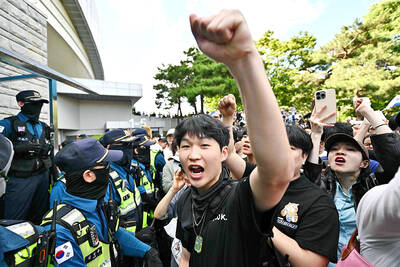
‘ABSURD MISTAKE’: The election commission said that there had been a failure to anticipate turnout after 14 polling stations ran short of ballot papers South Korean riot police yesterday cleared protesters from a Seoul polling station after a 35-hour blockade sparked by a shortage of ballot papers during local elections earlier this week. Wednesday’s election was the first nationwide vote since South Korean President Lee Jae-myung took office following the ouster of Yoon Suk-yeol over his short-lived martial law declaration. Lee’s ruling Democratic Party swept most races, but failed to flip the crucial Seoul mayoral seat. The South Korean National Election Commission apologized, blaming a failure to anticipate turnout after 14 polling stations in Seoul ran short of ballot papers. Some polling stations stayed open until 10pm to

Australian researchers have trained lab-grown brain cells on a silicon computer chip to play the 1990s shooter game Doom and said they are just scratching the surface of what the neurons could be capable of doing. It is the science-fiction work of biotech boffins at Cortical Labs, who researched and developed the technology that harnesses the workings of the brain’s networking system. Each so-called “biological computer” contains about 200,000 living human brain cells, grown from stem cells that were harvested from blood donations. Having mastered the simple computer game Pong, where a paddle is moved up and down to send a ball

France experienced its hottest spring on record, the French weather service said on Tuesday, after an exceptional early heat wave that also broke highs for the season in England and Wales. Meteo-France said the average nationwide temperature over March to May was 13.8°C — about 1.7°C above the norm, and surpassing records set in 2011 and 2020. “The warmest spring since records began in 1900,” it said in a bulletin. All three months were warmer than average, but the onset of an “unprecedented heatwave” late last month pushed the mercury to highs typically seen at the height of the summer. “Our country had never


 RSS
RSS