


A dozen people have been found stuffed inside a closet-sized cell hidden behind a bookshelf in a Philippine police station, triggering further alarm about abuse under Philippine President Rodrigo Duterte’s deadly war on drugs.
Members of the government’s human rights commission, accompanied by journalists, on Thursday evening found the men and women in a surprise visit to the station in the heart of capital Manila’s slum area.
Cries of “here we are, here we are” were heard from behind a wall, the rights workers and journalists said.
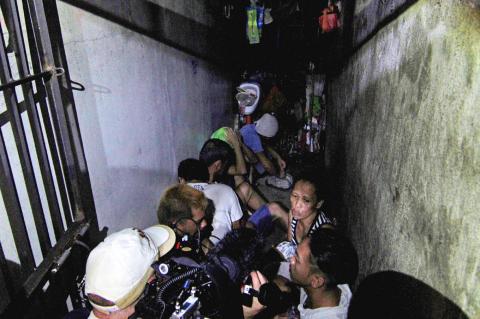
Photo: AFP
The rights workers then found a hidden door behind a bookshelf, leading to the cell.
Stunned detainees came stumbling out of the room, some begging for water while others, in tears, pleaded with the rights workers not to abandon them.
The detainees said they had been held for about a week after being arrested on allegations of drug use or trafficking and that police were demanding hefty payments in exchange for their freedom.
“They were picked up on the pretext of drugs, but they had not filed any charges against them,” Gilbert Boisner, Manila director for the rights commission who led the inspection, told reporters yesterday.
The station commander, Superintendent Robert Domingo, told reporters at the scene the detainees were arrested only the previous night and police were preparing to file charges against them.
Domingo was yesterday suspended pending an investigation, Philippine national police spokesman Senior Superintendent Dionardo Carlos said.
“He [Domingo] will undergo an administrative case. If evidence warrants, a criminal case will also be filed against him and the persons involved,” Carlos said in a statement.
Human Rights Watch said the incident was another sign of widespread rights abuse under Duterte’s war on drugs, which has seen thousands of drug suspects killed either by police officers or vigilantes.
“The discovery of the secret jail is just the latest sign of how police are exploiting Duterte’s abusive anti-drug campaign for personal gain,” a Human Rights Watch statement said.
Duterte in January briefly suspended all police from the crackdown after an official investigation found that drug officers had kidnapped a South Korean businessman and murdered him as part of an extortion scam.
Duterte then described the police force as “corrupt to the core” and vowed it would not be allowed to prosecute the drug war until its ranks had been “cleansed.”
Duterte redeployed police onto the drug war about a month later, without major reforms.
A Philippine lawyer on Monday filed a complaint at the International Criminal Court accusing Duterte of mass murder, saying his war on drugs had led to about 8,000 deaths.
The incident occurred as Duterte began welcoming Southeast Asian leaders for an ASEAN summit in Manila.
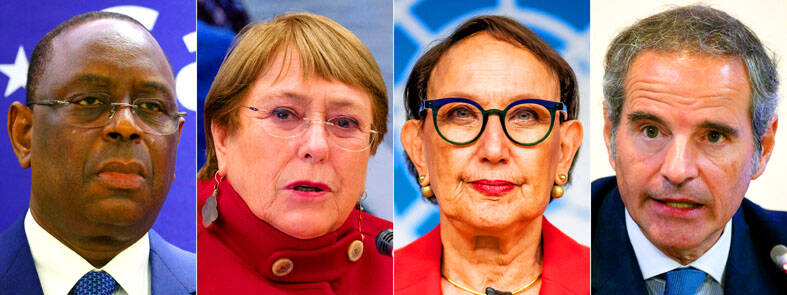
Four contenders are squaring up to succeed Antonio Guterres as secretary-general of the UN, which faces unprecedented global instability, wars and its own crushing budget crisis. Chile’s Michelle Bachelet, Argentina’s Rafael Grossi, Costa Rica’s Rebeca Grynspan and Senegal’s Macky Sall are each to face grillings by 193 member states and non-governmental organizations for three hours today and tomorrow. It is only the second time the UN has held a public question-and-answer, a format created in 2016 to boost transparency. Ultimately the five permanent members of the UN’s top body, the Security Council, hold the power, wielding vetoes over who leads the

South Korea’s air force yesterday apologized for a 2021 midair collision involving two fighter jets, a day after auditors said the pilots were taking selfies and filming during the flight and held them responsible for the accident. “We sincerely apologize to the public for the concern caused by the accident that occurred in 2021,” an air force spokesman told a news conference, adding that one of the pilots involved had been suspended from flying duties, received severe disciplinary action and has since left the military. The apology followed a report released on Wednesday by the South Korean Board of Audit and Inspection,

Young Chinese, many who fear age discrimination in their workplace after turning 35, are increasingly starting “one-person companies” that have artificial intelligence (AI) do most of the work. Smaller start-ups are already in vogue in Silicon Valley and elsewhere, with rapidly advancing AI tools seen as a welcome teammate even as they threaten layoffs at existing firms. More young people in China are subscribing to the model, as cities pledge millions of dollars in funding and rent subsidies for such ventures, in alignment with Beijing’s political goal of “technological self-reliance.” “The one-person company is a product of the AI era,” said Karen Dai

About 240 Indians claiming descent from a Biblical tribe landed at Tel Aviv airport on Thursday as part of a government operation to relocate them to Israel. The newcomers passed under a balloon arch in blue and white, the colors of the Israeli flag, as dozens of well-wishers welcomed them with a traditional Jewish song. They were the first “bnei Menashe” (“sons of Manasseh”) to arrive in Israel since the government in November last year announced funding for the immigration of about 6,000 members of the community from the states of Manipur and Mizoram in northeast India. The community claims to descend from


 RSS
RSS