


The former MI6 agent behind the controversial Trump Russia dossier returned to work on Tuesday, nearly two months after its publication caused an international scandal and furious denials from Washington and Moscow.
Christopher Steele posed for a photograph outside the office of his business intelligence company Orbis in Victoria, London.
Speaking for the first time since his dossier was revealed, Steele said he had received messages of support.
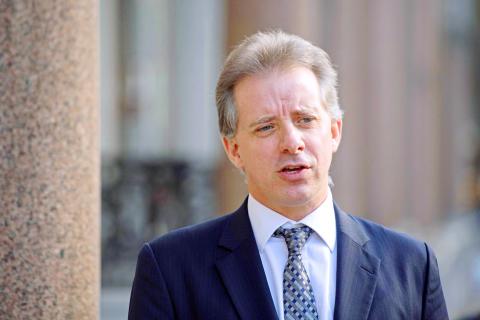
Photo: AP
“I’m now going to be focusing my efforts on supporting the broader interests of our company here,” he said. “I’d like to say a warm thank you to everyone who sent me kind messages and support over the last few weeks.”
Steele, who left British intelligence in 2009 and cofounded Orbis with an MI6 colleague, said he would not comment substantively on the contents of the dossier: “Just to add, I won’t be making any further statements or comments at this time.”
Published in January by BuzzFeed, the dossier suggested that US President Donald Trump’s team had colluded with Russian intelligence before the US election to sabotage Democratic candidate Hillary Rodham Clinton’s presidential campaign.
Citing unidentified sources, it said Trump had been “compromised” by Russia’s FSB spy agency during a trip to Moscow in 2013.
It alleged that Trump was secretly videoed with Russian prostitutes in a suite in the Ritz-Carlton hotel in Moscow. The prostitutes allegedly urinated on the bed used by former US president Barack Obama during a presidential visit.
Trump dismissed the dossier as fake news and said Steele was a “failed spy.”
Russian President Vladimir Putin also rejected the dossier.
His spokesman Dmitry Peskov claimed Russia did not collect kompromat — compromising material — on Trump or anyone else.
Steele’s friends say he has been keen to go back to work for some weeks.
They insist he has not been in hiding, but has been keeping a low profile to avoid paparazzi who have been camped outside his family home in Surrey, England.
Several of the lurid stories about him that have appeared in the media have been wrong, friends said.
The stories include claims that Steele met Alexander Litvinenko, the Russian dissident who was murdered in 2006 with a radioactive cup of tea, probably on Putin’s orders.
As head of MI6’s Russia desk, Steele led the inquiry into Litvinenko’s polonium poisoning, quickly concluding that this was a Russian state plot.
He did not meet Litvinenko and was not his case officer, his friends said.

‘CROSSING THE LINE’: China’s embassy in Seoul criticized US Forces Korea Commander General Xavier Brunson, asking if his ‘hostile’ remarks were authorized by Washington South Korea and the US are in talks over recent public remarks by the commander of US Forces Korea, Seoul’s presidential office said yesterday, after the comments drew sharp criticism from China. In a recent podcast interview, US Forces Korea Commander General Xavier Brunson described South Korea as “the dagger in the heart of Asia” from China’s east coast, prompting the Chinese embassy in Seoul to say that he had “truly crossed the line.” The interview came amid growing speculation that Washington might seek to expand the role of US Forces Korea in countering the growing regional influence of China, a key

SEEKING ORDER: Rodrigo Paz said that ‘anyone who wants to destroy the nation will have to deal with this president and the full force of the constitution’ Bolivian President Rodrigo Paz on Wednesday said that the nation was at a “breaking point” after nearly a month of protests that have caused shortages of food, fuel and medicine. Paz, who took office six months ago amid the worst economic crisis there in four decades, is battling a groundswell of fury over his policies. The political capital, La Paz, has been besieged by low-income workers and members of the indigenous majority calling for his resignation. “The country needs order and is reaching breaking point,” the 58-year-old said at a public event in La Paz, renewing his appeal for dialogue. On Tuesday, the Bolivian

Australian researchers have trained lab-grown brain cells on a silicon computer chip to play the 1990s shooter game Doom and said they are just scratching the surface of what the neurons could be capable of doing. It is the science-fiction work of biotech boffins at Cortical Labs, who researched and developed the technology that harnesses the workings of the brain’s networking system. Each so-called “biological computer” contains about 200,000 living human brain cells, grown from stem cells that were harvested from blood donations. Having mastered the simple computer game Pong, where a paddle is moved up and down to send a ball

Through the noise of rushing papers and whirring belts at a print factory in Kyoto, two creators watch their photo essay come to life in broadsheet form — part of an effort to win new audiences in the age of artificial intelligence (AI). Despite the decline of the publishing industry, self-publication and handmade “zine” magazines are growing in popularity in Japan, reflecting the nation’s enduring love of paper in the digital era. While speaking to Agence France-Presse at the plant, his hands black with ink, one of the creators, Kazuma Obara, said: “I think [paper] is a medium that engages all five


 RSS
RSS