


A German organization that calls itself True Religion and is known for distributing German-language copies of the Koran was outlawed on Tuesday after authorities accused it of recruiting people to fight in Iraq and Syria.
German Minister of the Interior Thomas de Maiziere said that the German government had banned the True Religion organization, which is also known as Read — as in the instruction to read the Korean — because it acted as a “collecting pool” for would-be Muslim fighters.
On Tuesday morning, officers raided 190 premises in more than half of Germany’s 16 states.
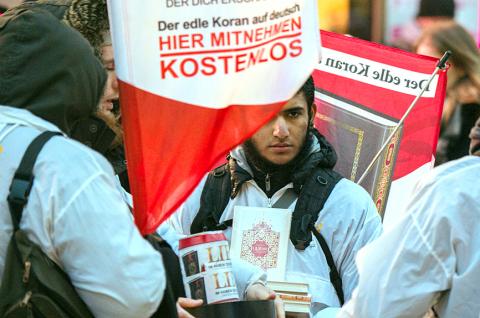
Photo: AFP
Materials were secured, but there were no detentions, De Maiziere said.
“The organization brings Islamic jihadists together under the pretext of the harmless distribution of the Koran,” De Maiziere told reporters in Berlin, adding that the authorities were acting against the group because of its work to foster violence, not because of its faith.
“A systematic curtailment of our rule of law has nothing to do with the alleged freedom of religion,” he said.
The move came after months of surveillance of the organization, whose bushy-bearded members have become a common sight in pedestrian shopping areas in major German cities.
De Maiziere said that 140 of the group’s supporters are known to have traveled to Syria or Iraq to fight on behalf of the Islamic State.
“The translations of the Koran are being distributed along with messages of hatred and unconstitutional ideologies,” De Maiziere said. “Teenagers are being radicalized with conspiracy theories.”
The move came a week after the authorities arrested five men who were accused of aiding the Islamic State in Germany by recruiting members and providing financial and logistics help.
True Religion is the sixth Islamist organization to be banned in Germany since 2012 under an effort to ensure domestic security and to prevent young people from leaving the country to fight abroad.
Germany has been gripped by a wave of small-scale terror attacks this year, including three that were claimed by the Islamic State: the knifing of a policeman in February, and an axe attack by a young refugee and a suicide bombing in July.
The only deaths in those assaults were those of the attackers.
Most of the nearly 1 million migrants and refugees who arrived in Germany last year were Muslims.
Security officials have been concerned that those who become frustrated or disillusioned at the difficulty of starting a new life in Europe could provide fertile ground for militants seeking to recruit.
The campaign to hand out the Korans to passersby was the idea of Ibrahim Abou-Nagie, a Palestinian who preaches a brand of Islam known as Salafism.
German security officials said that he was not in Germany at the time of the raids.
De Maiziere declined to comment on Abou-Nagie’s possible whereabouts.
Abou-Nagie, who has lived in Germany for more than 30 years, has been on the radar of German security officials since 2005, when he set up a Web site that officials say spreads extremist propaganda. An attempt to prosecute Abou-Nagie in 2012 on charges of incitement of religious hatred failed.

‘CROSSING THE LINE’: China’s embassy in Seoul criticized US Forces Korea Commander General Xavier Brunson, asking if his ‘hostile’ remarks were authorized by Washington South Korea and the US are in talks over recent public remarks by the commander of US Forces Korea, Seoul’s presidential office said yesterday, after the comments drew sharp criticism from China. In a recent podcast interview, US Forces Korea Commander General Xavier Brunson described South Korea as “the dagger in the heart of Asia” from China’s east coast, prompting the Chinese embassy in Seoul to say that he had “truly crossed the line.” The interview came amid growing speculation that Washington might seek to expand the role of US Forces Korea in countering the growing regional influence of China, a key

SEEKING ORDER: Rodrigo Paz said that ‘anyone who wants to destroy the nation will have to deal with this president and the full force of the constitution’ Bolivian President Rodrigo Paz on Wednesday said that the nation was at a “breaking point” after nearly a month of protests that have caused shortages of food, fuel and medicine. Paz, who took office six months ago amid the worst economic crisis there in four decades, is battling a groundswell of fury over his policies. The political capital, La Paz, has been besieged by low-income workers and members of the indigenous majority calling for his resignation. “The country needs order and is reaching breaking point,” the 58-year-old said at a public event in La Paz, renewing his appeal for dialogue. On Tuesday, the Bolivian

Through the noise of rushing papers and whirring belts at a print factory in Kyoto, two creators watch their photo essay come to life in broadsheet form — part of an effort to win new audiences in the age of artificial intelligence (AI). Despite the decline of the publishing industry, self-publication and handmade “zine” magazines are growing in popularity in Japan, reflecting the nation’s enduring love of paper in the digital era. While speaking to Agence France-Presse at the plant, his hands black with ink, one of the creators, Kazuma Obara, said: “I think [paper] is a medium that engages all five

Australian researchers have trained lab-grown brain cells on a silicon computer chip to play the 1990s shooter game Doom and said they are just scratching the surface of what the neurons could be capable of doing. It is the science-fiction work of biotech boffins at Cortical Labs, who researched and developed the technology that harnesses the workings of the brain’s networking system. Each so-called “biological computer” contains about 200,000 living human brain cells, grown from stem cells that were harvested from blood donations. Having mastered the simple computer game Pong, where a paddle is moved up and down to send a ball


 RSS
RSS