


North Korea held a massive parade in Pyongyang yesterday, turning the capital’s giant square into a sea of pink, to celebrate a ruling party congress seen as a formal coronation for North Korean leader Kim Jong-un.
Kim presided over the event from a balcony overlooking the expansive Kim Il-sung Square, with tens of thousands of people waving bouquets of artificial flowers over their heads as the leader arrived.
Nuclear-armed North Korea regularly holds mass military parades to celebrate key dates and show off its latest military hardware, including long-range ballistic missiles that are still under development.
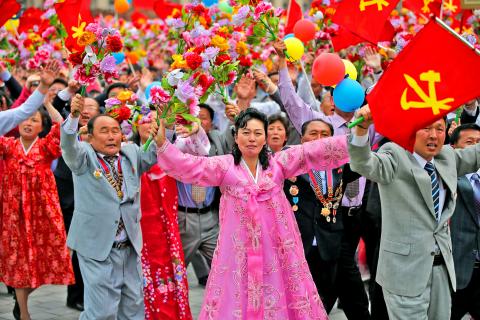
Photo: Reuters
Yesterday’s events were an all-civilian affair apart from a military band. However, several of the giant floats had military themes, showing cardboard mock-ups of missiles and space-launch vehicles.
“A strong nation needs nuclear arms and a strong army,” read the sign on the missile-themed float.
North Korea followed its last nuclear test in January with a satellite launch that was widely condemned as a disguised ballistic missile test.
North Korean Parliament Presidium President Kim Yong-nam addressed the parade before it began, praising Kim Jong-un and congratulating him on his election the day before as chairman of the ruling Workers’ Party.
“The election... showed the absolute trust... of our military and people in the great leader Kim Jong-un,” Kim Yong-nam said.
Kim Jong-un waved briefly to the crowd to thunderous applause but did not make a speech. Hundreds of balloons were released into the sky to boost the festive effect.
The four-day party congress, which ended on Monday, marked the first such gathering of the party’s top decisionmaking body in more than 35 years.
The event gave the 33-year-old Kim, who came to power following the death of his father Kim Jong-il in 2011, a podium to secure his status as supreme leader and rightful inheritor of the one-party state founded by his grandfather Kim Il-sung.
The congress formally endorsed Kim Jong-un’s Byungjin doctrine of building an effective nuclear arsenal in tandem with economic development.
Kim Yong-nam, in his speech to the parade, appeared to touch on this theme.
Now that North Korea is a powerful nation, he said, “we can concentrate on economic construction and improving people’s living standards.”
In speeches during the congress, Kim praised the country’s purported first hydrogen-bomb test in January and defended his nuclear arsenal as a deterrent against “hostile” nations such as the US.
He also vowed to use it only if North Korea’s sovereignty is threatened by another nuclear power.
The party meeting came at a time of heightened tension on the divided peninsula following the atomic test in January.
South Korean President Park Geun-hye, who has insisted denuclearization by Pyongyang is the only way to revive talks, said the congress showed that nothing had changed.
“The North failed to show any sincere change to improve inter-Korea ties and instead vowed to continue to strengthen its nuclear programs, this time describing itself as an official atomic power,” Park said at a meeting of the South Korean Cabinet yesterday.
Yesterday’s parade saw row after row of massed marchers, waving pink paper flowers, balloons of various colors and red party flags, and chanting mansei (Live Long), in unison.
Some carried giant banners reading “Mansei for comrade Kim Jong-un, the top leader of our party and people,” and “Glory to our beloved leader.”
On the main part of the square, crowds raised different colored placards to spell out giant slogans such as: “The leader’s Party,” “Kim Jong-un’s party” and “Solidarity,” and formed elaborate mosaic images of the party and national flags.

Through the noise of rushing papers and whirring belts at a print factory in Kyoto, two creators watch their photo essay come to life in broadsheet form — part of an effort to win new audiences in the age of artificial intelligence (AI). Despite the decline of the publishing industry, self-publication and handmade “zine” magazines are growing in popularity in Japan, reflecting the nation’s enduring love of paper in the digital era. While speaking to Agence France-Presse at the plant, his hands black with ink, one of the creators, Kazuma Obara, said: “I think [paper] is a medium that engages all five
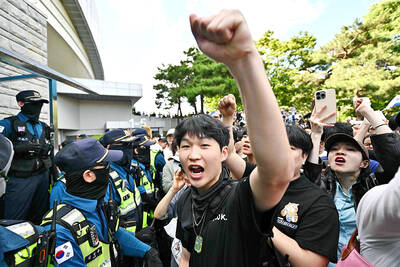
‘ABSURD MISTAKE’: The election commission said that there had been a failure to anticipate turnout after 14 polling stations ran short of ballot papers South Korean riot police yesterday cleared protesters from a Seoul polling station after a 35-hour blockade sparked by a shortage of ballot papers during local elections earlier this week. Wednesday’s election was the first nationwide vote since South Korean President Lee Jae-myung took office following the ouster of Yoon Suk-yeol over his short-lived martial law declaration. Lee’s ruling Democratic Party swept most races, but failed to flip the crucial Seoul mayoral seat. The South Korean National Election Commission apologized, blaming a failure to anticipate turnout after 14 polling stations in Seoul ran short of ballot papers. Some polling stations stayed open until 10pm to

Australian researchers have trained lab-grown brain cells on a silicon computer chip to play the 1990s shooter game Doom and said they are just scratching the surface of what the neurons could be capable of doing. It is the science-fiction work of biotech boffins at Cortical Labs, who researched and developed the technology that harnesses the workings of the brain’s networking system. Each so-called “biological computer” contains about 200,000 living human brain cells, grown from stem cells that were harvested from blood donations. Having mastered the simple computer game Pong, where a paddle is moved up and down to send a ball

France experienced its hottest spring on record, the French weather service said on Tuesday, after an exceptional early heat wave that also broke highs for the season in England and Wales. Meteo-France said the average nationwide temperature over March to May was 13.8°C — about 1.7°C above the norm, and surpassing records set in 2011 and 2020. “The warmest spring since records began in 1900,” it said in a bulletin. All three months were warmer than average, but the onset of an “unprecedented heatwave” late last month pushed the mercury to highs typically seen at the height of the summer. “Our country had never


 RSS
RSS