


In a hotel not in a galaxy far, far away, a robot bids you welcome as you pull into the driveway.
Another hands out a keycard to your room, and a third gives you the password to the Wi-Fi network.
Robots are making an entry into the hospitality industry that has, until now, always prided itself on delivering a warm and personable touch.
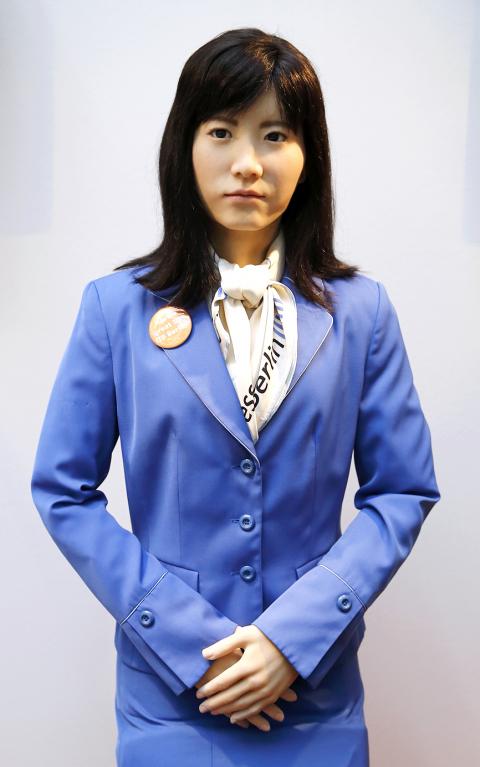
Photo: Reuters
At an entrance to Berlin’s exhibition hall, where thousands of travel industry professionals gathered for the ITB trade show, humanoid robot Chihira Kanae greeted visitors — in English, German, Chinese and Japanese.
Dressed in a blue jacket with a neck scarf, Chihira Kanae is on her first visit to Europe, where she is seeking potential employment for herself and her kind.
Three months ago, her “sister” began working as a meet-and-greeter in a Tokyo shopping center.
Their creator, Toshiba, also foresees a great future ahead for them in tourism. Mario has already found a job — at the Ghent Marriott Hotel in Belgium, where he has welcomed visitors since June last year.
He is multilingual, speaking 19 languages to be precise. In addition, he helps with serving at hotel buffets and entertains guests by singing and dancing.
Unlike Chihira Kanae, Mario does not pretend to look like a human. Standing just 50cm tall, Mario is white with red stripes, has speakers for ears and a total of just six fingers.
However, his employer is pleased with his work.
He “puts a smile on everybody’s face,” hotel director Roger Langhout said, adding that “it is a good way to get people to remember our hotel.”
“We are still exploring the possibilities of Mario,” he said, but added that humans can never be fully replaced by machines in the hotel business.
However, Oxford University’s Carl Benedikt Frey said that robots do have a big future in the industry.
“In tourism, quite a few jobs remain non-automatable, like concierges or chefs, but a wide range of jobs are very much sustainable to automation,” he said, adding that robots could work as waiters, dishwashers, tour guides or even chauffeurs.
What is key is that they should do tasks that require only basic communication, he said.
A survey of 6,000 travelers by US online bookings company Travelzoo found that two in three people are comfortable with seeing robots in the tourism industry. Chinese are among the most enthusiastic, while French and Germans are more reticent.
UN World Tourism Organization Secretary-General Taleb Rifai said the industry should broaden its usage of technology and robots.
“I would not put any limit on the use of technology or innovation in any hotel or tourism facility,” Rifai said. “As a matter of fact, we are way behind as a sector in the implementation of technology and the use of it. We were able to send a man to the moon long before we thought about adding wheels on a suitcase.”
If robots are still a nascent discovery in the industry, virtual reality (VR) has charmed operators.
German high-tech association Bitkom said virtual reality is the technology that “perhaps has the greatest potential” in the travel industry.
At several stands at the ITB fair, which ended yesterday, guests could put on virtual-reality glasses and escape the gloomy Berlin winter.
In one case, uses could lounge on a tropical terrace and watch elephants lumbering against the backdrop of the setting sun, while a waiter delivered a colorful cocktail.
The hotel chain Cinnamon, which is active in the Maldives and Sri Lanka, is using the “new marketing tool” to allow potential visitors to get “closer to the product you see,” marketing director Dileep Mudadeniya said. At the stand for southern Germany’s Bavaria region, young women dressed in traditional dirndl dress were trying to tempt visitors to put on the glasses for a glimpse of its green meadows and snow-capped mountains.
British tour operator Thomas Cook offered a VR preview of adventure — a tour by helicopter above Manhattan.
Professor Armin Brysch, from Kempten’s Applied Sciences University in Germany, said that VR is here to stay in the industry as it provides a “new quality of experience” that could entice people to book holidays in destinations that they might not have considered.
However, would people just opt to see the world from their armchairs?
Unlikely, Rifai said.
“To think that virtual reality could be used so that you stay at home and travel the world, it is not going to happen — I hope,” he said.
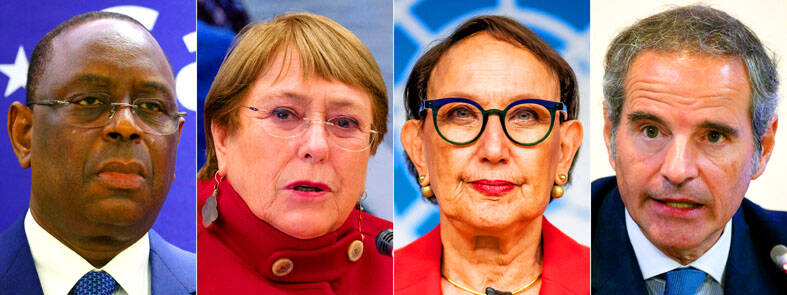
Four contenders are squaring up to succeed Antonio Guterres as secretary-general of the UN, which faces unprecedented global instability, wars and its own crushing budget crisis. Chile’s Michelle Bachelet, Argentina’s Rafael Grossi, Costa Rica’s Rebeca Grynspan and Senegal’s Macky Sall are each to face grillings by 193 member states and non-governmental organizations for three hours today and tomorrow. It is only the second time the UN has held a public question-and-answer, a format created in 2016 to boost transparency. Ultimately the five permanent members of the UN’s top body, the Security Council, hold the power, wielding vetoes over who leads the

South Korea’s air force yesterday apologized for a 2021 midair collision involving two fighter jets, a day after auditors said the pilots were taking selfies and filming during the flight and held them responsible for the accident. “We sincerely apologize to the public for the concern caused by the accident that occurred in 2021,” an air force spokesman told a news conference, adding that one of the pilots involved had been suspended from flying duties, received severe disciplinary action and has since left the military. The apology followed a report released on Wednesday by the South Korean Board of Audit and Inspection,

Young Chinese, many who fear age discrimination in their workplace after turning 35, are increasingly starting “one-person companies” that have artificial intelligence (AI) do most of the work. Smaller start-ups are already in vogue in Silicon Valley and elsewhere, with rapidly advancing AI tools seen as a welcome teammate even as they threaten layoffs at existing firms. More young people in China are subscribing to the model, as cities pledge millions of dollars in funding and rent subsidies for such ventures, in alignment with Beijing’s political goal of “technological self-reliance.” “The one-person company is a product of the AI era,” said Karen Dai

About 240 Indians claiming descent from a Biblical tribe landed at Tel Aviv airport on Thursday as part of a government operation to relocate them to Israel. The newcomers passed under a balloon arch in blue and white, the colors of the Israeli flag, as dozens of well-wishers welcomed them with a traditional Jewish song. They were the first “bnei Menashe” (“sons of Manasseh”) to arrive in Israel since the government in November last year announced funding for the immigration of about 6,000 members of the community from the states of Manipur and Mizoram in northeast India. The community claims to descend from


 RSS
RSS