


Thailand’s status as a hub for medical tourism could be helping the country contain the spread of Middle East respiratory syndrome (MERS), government and health officials said, after confirming its first case of the deadly virus last week.
Tourism accounts for about 10 percent of the Thai economy, and the country is also the top destination in Southeast Asia for patients seeking low-cost, quality healthcare, with an average of 1.4 million medical tourists per year, compared with 600,000 for Singapore, a Thai medical tourism association said.
That meant the stakes were high for Thailand when the Thai Ministry of Public Health on Thursday reported the first case of MERS in a 75-year-old man from Oman, who had traveled to Bangkok for treatment for a heart condition.
South Korea, currently battling the largest MERS outbreak outside of Saudi Arabia, reported two more deaths and three new cases yesterday, bringing the number of fatalities to 27 and the total infections to 172.
In Thailand, although authorities said 176 people had been exposed to the MERS patient, Thai Deputy Minister of Public Health Vachira Pengchan yesterday said there were no new cases.
“It is the very fact that we are a travel and medical hub that works in our favor and that allows us to be prepared,” Thai Minister of Tourism and Sports Kobkarn Wattanavrangkul told reporters.
“It is our experience handling foreign visitors and medical tourists from high-risk regions like the Middle East and South Korea. Thailand is also prepared, because we saw what happened in South Korea, we had time,” the minister said.
As well as being a gateway for many of the more than 25 million visitors to Thailand each year, Bangkok is also one of the region’s main aviation hubs.
At the city’s Suvarnabhumi Airport, face masks were handed out to passengers over the weekend, while Thailand’s health and tourism ministers showed reporters thermoscanning equipment and special airplane parking bays set aside for flights coming in from high-risk countries.
The airport has ordered heightened screening of arrivals from South Korea and the Middle East, general manager Sirote Duangratana told reporters.
The unidentified man whom laboratory tests on Thursday confirmed had MERS was a patient at the high-end Bumrungrad International Hospital. Popular with international visitors, it said 20 percent of its patients are from the Middle East.
The sick man was later moved to an infectious disease institute. Doctors at Bumrungrad on Friday said that 58 staff had been quarantined and were under observation.
Prasert Thongcharoen, an adviser to the Ministry of Public Health’s Department of Communicable Disease Control, said he had investigated Bumrungrad’s handling of the MERS case and found it to be “flawless.”
“They put the patient in an isolation room and everything that was needed for infectious control was done,” Prasert said in a telephone interview.
The Geneva-based WHO, in an e-mailed response to reporters, also commended Thailand’s response.
“Thailand diagnosed and isolated the MERS patient in a designated, well-equipped facility,” WHO Southeast Asia Region Director Poonam Khetrapal Singh said.
Josef Woodman, CEO of Patients Beyond Borders, a US-based Web site that offers consumers information about medical travel, said Thailand could see a temporary drop in visitors but, as with the impact of last year’s coup, it was likely to be short-lived.
“I believe, as with social and political unrest in Thailand ... a temporary drop in tourism and medical tourism may be experienced, usually with a rapid recovery to normal levels,” he said.
Josephine Guillot, 28, a French postgraduate student traveling around Southeast Asia, said she had gone to Bumrungrad for a health check-up despite knowing that Thailand’s first MERS patient was treated there.
“I’m comfortable getting treatment here,” she told reporters. “The news does not deter me.”
Meanwhile, Malaysia has stepped up health screenings at all entry points into the country.
The Southeast Asian nation, which shares a 650km land border with Thailand, has already begun monitoring the body temperatures of visitors at airports, Malaysian Deputy Minister of Health Hilmi Yahaya said in a statement to state news agency Bernama.
“Now, we are going further to include all entry points,” he said.
Visitors entering the country would also be briefed on precautions to be taken to avoid being infected with the disease, the minister said in the statement. There have so far been no cases of MERS reported in Malaysia.

Through the noise of rushing papers and whirring belts at a print factory in Kyoto, two creators watch their photo essay come to life in broadsheet form — part of an effort to win new audiences in the age of artificial intelligence (AI). Despite the decline of the publishing industry, self-publication and handmade “zine” magazines are growing in popularity in Japan, reflecting the nation’s enduring love of paper in the digital era. While speaking to Agence France-Presse at the plant, his hands black with ink, one of the creators, Kazuma Obara, said: “I think [paper] is a medium that engages all five
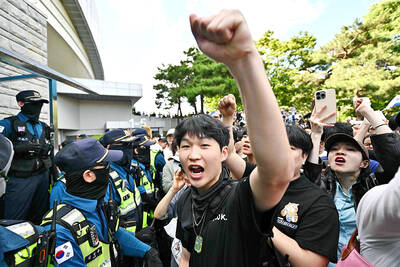
‘ABSURD MISTAKE’: The election commission said that there had been a failure to anticipate turnout after 14 polling stations ran short of ballot papers South Korean riot police yesterday cleared protesters from a Seoul polling station after a 35-hour blockade sparked by a shortage of ballot papers during local elections earlier this week. Wednesday’s election was the first nationwide vote since South Korean President Lee Jae-myung took office following the ouster of Yoon Suk-yeol over his short-lived martial law declaration. Lee’s ruling Democratic Party swept most races, but failed to flip the crucial Seoul mayoral seat. The South Korean National Election Commission apologized, blaming a failure to anticipate turnout after 14 polling stations in Seoul ran short of ballot papers. Some polling stations stayed open until 10pm to

Australian researchers have trained lab-grown brain cells on a silicon computer chip to play the 1990s shooter game Doom and said they are just scratching the surface of what the neurons could be capable of doing. It is the science-fiction work of biotech boffins at Cortical Labs, who researched and developed the technology that harnesses the workings of the brain’s networking system. Each so-called “biological computer” contains about 200,000 living human brain cells, grown from stem cells that were harvested from blood donations. Having mastered the simple computer game Pong, where a paddle is moved up and down to send a ball

France experienced its hottest spring on record, the French weather service said on Tuesday, after an exceptional early heat wave that also broke highs for the season in England and Wales. Meteo-France said the average nationwide temperature over March to May was 13.8°C — about 1.7°C above the norm, and surpassing records set in 2011 and 2020. “The warmest spring since records began in 1900,” it said in a bulletin. All three months were warmer than average, but the onset of an “unprecedented heatwave” late last month pushed the mercury to highs typically seen at the height of the summer. “Our country had never


 RSS
RSS