


Thousands of people gathered in Singapore yesterday to bid farewell to former leader Lee Kuan Yew (李光耀) in an unprecedented wave of sympathy after authorities had to temporarily suspend queues overnight to manage surging crowds.
The waiting time to enter Singapore’s Parliament House where Lee’s body was lying in state was as long as six hours just before midday, a rare sight in a city where public gatherings are tightly controlled.
Mourners walked by Lee’s coffin, draped with a Singaporean flag and flanked by five uniformed military officers, in silence. Many bowed. Some saluted. Others sobbed.
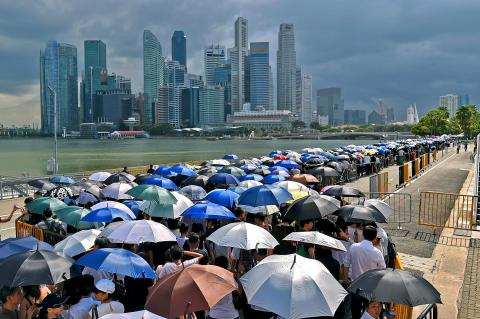
Photo: AFP
“In our lifetime, this is probably the only person who will garner this kind of respect from everyone, so I think it’s something that we should do,” Ho Shaw Ming said as he waited in line.
Lee, Singapore’s first prime minister, died on Monday at the age of 91.
He is credited with transforming the city-state from a British colonial outpost into one of the world’s wealthiest nations, with a strong, pervasive role for the state and little patience for dissent.
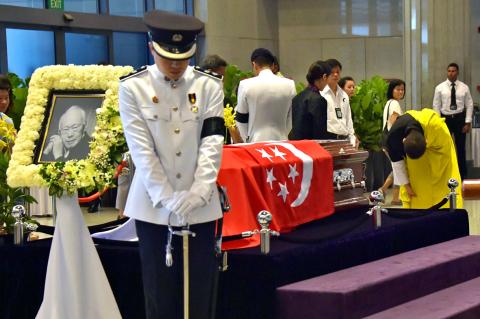
Photo: AFP
Commercial activity in Singapore, known for its shopping and food, is expected to slow significantly today. Several shopping mall owners and big stores such as Tangs and Metro said they would close on the day of the funeral.
The casino at Genting Singapore’s Resorts World Sentosa is to be closed from 2pm to 6pm as a mark of respect, it said on its Web site.
Lee’s funeral procession is to begin at about 12:30pm and cover 15.4km to the National University of Singapore, where a funeral service will be held.
Asia-Pacific leaders including Japanese Prime Minister Shinzo Abe, Indian Prime Minister Narendra Modi, Australian Prime Minister Tony Abbott, New Zealand Prime Minister John Key, Indonesian President Joko Widodo and South Korean President Park Geun-hye are among those attending the service.
The number of visitors to Parliament House has exceeded 300,000, or 5 percent of Singapore’s population, since the public viewing opened on Wednesday morning.
More than half a million visitors have flocked to 18 designated community tributes, writing messages of condolence and leaving flowers.
Singaporean Prime Minister Lee Hsien Loong (李顯龍) and his ministers visited the queues near the parliament house and community centers where people were lining up.
“I am deeply moved by the overwhelming response of people wanting to visit my father’s lying in state at Parliament House,” Lee said on his Facebook page.
With elections expected as early as later this year, it was unclear whether the wave of support for the country’s founder would generate more votes for Lee’s People’s Action Party (PAP), which has ruled Singapore since independence.
Income inequality, resentment over immigration and expensive housing were among the issues which knocked the PAP’s share of the vote down to 60 percent from 67 percent in elections four years ago.
“Don’t expect sympathy votes for the PAP on account of the late Mr Lee,” Singapore Management University associate professor of law Eugene Tan said. “The PAP instead has the unenviable task of unequivocally showing that they are noble and worthy successors to the late Mr Lee and his founding generation of leaders.”

When a hiker fell from a 55m waterfall in wild New Zealand bush, rescuers were forced to evacuate the badly hurt woman without her dog, which could not be found. After strangers raised thousands of dollars for a search, border collie Molly was flown to safety by a helicopter pilot who was determined to reunite the pet and the owner. A week earlier, an emergency rescue helicopter found the woman with bruises and lacerations after a fall at a rocky spot at the waterfall on the South Island’s West Coast. She was airlifted on March 24, but they were forced to

CONFIDENCE BOOSTER: ’After parkour ... you dare to do a lot of things that you think only young people can do,’ a 67-year-old parkour enthusiast said In a corner of suburban Singapore, Betty Boon vaults a guardrail, crawls underneath a slide, executes forward shoulder rolls and scales a steep slope, finishing the course to applause. “Good job,” the 69-year-old’s coach cheers. This is “geriatric parkour,” where about 20 retirees learned to tackle a series of relatively demanding exercises, building their agility and enjoying a sense of camaraderie. Boon, an upbeat grandmother, said learning parkour has aided her confidence and independence as she ages. “When you’re weak, you will be dependent on someone,” she said after sweating it out with her parkour classmates in suburban Toa Payoh,
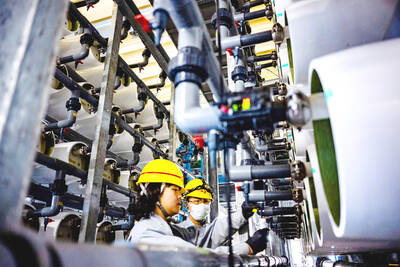
HIGH HOPES: The power source is expected to have a future, as it is not dependent on the weather or light, and could be useful for places with large desalination facilities A Japanese water plant is harnessing the natural process of osmosis to generate renewable energy that could one day become a common power source. The possibility of generating power from osmosis — when water molecules pass from a less salty solution to a more salty one — has long been known. However, actually generating energy from that has proved more complicated, in part due the difficulty of designing the membrane through which the molecules pass. Engineers in Fukuoka, Japan, and their private partners think they might have cracked it, and have opened what is only the world’s second osmotic power plant. It generates
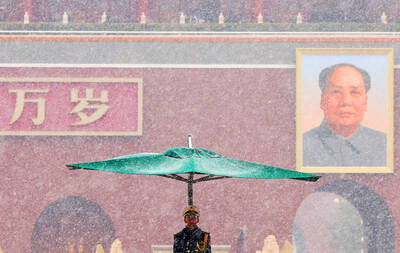
Chinese dissident artist Gao Zhen (高兟), famous for making provocative satirical sculptures of former Chinese leader Mao Zedong (毛澤東), was tried on Monday over accusations of “defaming national heroes and martyrs,” his wife and a rights group said. Gao, 69, who was detained in 2024 during a visit from the US, faces a maximum three-year prison sentence, said his wife, Zhao Yaliang (趙雅良), and Shane Yi, a researcher at the Chinese Human Rights Defenders group which operates outside the nation. The closed-door, one-day trial took place at Sanhe City People’s Court in Hebei Province neighboring the capital, Beijing, and ended without a


 RSS
RSS