


A former Marine on Tuesday was sentenced to life in prison without parole after being convicted of murdering the US Navy SEAL whose story inspired the blockbuster movie American Sniper.
After deliberating less than three hours, jurors unanimously rejected claims from Eddie Ray Routh, 27, that he was not guilty by way of insanity when he killed famed sniper Chris Kyle and his friend Chad Littlefield at a Texas shooting range in February 2013.
The two-week trial in Erath County, about 160km southwest of Dallas, attracted massive media attention across the US, coinciding with the release of Clint Eastwood’s movie based on Kyle’s experiences in Iraq.
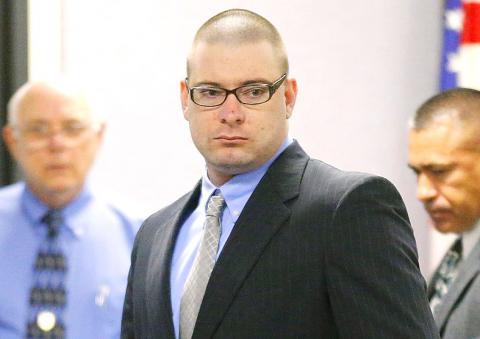
Photo: EPA
The jury of two men and 10 women found Routh guilty with a unanimous vote.
Erath County District Court Judge Jason Cason sentenced him to life in prison without the possibility of parole. It was a capital case, but prosecutors took the death penalty off the table before the trial started, the Washington Post reported.
Kyle and Littlefield were killed after Routh’s mother asked the Navy SEAL veteran to help her son with post-traumatic stress disorder, the said.
They picked him up in Kyle’s pickup truck the day of the killings with plans to enjoy the shared hobby of shooting and offer some ways to help.
Kyle, a father of two, was shot six times with one of his own .45-caliber pistols, including a wound to the back that pierced his aorta and another to the jaw that caused a lethal spinal cord injury, the Post said.
Littlefield, a father of one, was hit seven times, including four that would have been instantly fatal, according to court testimony.
Judy Littlefield, Chad’s mother, made a brief statement after the verdict.
“We have waited two years for God to give us justice on behalf of our son, and God has proved to be faithful,” she said. “We are so thrilled that we have the verdict that we have.”
Kyle, officially credited with killing 160 people during four military tours, was lionized in the blockbuster film starring Bradley Cooper as the soldier.
Routh’s attorneys pleaded insanity and said their client was gripped by psychosis. Routh said he suffered from post-traumatic stress disorder.
After the shootings on Feb. 2, 2013, Routh took Kyle’s truck and was later arrested at the home of his sister.
He allegedly confessed to the killings after complaining that “people were sucking his soul and that he could smell the pigs.”
During the trial, jurors heard how Kyle and Littlefield knew something was badly wrong minutes before Routh opened fire.
“This dude is straight up nuts,” Kyle wrote to Littlefield in an alarmed text message.
“He’s right behind me, watch my six,” replied his friend, using military jargon for “watch my back.”
It is not clear how much Kyle and Littlefield knew about Routh’s mental instability.
Routh, who had been diagnosed with post-traumatic stress, had been released from psychiatric treatment about a week before meeting Kyle and Littlefield for the first and last time, the Post said.
Jurors also heard emotional testimony from Kyle’s widow, Taya, who sobbed as she recounted their life together.
Lawyers had questioned whether Routh could receive a fair trial in the small town, given the success of American Sniper and the widely held view of Kyle as a hero.

‘CROSSING THE LINE’: China’s embassy in Seoul criticized US Forces Korea Commander General Xavier Brunson, asking if his ‘hostile’ remarks were authorized by Washington South Korea and the US are in talks over recent public remarks by the commander of US Forces Korea, Seoul’s presidential office said yesterday, after the comments drew sharp criticism from China. In a recent podcast interview, US Forces Korea Commander General Xavier Brunson described South Korea as “the dagger in the heart of Asia” from China’s east coast, prompting the Chinese embassy in Seoul to say that he had “truly crossed the line.” The interview came amid growing speculation that Washington might seek to expand the role of US Forces Korea in countering the growing regional influence of China, a key

SEEKING ORDER: Rodrigo Paz said that ‘anyone who wants to destroy the nation will have to deal with this president and the full force of the constitution’ Bolivian President Rodrigo Paz on Wednesday said that the nation was at a “breaking point” after nearly a month of protests that have caused shortages of food, fuel and medicine. Paz, who took office six months ago amid the worst economic crisis there in four decades, is battling a groundswell of fury over his policies. The political capital, La Paz, has been besieged by low-income workers and members of the indigenous majority calling for his resignation. “The country needs order and is reaching breaking point,” the 58-year-old said at a public event in La Paz, renewing his appeal for dialogue. On Tuesday, the Bolivian

Through the noise of rushing papers and whirring belts at a print factory in Kyoto, two creators watch their photo essay come to life in broadsheet form — part of an effort to win new audiences in the age of artificial intelligence (AI). Despite the decline of the publishing industry, self-publication and handmade “zine” magazines are growing in popularity in Japan, reflecting the nation’s enduring love of paper in the digital era. While speaking to Agence France-Presse at the plant, his hands black with ink, one of the creators, Kazuma Obara, said: “I think [paper] is a medium that engages all five

Australian researchers have trained lab-grown brain cells on a silicon computer chip to play the 1990s shooter game Doom and said they are just scratching the surface of what the neurons could be capable of doing. It is the science-fiction work of biotech boffins at Cortical Labs, who researched and developed the technology that harnesses the workings of the brain’s networking system. Each so-called “biological computer” contains about 200,000 living human brain cells, grown from stem cells that were harvested from blood donations. Having mastered the simple computer game Pong, where a paddle is moved up and down to send a ball


 RSS
RSS