


Hundreds of people attended the funeral of former Haitian dictator Jean-Claude “Baby Doc” Duvalier on Saturday, displaying lingering respect for a man who was widely reviled for repression and corruption during his 15 years in power.
Mourners paused to pay their respects in front of Duvalier’s coffin draped with Haiti’s red-and-blue flag as they greeted his partner, Veronique Roy, his ex-wife, Michele Bennett, and their two children.
Members of Haiti’s elite and former officials of Duvalier’s regime arrived in luxury SUVs, joining more humble citizens in ill-fitting suits, and quickly filled the chapel on the grounds of the Saint-Louis de Gonzague school in the Delmas district of Port-au-Prince.
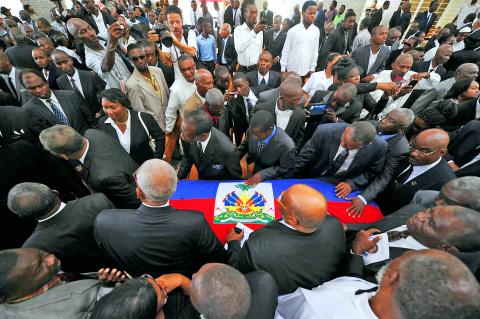
Photo: AFP
Former Haitian president Boniface Alexandre attended, as did some officials of Haitian President Michel Martelly’s administration, including one of his advisers, the chief of protocol for the National Palace and the delegate of Port-au-Prince.
However, Damian Merlo, an adviser to Haitian Prime Minister Laurent Lamothe, said no one went in an official capacity for Lamothe or Martelly.
Lamothe was out of the country, while Martelly was in Haiti, but did not attend the funeral.
Some officials in Martelly’s administration have ties to Duvalier’s regime, but Merlo said the Wgovernment has not given any special treatment to former members of that regime.
The “Martelly-Lamothe government does not share those values,” he said.
After the service ended, former members of the military under Duvalier’s regime carried his coffin from the chapel while a crowd chanted: “Long live Duvalier. He’s not dead.”
Jean Ronald Lerison, 20, said he attended the service at the request of his ailing father.
“He asked me to come, to pay respects to Jean-Claude Duvalier,” Lerison said, adding that his father had told him that crime was rare under Duvalier’s regime and that people could sleep with their doors unlocked.
In the crowd outside was 19-year-old Mark Etienne, who said members of Duvalier’s Tonton Macoutes civilian militia killed his father in 1984 because he had supported a movement to oust Duvalier.
“I was curious to see the people who were part of the regime,” Etienne said. “They should hold trials for the rest of the criminals.”
Many had wondered whether Duvalier, the self-proclaimed “president for life,” would receive a state funeral following his death on Oct. 4 last week from a heart attack at age 63. However, Duvalier’s attorney announced last week that friends and family would arrange a simple and private funeral.
“It’s a small victory in many ways for the opponents of the Duvalier regime that he’s not being given the honor of a state funeral,” Alex Dupuy, a Haiti-born sociologist who teaches at Wesleyan University in Connecticut, said by telephone. “To have a state funeral for him would have signaled perhaps a sort of vindication of what that regime represented, rather than a condemnation of it.”
There were no protests at Duvalier’s funeral, although a couple of men outside the chapel yelled “Down with Duvalier” as his coffin was carried away.
Some victims of his regime organized a sit-in outside a government agency.
Duvalier became president in 1971 at age 19 when his father, former Haitian dictator Francois “Papa Doc” Duvalier, died. “Baby Doc” presided over a regime widely acknowledged as brutal and corrupt until he was ousted by a popular uprising in 1986.
As many as 30,000 Haitians were killed, many by execution, under the regime of the two Duvaliers, according to the New York-based Human Rights Watch.
Duvalier lived in exile in France until his surprise return to Haiti on Jan. 16, 2011. That prompted authorities to open a criminal inquiry into human rights abuses and allegations of corruption, but the case did not gain traction and Duvalier moved freely about Haiti before his death.
Laurent Dubois, a historian at Duke University and author of Haiti: The Aftershocks of History, said Duvalier’s death does not offer any closure to victims and their families.
“While Duvalier’s body will soon be buried, the legacy of his rule and that of his father remains as alive as ever in Haiti, and one way or another will continue to animate political life in the country,” Dubois said.
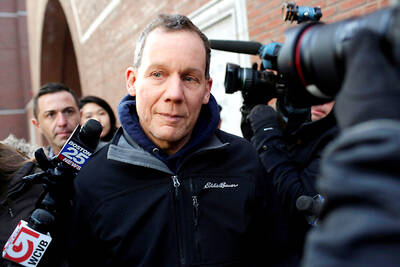
An American scientist convicted of lying to US authorities about payments from China while he was at Harvard University has rebuilt his research lab in Shenzhen, China, to pursue technology the Chinese government has identified as a national priority: embedding electronics into the human brain. Charles Lieber, 67, is among the world’s leading researchers in brain-computer interfaces. The technology has shown promise in treating conditions such as amyotrophic lateral sclerosis and restoring movement in paralyzed people. It also has potential military applications: Scientists at the Chinese People’s Liberation Army have investigated brain interfaces as a way to engineer super soldiers by boosting
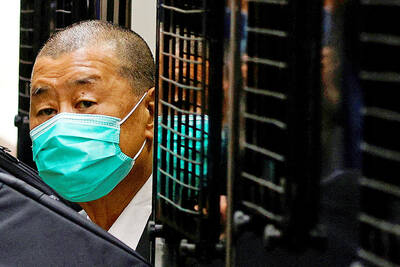
Jailed media entrepreneur Jimmy Lai (黎智英) has been awarded Deutsche Welle’s (DW) freedom of speech award for his contribution to Hong Kong’s pro-democracy movement. The German public broadcaster on Thursday said Lai would be presented in absentia with the 12th iteration of the award on June 23 at the DW Global Media Forum in Bonn. Deutsche Welle director-general Barbara Massing praised the 78-year-old founder of the now-shuttered news outlet Apple Daily for standing “unwaveringly for press freedom in Hong Kong at great personal risk.” “With Apple Daily, he gave journalists a platform for free reporting and a voice to the democracy movement in
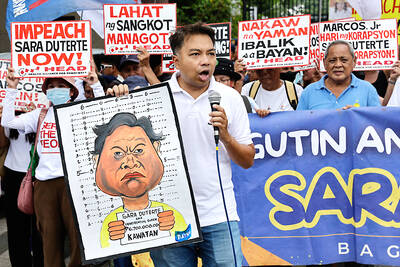
PHILIPPINE COMMITTEE: The head of the committee that made the decision said: ‘If there is nothing to hide, there is no reason to hide, there is no reason to obstruct’ A Philippine congressional committee on Wednesday ruled that there was “probable cause” to impeach Philippine Vice President Sara Duterte after hearing allegations of unexplained wealth, misuse of state funds and threats to have the president assassinated. The unanimous decision of the 53-member committee in the Philippine House of Representatives sends the two impeachment complaints to deliberations and voting by the entire lower chamber, which has more than 300 lawmakers. The complaints centered on Duterte’s alleged illegal use and mishandling of intelligence funds from the vice president’s office, and from her time as education secretary under Philippine President Ferdinand Marcos Jr. Duterte and the

Burmese President Min Aung Hlaing yesterday cut all prisoners’ sentences by one-sixth, a blanket measure that a source close to deposed leader Aung San Suu Kyi said would further shorten her detention. Aung San Suu Kyi has been sequestered since a 2021 military coup, but the senior member of her dissolved National League for Democracy (NLD) party said that while her term had been reduced, her remaining sentence is still unclear. “We also don’t know exactly how many years she has left,” the source told reporters, speaking on condition of anonymity for security reasons. The military toppled Aung San Suu Kyi’s elected government


 RSS
RSS