


Just as he attends church on Sunday morning, there is another sacred place Nick, a 23-year-old Kampala stylist, flocks to every Sunday night.
“It gives me fuel for the whole week,” he says, standing beer in hand outside an inconspicuous bar, in a red check shirt and jeans. “When I come here, I don’t mind if I miss sleep and then go to work, because I go to work feeling happy, new. It’s a beautiful Sunday.”
During the week, this pub, located in the capital’s business district, but away from the nightclub strip, is full of unsuspecting, heterosexual Ugandans.
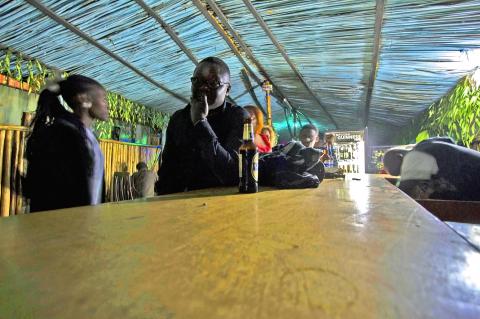
Photo: AFP
However, for six hours on a Sunday night that fly by all too fast, the venue, with its grass thatched roof and flashing fluorescent disco floor lights, becomes a haven for Uganda’s gay community, who meet to drink, dance and more.
“It’s accepting, they do not discriminate,” says Nick, who has arrived at about 8pm and is waiting for the bar, informally chosen by his community as their spot, to fill up.
This normally happens from about midnight.
“We were chased all over before the gay bill was removed,” Nick says.
In December last year, the Ugandan parliament passed a bill that stipulated repeat homosexuals should be jailed for life, outlawed the promotion of homosexuality and required people to denounce gays.
The bill was signed into law by Ugandan President Yoweri Museveni in February, but in August it was struck down by the east African nation’s constitutional court on a technicality.
After the law was passed, the bar was shut by police for two months.
On Sunday night you would “stay home and cook,” says Nick, who is a Christian and lives next to a church.
The nightspot reopened just a couple of days after the law was overturned. Although the group marking this victory was small in number, they were “celebrating like there’s no tomorrow,” one activist says.
The pub is now a place for “connections and reconnections,” transsexual activist Pepe Julian Onziema says. “It’s like a typical bar. Inside it’s drinks, chit-chatting, talking about work... meeting new people, love interests.”
Chris, 19, a corporate worker, says he has known he was gay since he was 16, but has not told his family.
“They’d faint, they’d die,” he says, standing next to a friend, both of them laughing at the notion.
In the lead-up to the bill being passed by Ugandan legislators, Chris stayed away from the bar.
“I was scared. You cannot be caught in a place like this,” he says, adding he was only out for the first time in 18 months.
However, tonight it “feels good being with the kind of people who are the same as you, to hang out and feel free, do whatever you want. People get cozy, people kiss.”
For a year Steve, 19, a full-time DJ, has been supplying Ugandan, Nigerian and Western music for the bar.
“I was very shocked hearing about that thing,” he says when asked his thoughts on homosexuality. “I feel bad when they’re doing their stuff. It hurts me.”
However, he says: “I need money.”
He is not the only one realizing the potential business value in Uganda’s gay community.
The female owner of the bar was “caring enough” to think “we just found ourselves in these shoes,” Nick says.
However, she is in a minority in Uganda, a socially conservative nation where most people support the anti-gay legislation. Members of parliament are attempting to reintroduce the measures and under a standing colonial-era penal code gay Ugandans can still be jailed for “carnal knowledge against the order of nature.”
As the clock ticks along toward Monday and the revelers step out of their boozy, smoky haze, ready to face the week with a hangover, they are all too aware they will not be able to tell their work colleagues about their Sunday night.
“Can you imagine, that in a very sociable country like Uganda, where bars are open Monday to Monday, we have only six hours in a week to be ourselves?” Onziema asks. “The moment you walk out, it’s like you don’t know each other, you’ve not been having fun.”

Young Chinese, many who fear age discrimination in their workplace after turning 35, are increasingly starting “one-person companies” that have artificial intelligence (AI) do most of the work. Smaller start-ups are already in vogue in Silicon Valley and elsewhere, with rapidly advancing AI tools seen as a welcome teammate even as they threaten layoffs at existing firms. More young people in China are subscribing to the model, as cities pledge millions of dollars in funding and rent subsidies for such ventures, in alignment with Beijing’s political goal of “technological self-reliance.” “The one-person company is a product of the AI era,” said Karen Dai

South Korea’s air force yesterday apologized for a 2021 midair collision involving two fighter jets, a day after auditors said the pilots were taking selfies and filming during the flight and held them responsible for the accident. “We sincerely apologize to the public for the concern caused by the accident that occurred in 2021,” an air force spokesman told a news conference, adding that one of the pilots involved had been suspended from flying duties, received severe disciplinary action and has since left the military. The apology followed a report released on Wednesday by the South Korean Board of Audit and Inspection,

About 240 Indians claiming descent from a Biblical tribe landed at Tel Aviv airport on Thursday as part of a government operation to relocate them to Israel. The newcomers passed under a balloon arch in blue and white, the colors of the Israeli flag, as dozens of well-wishers welcomed them with a traditional Jewish song. They were the first “bnei Menashe” (“sons of Manasseh”) to arrive in Israel since the government in November last year announced funding for the immigration of about 6,000 members of the community from the states of Manipur and Mizoram in northeast India. The community claims to descend from

‘TROUBLING’: The firing of Phelan, who was an adviser to a nonprofit that supported the defense of Taiwan, was another example of ‘dysfunction’ under Trump, a US senator said US Secretary of the Navy John Phelan has been fired, a US official and a person familiar with the matter said on Wednesday, in another wartime shakeup at the Pentagon coming just weeks after US Secretary of Defense Pete Hegseth ousted the Army’s top general. The Pentagon announced his departure in a brief statement, saying he was leaving the administration “effective immediately,” but it did not provide a reason or say whether it was his decision to go. The sources, who spoke on condition of anonymity, said Phelan was dismissed in part because he was moving too slowly to implement reforms to


 RSS
RSS