


Scottish and English fighters were to meet again on the battlefield yesterday to mark 700 years since their legendary clash at Bannockburn, in an anniversary laden with symbolism just months before Scotland votes on whether to leave the UK.
For many Scottish nationalists, the victory of King Robert the Bruce’s small force over the mighty English army of King Edward II was a decisive moment in Scotland’s fight for independence from its overbearing southern neighbor.
Up to 15,000 people were expected at the site in Stirling yesterday and today to watch a re-enactment of key moments from the 1314 Battle of Bannockburn, performed by the group behind the epic scenes in Hollywood movies Gladiator and Robin Hood.
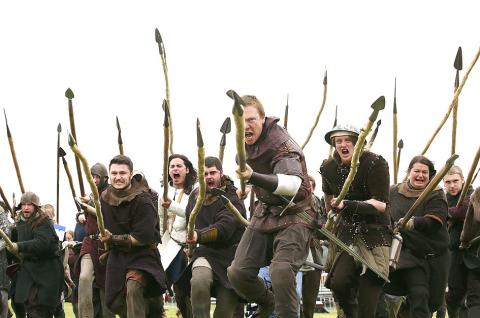
Photo: Reuters
The anniversary falls three months before Scotland holds a referendum in September on whether to stay or leave the UK, and critics of the nationalist government in Edinburgh say the timing of the vote was deeply cynical.
In the event, however, politicians of all hues have taken a back seat from the Bannockburn event, instead focusing on Armed Forces Day, which was also being held in Stirling yesterday.
Scottish First Minister Alex Salmond was due to attend the re-enactment, but also joined British Prime Minister David Cameron for a military parade and fly-pasts celebrating the contribution of troops and veterans from all over the UK.
Danus Skene, a clan chief whose ancestors fought with Bruce at Bannockburn, said a nostalgic view of the past was good for tourism, but should have no place in discussions about Scotland’s future.
“This image of Scottishness is not helpful,” the 70-year-old said by telephone from his home in the Shetland Islands.
Skene is head of the Clan Skene, a grouping of Scots who can trace their family name back to medieval times, and a strong supporter of independence.
However, the former high-school teacher said: “The debate is about national self-management, it’s about a whole range of contemporary issues. That’s what we’re talking about, not dressing up in armor.”
The story of how Bruce’s soldiers faced down an invading army that was both much larger and better equipped is a wonderful tale of winning against the odds, even if it has been embellished over the centuries.
About 250 performers from around the world donned replica armor and picked up swords, maces and pikes yesterday to demonstrate the battle in epic style, led by a farmer from Fife as the ruthless Bruce.
He was to open the re-enactment by thundering on his horse across the field on which the real Scottish king fought, bringing down his axe on the skull of an unfortunate English knight.
The weekend’s events started with a parade by hundreds of pipers on Friday night, where many in the crowd waved flags with a Union Flag on one side and the Scottish Saltire on the other.
A six-year-old boy, Matthew, stood on a bench and shouted “Scotland” as loud as he could, but he and his family, supporters of a “yes” vote in September, were outnumbered by those who want to stay in the UK.
On a national scale, the most recent poll for the Financial Times put the “No” camp on 47 percent, 10 percentage points ahead of the “yes” vote, while 15 percent were undecided.
Watching the pipers with their kilts and bagpipes set off for the parade at Stirling Castle, the subject of decades of fighting between the English and the Scots, Scottish tourist Rodney Collins admitted it was stirring stuff.
However, he said Scottish voters must think with their heads, not their hearts, in September.
“I don’t think Scotland stands on its own economically. I think a lot of it is focused on emotions, not good commercial sense,” he said.

‘CROSSING THE LINE’: China’s embassy in Seoul criticized US Forces Korea Commander General Xavier Brunson, asking if his ‘hostile’ remarks were authorized by Washington South Korea and the US are in talks over recent public remarks by the commander of US Forces Korea, Seoul’s presidential office said yesterday, after the comments drew sharp criticism from China. In a recent podcast interview, US Forces Korea Commander General Xavier Brunson described South Korea as “the dagger in the heart of Asia” from China’s east coast, prompting the Chinese embassy in Seoul to say that he had “truly crossed the line.” The interview came amid growing speculation that Washington might seek to expand the role of US Forces Korea in countering the growing regional influence of China, a key

Through the noise of rushing papers and whirring belts at a print factory in Kyoto, two creators watch their photo essay come to life in broadsheet form — part of an effort to win new audiences in the age of artificial intelligence (AI). Despite the decline of the publishing industry, self-publication and handmade “zine” magazines are growing in popularity in Japan, reflecting the nation’s enduring love of paper in the digital era. While speaking to Agence France-Presse at the plant, his hands black with ink, one of the creators, Kazuma Obara, said: “I think [paper] is a medium that engages all five

Australian researchers have trained lab-grown brain cells on a silicon computer chip to play the 1990s shooter game Doom and said they are just scratching the surface of what the neurons could be capable of doing. It is the science-fiction work of biotech boffins at Cortical Labs, who researched and developed the technology that harnesses the workings of the brain’s networking system. Each so-called “biological computer” contains about 200,000 living human brain cells, grown from stem cells that were harvested from blood donations. Having mastered the simple computer game Pong, where a paddle is moved up and down to send a ball

France experienced its hottest spring on record, the French weather service said on Tuesday, after an exceptional early heat wave that also broke highs for the season in England and Wales. Meteo-France said the average nationwide temperature over March to May was 13.8°C — about 1.7°C above the norm, and surpassing records set in 2011 and 2020. “The warmest spring since records began in 1900,” it said in a bulletin. All three months were warmer than average, but the onset of an “unprecedented heatwave” late last month pushed the mercury to highs typically seen at the height of the summer. “Our country had never


 RSS
RSS