


A top Chinese military officer has been exposed as owning dozens of homes, gold statues and crates of luxury liquor, reports said yesterday, in a rare revelation of corruption in the country’s armed forces.
The revelations about Lieutenant General Gu Junshan (谷俊山), a former deputy logistics chief for the People’s Liberation Army believed to be under investigation, came as China’s leaders ramp up a much-publicized crackdown on official corruption.
“There is grave corruption in the military, especially in the logistics sector, but revelations on the military’s graft fight is always kept off the radar for the sake of the military’s image,” said the Global Times newspaper, citing an “anti-graft expert” who did not want to be named.
Gu owned dozens of apartments in central Beijing, and his mansion in Puyang in Henan Province housed several gold art pieces, the magazine Caixin reported on Wednesday after a two-year investigation. The home was modeled on the Forbidden City, the former imperial palace in Beijing, covered 1 hectare and was dubbed the “General’s Mansion” by locals, it said.
Officials seized “a gold boat, a gold wash basin and a gold statue of Mao Zedong” (毛澤東) along with “crates of expensive liquor” on the premises, it added.
Gu, who joined the military in 1971 after finishing junior-high school, began handling military business operations in Puyang in 1985 and rose over the next decade to oversee logistics in the area.
His career trajectory saw him become deputy chief of the PLA general logistics department in 2009, and he “profited from the projects and land deals” in which he was involved, Caixin said.
Gu’s name disappeared from an official list in his logistics department in early 2012 and eventually the entire defense ministry Web site, and he left his post that year, it said.
A corruption probe has not been officially acknowledged, and was only obliquely referred to when a National Defense University professor, Senior Colonel Gong Fangbin (龔方濱), referred to corruption by Gu and his predecessor in an interview in August last year.
However, widespread coverage of this week’s revelations in China’s strictly controlled media indicated that authorities were willing to have news of Gu’s alleged misdeeds publicized.
His brother — whose home was next to Gu’s in Puyang, with the two sharing a long basement “filled with expensive liquor” — was arrested in August last year for bribery. The account follows extensive Chinese media reports about government officials who have come under investigation, and repeated pledges by Chinese President Xi Jinping (習近平) to fight corruption high and low.
China’s leadership has issued a raft of bans over the past year ranging from fancy banquets to expensive gifts, in an effort to deter endemic graft — which causes widespread public anger — and impose frugality.
This week, the military was required to purchase only local-brand vehicles as a way to save money, Xinhua news agency reported.

Through the noise of rushing papers and whirring belts at a print factory in Kyoto, two creators watch their photo essay come to life in broadsheet form — part of an effort to win new audiences in the age of artificial intelligence (AI). Despite the decline of the publishing industry, self-publication and handmade “zine” magazines are growing in popularity in Japan, reflecting the nation’s enduring love of paper in the digital era. While speaking to Agence France-Presse at the plant, his hands black with ink, one of the creators, Kazuma Obara, said: “I think [paper] is a medium that engages all five
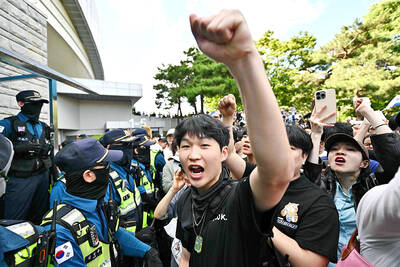
‘ABSURD MISTAKE’: The election commission said that there had been a failure to anticipate turnout after 14 polling stations ran short of ballot papers South Korean riot police yesterday cleared protesters from a Seoul polling station after a 35-hour blockade sparked by a shortage of ballot papers during local elections earlier this week. Wednesday’s election was the first nationwide vote since South Korean President Lee Jae-myung took office following the ouster of Yoon Suk-yeol over his short-lived martial law declaration. Lee’s ruling Democratic Party swept most races, but failed to flip the crucial Seoul mayoral seat. The South Korean National Election Commission apologized, blaming a failure to anticipate turnout after 14 polling stations in Seoul ran short of ballot papers. Some polling stations stayed open until 10pm to

Australian researchers have trained lab-grown brain cells on a silicon computer chip to play the 1990s shooter game Doom and said they are just scratching the surface of what the neurons could be capable of doing. It is the science-fiction work of biotech boffins at Cortical Labs, who researched and developed the technology that harnesses the workings of the brain’s networking system. Each so-called “biological computer” contains about 200,000 living human brain cells, grown from stem cells that were harvested from blood donations. Having mastered the simple computer game Pong, where a paddle is moved up and down to send a ball

France experienced its hottest spring on record, the French weather service said on Tuesday, after an exceptional early heat wave that also broke highs for the season in England and Wales. Meteo-France said the average nationwide temperature over March to May was 13.8°C — about 1.7°C above the norm, and surpassing records set in 2011 and 2020. “The warmest spring since records began in 1900,” it said in a bulletin. All three months were warmer than average, but the onset of an “unprecedented heatwave” late last month pushed the mercury to highs typically seen at the height of the summer. “Our country had never


 RSS
RSS