


Thai opposition protesters marched on key state communications targets yesterday after vowing a final push to topple the government, as the capital braces for mass rival rallies. Defiant demonstrators have besieged key government buildings in Bangkok in the biggest street protests since mass rallies in 2010 degenerated into the kingdom’s worst civil strife in decades.
The protesters — a mix of royalists, southerners and the urban middle class sometimes numbering in their tens of thousands — are united by their loathing of former Thai prime minister Thaksin Shinawatra.
The controversial former telecoms tycoon was ousted in a military coup in 2006 and lives in self-imposed exile, but he is widely believed to be the real power behind the embattled government of his younger sister Thai Prime Minister Yingluck Shinawatra.
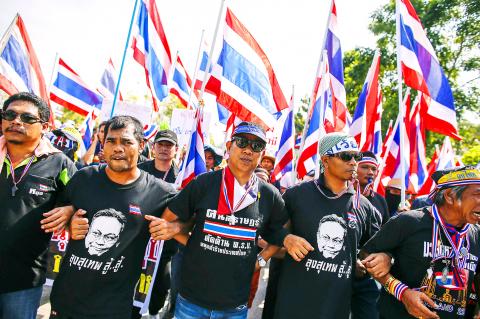
Photo: Reuters
Several thousand antigovernment protesters were scattered across five bases in the capital yesterday, according to city police.
Turnout is expected to spike over the weekend as organizers seek a final push ahead of celebrations for Thailand’s King Bhumibol Adulyadej’s birthday on Dec. 5, which is traditionally marked in an atmosphere of calm and respect.
They declared today a “day of victory,” with plans to gather near the heavily guarded Government House, besiege more important buildings — even Bangkok’s zoo — and to tighten their blockade of government ministry buildings.
Protesters yesterday began surrounding offices of the Telephone Organization of Thailand and the Communications Authority of Thailand, two key state telecoms firms.
“We will control the area, like we did at the finance ministry, and ask staff not to work. So on Monday [tomorrow] everything will shut down,” rally spokesman Akanat Promphan said.
The Thai Ministry of Information and Communications Technology said that back-up systems were in place and communications in Thailand would not be affected.
Protesters are demanding the end of the “Thaksin regime” and want to replace the government with an unelected “people’s council.”
Demonstrators on Friday forced open the gates of the compound of the army headquarters in Bangkok and occupied the lawn inside for several hours, calling on the military to support their fight to bring down the government.
It was the latest in a string of provocative moves targeting a symbol of state power, which have made headlines, but failed to rattle the government into acting to disperse their rallies.
“The prime minister has given clear orders for authorities to deal leniently with protesters and not to use violence,” Thai Deputy Prime Minister Pracha Promnog said on television yesterday.
Yingluck has faced down a barrage of legal and institutional challenges in recent weeks from the opposition Democrat Party, many of whose members have taken to the streets with the antigovernment protesters.
Her ruling Puea Thai party came to power in 2011 elections on a wave of Thaksin support, after a bloody 2010 military crackdown on Red Shirt protests under the then-Democrat government left about 90 people dead.
The pro-Thaksin Red Shirts also plan a weekend rally, with about 20,000 people gathered in a stadium in Bangkok yesterday. They have so far shown no intention of taking to the streets of the capital.
Thaksin is adored by many of the country’s rural and urban working class, but hated by many southerners, middle-class Thais and the Bangkok elite, who see him as corrupt and a threat to the monarchy.
He remains a hugely divisive figure seven years after he was deposed by royalist generals. Pro-Thaksin parties have won every election for more than a decade, but Yingluck has given no indication that she is thinking of calling fresh polls as a way out of the crisis.
In a statement released on Friday, Thai Army Chief Prayuth Chan-O-Cha urged protesters to respect “the democratic process under the law,” urging people to come together ahead of the king’s birthday.
The generals are traditionally seen as staunch defenders of the monarchy with close links to its supporters in the royalist Yellow Shirt protest movement — the archrivals of the Red Shirts.
They have so far shown little appetite for getting involved in the latest standoff.
The protests snowballed after the ruling party tried to introduce an amnesty that could have allowed Thaksin’s return, and have continued despite the Thai senate’s rejection of the bill.
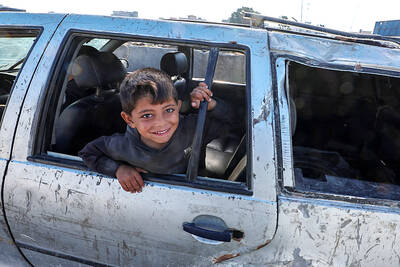
Gaza is rapidly running out of its limited fuel supply and stocks of food staples might become tight, officials said, after Israel blocked the entry of fuel and goods into the war-shattered territory, citing fighting with Iran. The Israeli military closed all Gaza border crossings on Saturday after announcing airstrikes on Iran carried out jointly with the US. Israeli authorities late on Monday night said that they would reopen the Kerem Shalom crossing from Israel to Gaza yesterday, for “gradual entry of humanitarian aid” into the strip, without saying how much. Israeli authorities previously said the crossings could not be operated safely during

Hungarian authorities temporarily detained seven Ukrainian citizens and seized two armored cars carrying tens of millions of euros in cash across Hungary on suspicion of money laundering, officials said on Friday. The Ukrainians were released on Friday, following their detention on Thursday, but Hungarian officials held onto the cash, prompting Ukraine to accuse Hungary’s Russia-friendly government of illegally seizing the money. “We will not tolerate this state banditism,” Ukrainian Minister of Foreign Affairs Andrii Sybiha said. The seven detained Ukrainians were employees of the Ukrainian state-owned Oschadbank, who were traveling in the two armored cars that were carrying the money between Austria and

Kosovar President Vjosa Osmani on Friday after dissolving the Kosovar parliament said a snap election should be held as soon as possible to avoid another prolonged political crisis in the Balkan country at a time of global turmoil. Osmani said it is important for Kosovo to wrap up the upcoming election process and form functional institutions for political stability as the war rages in the Middle East. “Precisely because the geopolitical situation is that complex, it is important to finish this electoral process which is coming up,” she said. “It is very hard now to imagine what will happen next.” Kosovo, which declared

MORE BANS: Australia last year required sites to remove accounts held by under-16s, with a few countries pushing for similar action at an EU level and India considering its own ban Indonesia on Friday said it would ban social media access for children under 16, citing threats from online pornography, cyberbullying, online fraud and Internet addiction. “Accounts belonging to children under 16 on high-risk platforms will start to be deactivated, beginning with YouTube, TikTok, Facebook, Instagram, Threads, X, Bigo Live and Roblox,” Indonesian Minister of Communications and Digital Meutya Hafid said. “The government is stepping in so that parents no longer have to fight alone against the giants of the algorithm. Implementation will begin on March 28, 2026,” she said. The social media ban would be introduced in stages “until all platforms fulfill their


 RSS
RSS