


A Philippine sultan, whose armed followers invaded a vast Malaysian region and sparked a security crisis in February that left dozens dead, has died of multiple organ failure. He was 75.
Fatima Celia, the wife of Sultan Jamalul Kiram III, said that her husband died in her arms early yesterday at a Philippine hospital, adding that before he died, he ordered his family and followers to keep alive the historic territorial claims to Sabah State in neighboring Malaysia.
Although largely forgotten and dismissed as a vestige from a bygone era, Kiram’s Muslim sultanate, based in the southern Philippine province of Sulu, stirred up a security crisis in Malaysia when his younger brother and about 200 followers, dozens of them armed, barged into Sabah’s coastal village of Lahad Datu.
Stunned, Malaysia responded by sending in ground troops and launching air strikes. Dozens were killed in weeks of sporadic fighting before the standoff eased.
Malaysia has governed the resource-rich frontier region of timberlands and palm oil plantations in northern Borneo as its second-largest federal state since the 1960s.
The Kiram sultanate, which emerged in the 1400s, built a legend for its wide influence at the time and its feared Tausug warriors.
Chinese and European leaders once sent vassals to pay homage to their powerful forebears, sultanate spokesman Abraham Idjirani said.
The Sulu sultanate preceded both the Philippine republic and Malaysia by centuries.
However, overrun by history, the Kirams now carry royal titles and nothing much else.
“I’m the poorest sultan in the world,” an ailing Kiram said in an interview in March at his rundown residence in a Muslim village in the Philippine capital.
The Kirams claim Sabah has belonged to their sultanate for centuries and was only leased to Malaysia, which they say pays them a paltry annual rent.
Malaysian officials say the payments are part of an arrangement under which the sultanate has ceded the 74,000km2 of Sabah territory to their country.
Philippine presidents have relegated the volatile feud to the backburner, despite efforts by the Kirams to put it on the national agenda.
Kiram’s sultantate still has hundreds of followers in Sulu and nearby southern provinces, which are among the Philippines’ poorest and are troubled by Muslim rebels, extremists and outlaws.
Kiram’s family said he would be buried in his hometown of Maimbung in Sulu.
He left eight children with two wives and would likely be replaced by a younger brother, Esmail Kiram II, in a succession often marred in the past by clan infighting and claims by fake descendants of the once-powerful Muslim royalty.

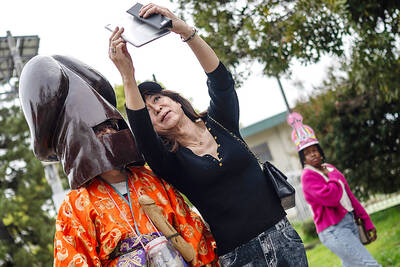
Showcasing phallus-shaped portable shrines and pink penis candies, Japan’s annual fertility festival yesterday teemed with tourists, couples and families elated by its open display of sex. The spring Kanamara Matsuri near Tokyo features colorfully dressed worshipers carrying a trio of giant phallic-shaped objects as they parade through the street with glee. The festival, as legend has it, honors a local blacksmith in the Edo Period (1603-1868) who forged an iron dildo to break the teeth of a sharp-toothed demon inhabiting a woman’s vagina that had been castrating young men on their wedding nights. A 1m black steel phallus sits in the courtyard of

HIGH HOPES: The power source is expected to have a future, as it is not dependent on the weather or light, and could be useful for places with large desalination facilities A Japanese water plant is harnessing the natural process of osmosis to generate renewable energy that could one day become a common power source. The possibility of generating power from osmosis — when water molecules pass from a less salty solution to a more salty one — has long been known. However, actually generating energy from that has proved more complicated, in part due the difficulty of designing the membrane through which the molecules pass. Engineers in Fukuoka, Japan, and their private partners think they might have cracked it, and have opened what is only the world’s second osmotic power plant. It generates

JAN. 1 CLAUSE: As military service is voluntary, applications for permission to stay abroad for over three months for men up to age 45 must, in principle, be granted A little-noticed clause in sweeping changes to Germany’s military service policy has triggered an uproar after it emerged that the law requires men aged up to 45 to get permission from the armed forces before any significant stay abroad, even in peacetime. The legislation, which went into effect on Jan. 1 aims to bolster the military and demands all 18-year-old men fill out a questionnaire to gauge their suitability to serve in the armed forces, but stops short of conscription. If the “modernized” model fails to pull in enough recruits, parliament will be compelled to discuss the reintroduction of compulsory service, German

Hundreds of Filipinos and tourists flocked to a sun-bleached field north of Manila yesterday, on Good Friday, to witness one of the country’s most blood-soaked displays of religious fervor, undeterred by rising fuel prices. Scores of bare-chested flagellants with covered faces walked barefoot through the dusty streets of Pampanga Province’s San Fernando as they flogged their backs with bamboo whips in the scorching heat. Agence France-Presse (AFP) journalists said they saw devotees deliberately puncturing their skin with glass shards attached to a small wooden paddle to ensure their bleeding during the ritual, a way to atone for sins and seek miracles from


 RSS
RSS