


More than US$2.5 billion is being poured into the hometown of Communist China’s founding father Mao Zedong (毛澤東) for projects marking the 120th anniversary of his birth, local media reported, prompting outrage yesterday.
Mao, who led the Chinese Communist Party to victory in China’s civil war, was born in Shaoshan, Hunan Province, on Dec. 26, 1893.
Xiangtan City, which includes Shaoshan, is spending 15.5 billion yuan (US$2.54 billion) on 16 schemes linked to the occasion, the Changsha Evening News said, including renovating a tourist center and preserving Mao’s former residence.
The works also include broader infrastructure projects, such as high-speed rail stations and highways, to impress the expected influx of visitors.
Xiangtan authorities have hailed the commemoration by saying its “importance overrides any other at the moment,” the Global Times, which is close to the ruling party, reported earlier this week.
However, Chinese Internet users reacted to the 15.5 billion yuan sum — which far exceeds a 1.95 billion yuan figure reported earlier this week — with indignation on the country’s popular microblogging platforms.
“How much money does it cost to deal with pollution?” one poster on Sina Weibo wrote. “How much does it cost to provide medical insurance? How much to offer students from poor districts free lunch? I can’t believe they’re spending this much money on a dead man, a controversial dead man.”
“Xiangtan’s economy is not doing well and a lot of people have been laid off by state-owned enterprises. And they spent so lavishly! I am so ‘proud’ of them. Who are those Xiangtan officials really serving?” another wrote.
The comments underscore the thorny issue of such lavish outlays at a time when many ordinary Chinese are lashing out at officials over corruption, and the government itself has launched an austerity campaign, banning banquets and other overindulgences.
In addition to its spending on infrastructure and other projects, Xiangtan plans to mark the anniversary with a host of events, including a “large-scale” cultural performance, a national cycling competition and a photography exhibition, local authorities have said previously.
City residents traditionally celebrate the date by eating “longevity noodles” and singing The East is Red the Cultural Revolution-era anthem glorifying Mao.
A Xiangtan government spokesperson declined to comment on the newspaper report when asked by reporters yesterday.
The city’s spending is part of a broader commemoration of the Mao anniversary in China.
The late leader’s legacy is principally associated in the West with horrors such as China’s Great Leap Forward, when tens of millions died through famine, and the Cultural Revolution.
Yet within China, his supporters focus on Mao’s earlier revolutionary years, his role in the 1949 founding of the People’s Republic of China and his nationalistic stance.
Chinese President Xi Jinping (習近平) has sought to capitalize on the sentiment by invoking Maoist doctrine in some of his rhetoric.
University of California Irvine professor of history Jeffrey Wasserstrom said the 120th anniversary will see an effort to put Mao “into a context as the person who began China’s resurgence to world-power status, as opposed to what the Western associations with Mao often now are.”
“That’s an ongoing kind of disconnect in the way some Chinese think about Mao,” he said.
Not only politicians, but also some Chinese businesses are looking to profit from all the Mao-themed celebrations. One company that makes maotai, a popular Chinese spirit, is seizing the opportunity to promote a special Mao Zedong 120th Anniversary version with a limited circulation of 12,000 bottles.

Through the noise of rushing papers and whirring belts at a print factory in Kyoto, two creators watch their photo essay come to life in broadsheet form — part of an effort to win new audiences in the age of artificial intelligence (AI). Despite the decline of the publishing industry, self-publication and handmade “zine” magazines are growing in popularity in Japan, reflecting the nation’s enduring love of paper in the digital era. While speaking to Agence France-Presse at the plant, his hands black with ink, one of the creators, Kazuma Obara, said: “I think [paper] is a medium that engages all five
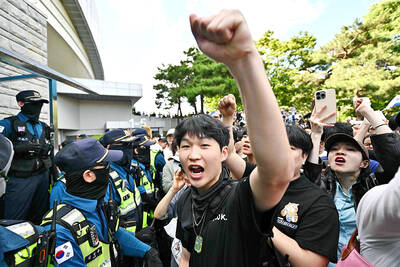
‘ABSURD MISTAKE’: The election commission said that there had been a failure to anticipate turnout after 14 polling stations ran short of ballot papers South Korean riot police yesterday cleared protesters from a Seoul polling station after a 35-hour blockade sparked by a shortage of ballot papers during local elections earlier this week. Wednesday’s election was the first nationwide vote since South Korean President Lee Jae-myung took office following the ouster of Yoon Suk-yeol over his short-lived martial law declaration. Lee’s ruling Democratic Party swept most races, but failed to flip the crucial Seoul mayoral seat. The South Korean National Election Commission apologized, blaming a failure to anticipate turnout after 14 polling stations in Seoul ran short of ballot papers. Some polling stations stayed open until 10pm to

Australian researchers have trained lab-grown brain cells on a silicon computer chip to play the 1990s shooter game Doom and said they are just scratching the surface of what the neurons could be capable of doing. It is the science-fiction work of biotech boffins at Cortical Labs, who researched and developed the technology that harnesses the workings of the brain’s networking system. Each so-called “biological computer” contains about 200,000 living human brain cells, grown from stem cells that were harvested from blood donations. Having mastered the simple computer game Pong, where a paddle is moved up and down to send a ball

France experienced its hottest spring on record, the French weather service said on Tuesday, after an exceptional early heat wave that also broke highs for the season in England and Wales. Meteo-France said the average nationwide temperature over March to May was 13.8°C — about 1.7°C above the norm, and surpassing records set in 2011 and 2020. “The warmest spring since records began in 1900,” it said in a bulletin. All three months were warmer than average, but the onset of an “unprecedented heatwave” late last month pushed the mercury to highs typically seen at the height of the summer. “Our country had never


 RSS
RSS