


China yesterday welcomed its first authentic version of the giant Rubber Duck that has made a splash around the world and inspired fakes across the country — but there were complaints visitors had to pay to see it.
The inflatable yellow bird by Dutch artist Florentijn Hofman, which has made appearances from Australia to South America since 2007, attracted huge attention in China after photos of it were taken bobbing in Hong Kong’s Victoria Harbour.
The artwork soon took a commercial turn in China, with property developers setting up imitations in Hangzhou, Tianjin and other cities, acts that were criticized by the ruling Chinese Communist Party mouthpiece the People’s Daily.
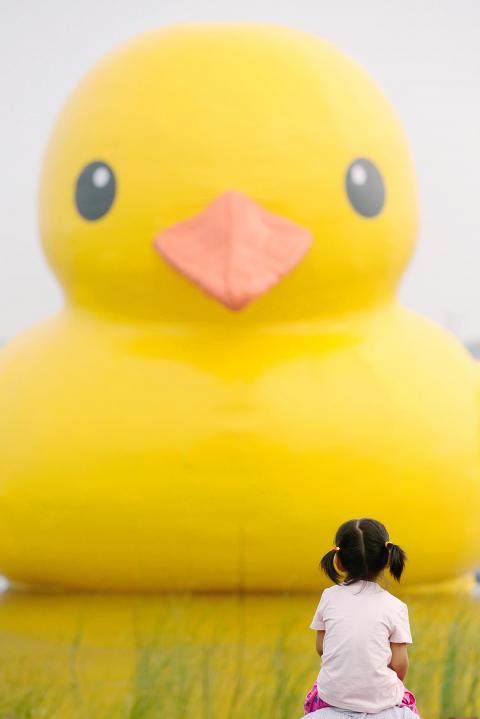
Photo: AFP
Its previous displays have normally been free, but the moneymaking continued with the authentic creation in Beijing as it went on show at the International Garden Expo on the outskirts of the capital city, which costs 100 yuan (US$16) to enter.
After a few weeks the duck will shift to the Summer Palace, a tourist spot that also charges an entrance fee. There are currently no plans to offer a free day, but the expo offers a vast space to accommodate large numbers of visitors, expo official Qiao Xiaopeng said.
However, the first crowds were small yesterday.
Kang Jing, 26, said she thought viewing the duck should be free, at least for Beijing residents.
“That would let more people come see it, which would be better,” she said.
The duck was not completely inflated by the time of its debut, its beak somewhat limp and body tilting forward.
“It should be fatter and cuter,” Kang said.
The duck looked smaller than she expected, Kang added — even though the Beijing version was made to be 18m high, compared with the 16.5m version in Hong Kong.
A well-known restaurant, Quanjude, sought to take advantage of the installation by using it to advertise its own showpiece, Peking duck.
A sign at the expo entrance showed the artwork in a chef’s hat with the words: “Come see the big yellow duck and eat a Quanjude duck burger.”
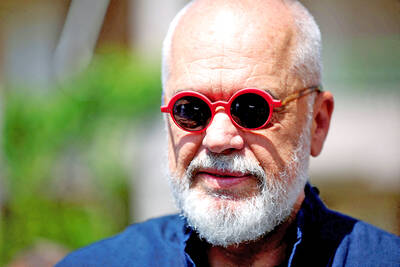
FRAUD ALLEGED: The leader of an opposition alliance made allegations of electoral irregularities and called for a protest in Tirana as European leaders are to meet Albanian Prime Minister Edi Rama’s Socialist Party scored a large victory in parliamentary elections, securing him his fourth term, official results showed late on Tuesday. The Socialist Party won 52.1 percent of the vote on Sunday compared with 34.2 percent for an alliance of opposition parties led by his main rival Sali Berisha, according to results released by the Albanian Central Election Commission. Diaspora votes have yet to be counted, but according to initial results, Rama was also leading there. According to projections, the Socialist Party could have more lawmakers than in 2021 elections. At the time, it won 74 seats in the

EUROPEAN FUTURE? Albanian Prime Minister Edi Rama says only he could secure EU membership, but challenges remain in dealing with corruption and a brain drain Albanian Prime Minister Edi Rama seeks to win an unprecedented fourth term, pledging to finally take the country into the EU and turn it into a hot tourist destination with some help from the Trump family. The artist-turned-politician has been pitching Albania as a trendy coastal destination, which has helped to drive up tourism arrivals to a record 11 million last year. US President Donald Trump’s son-in-law, Jared Kushner, also joined in the rush, pledging to invest US$1.4 billion to turn a largely deserted island into a luxurious getaway. Rama is expected to win another term after yesterday’s vote. The vote would

CANCER: Jose Mujica earned the moniker ‘world’s poorest president’ for giving away much of his salary and living a simple life on his farm, with his wife and dog Tributes poured in on Tuesday from across Latin America following the death of former Uruguayan president Jose “Pepe” Mujica, an ex-guerrilla fighter revered by the left for his humility and progressive politics. He was 89. Mujica, who spent a dozen years behind bars for revolutionary activity, lost his battle against cancer after announcing in January that the disease had spread and he would stop treatment. “With deep sorrow, we announce the passing of our comrade Pepe Mujica. President, activist, guide and leader. We will miss you greatly, old friend,” Uruguayan President Yamandu Orsi wrote on X. “Pepe, eternal,” a cyclist shouted out minutes later,
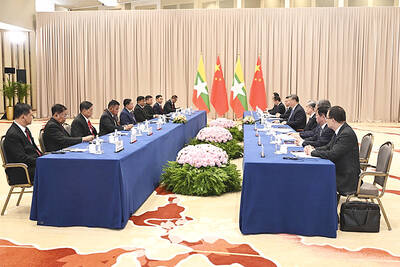
Myanmar’s junta chief met Chinese President Xi Jinping (習近平) for the first time since seizing power, state media reported yesterday, the highest-level meeting with a key ally for the internationally sanctioned military leader. Senior General Min Aung Hlaing led a military coup in 2021, overthrowing Myanmar’s brief experiment with democracy and plunging the nation into civil war. In the four years since, his armed forces have battled dozens of ethnic armed groups and rebel militias — some with close links to China — opposed to its rule. The conflict has seen Min Aung Hlaing draw condemnation from rights groups and pursued by the


 RSS
RSS