


Millions of people in western India are suffering their worst drought in more than four decades, with critics blaming official ineptitude and corruption for exacerbating the natural water shortage.
Central areas of Maharashtra State, of which Mumbai is the capital, are facing a water shortage worse than the severe drought in 1972, Maharashtra Chief Minister Prithviraj Chavan told reporters.
“In recorded history, the reservoirs have never been so low in central Maharashtra,” he said.
Chavan blamed the crisis on two successive poor monsoons, though others say a public policy failure is also responsible.
Nearly 2,000 tanker trucks are being used to transport drinking water to the needy, while hundreds of cattle camps have been set up to keep livestock alive until the monsoon, which usually arrives in June.
Chavan’s office could not put an exact figure on the population in the 10,000 villages affected, but said it ran into the millions.
Christopher Moses, who runs a charitable hospital in Jalna, one of the worst-hit districts, said many had lost their livelihoods as companies shut down and crops withered.
“This is a famine. Villagers have nothing to eat, they are scraping literally the bottom of their pot,” Moses told reporters. “Water-related diseases are on the up, starvation will start coming up, malnutrition will start coming up now.”
He said the crisis may force him to shut down parts of his Jalna Mission Hospital for the first time in its 117-year history. It has not yet seen any emergency water supplies from the government.
With nearly three-quarters of Indians dependent on rural incomes, the yearly monsoon is a lifeline — especially given that about two-thirds of farmland is not irrigated.
The 1972 drought led to a massive shortage of food grains and the prices of all commodities skyrocketed, forcing New Delhi to increase imports.
While last year’s monsoon picked up late in western parts of India, low rainfall in the key month of June led to water deficiency for the season, said Medha Khole from the India Meteorological Department.
An alleged irrigation scam has been blamed for worsening Maharashtra’s crisis, with politicians and bureaucrats accused of wasting vast public funds on unfinished projects in the state through corruption and nepotism.
Maharashtra’s proportion of irrigated land grew by just 0.1 percentage points between 2000 and 2010, an official economic survey said, despite billions being spent on it.
A controversial Indian government white paper has disputed the statistics and Chavan declined to comment on graft allegations involving other ministers because the courts are investigating the claims.
He said that the government “could have planned better” irrigation schemes and was now trying to complete projects to provide drinking water in deficient areas.
Economist H.M. Desarda said corruption was a “very significant part of the problem,” but a lack of understanding of how best to harvest rainwater was also to blame.

A new online voting system aimed at boosting turnout among the Philippines’ millions of overseas workers ahead of Monday’s mid-term elections has been marked by confusion and fears of disenfranchisement. Thousands of overseas Filipino workers have already cast their ballots in the race dominated by a bitter feud between President Ferdinand Marcos Jr and his impeached vice president, Sara Duterte. While official turnout figures are not yet publicly available, data from the Philippine Commission on Elections (COMELEC) showed that at least 134,000 of the 1.22 million registered overseas voters have signed up for the new online system, which opened on April 13. However,

EUROPEAN FUTURE? Albanian Prime Minister Edi Rama says only he could secure EU membership, but challenges remain in dealing with corruption and a brain drain Albanian Prime Minister Edi Rama seeks to win an unprecedented fourth term, pledging to finally take the country into the EU and turn it into a hot tourist destination with some help from the Trump family. The artist-turned-politician has been pitching Albania as a trendy coastal destination, which has helped to drive up tourism arrivals to a record 11 million last year. US President Donald Trump’s son-in-law, Jared Kushner, also joined in the rush, pledging to invest US$1.4 billion to turn a largely deserted island into a luxurious getaway. Rama is expected to win another term after yesterday’s vote. The vote would

ALLIES: Calling Putin his ‘old friend,’ Xi said Beijing stood alongside Russia ‘in the face of the international counter-current of unilateralism and hegemonic bullying’ Chinese President Xi Jinping (習近平) yesterday was in Moscow for a state visit ahead of the Kremlin’s grand Victory Day celebrations, as Ukraine accused Russia’s army of launching air strikes just hours into a supposed truce. More than 20 foreign leaders were in Russia to attend a vast military parade today marking 80 years since the defeat of Nazi Germany in World War II, taking place three years into Russia’s offensive in Ukraine. Putin ordered troops into Ukraine in February 2022 and has marshaled the memory of Soviet victory against Nazi Germany to justify his campaign and rally society behind the offensive,
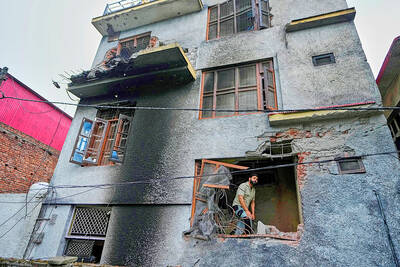
CONFLICTING REPORTS: Beijing said it was ‘not familiar with the matter’ when asked if Chinese jets were used in the conflict, after Pakistan’s foreign minister said they were The Pakistan Army yesterday said it shot down 25 Indian drones, a day after the worst violence between the nuclear-armed rivals in two decades. Pakistani Prime Minister Shehbaz Sharif vowed to retaliate after India launched deadly missile strikes on Wednesday morning, escalating days of gunfire along their border. At least 45 deaths were reported from both sides following Wednesday’s violence, including children. Pakistan’s military said in a statement yesterday that it had “so far shot down 25 Israeli-made Harop drones” at multiple location across the country. “Last night, India showed another act of aggression by sending drones to multiple locations,” Pakistan military spokesman Ahmed


 RSS
RSS