


Jordanians yesterday voted for a parliament touted to be the most powerful in the kingdom’s history, but with much of the opposition boycotting it, it is unclear how far the vote and its accompanying reforms will go to pacify a two-year long wave of protests.
At least 125,000 Jordanians, or 5 percent of the 2.3 million who registered to vote, cast ballots in the first two hours after polls opened, despite technical computer problems with the balloting, elections commission head Abdul-Illah Khatib said. That is reasonably heavy turnout for the early morning.
Jordanian King Abdullah II has given the parliament the right to choose the prime minister, previously appointed by the crown. It is one of several major reforms that will see the elected legislature take over much of the responsibility for day-to-day affairs of state, although the king will still set broader foreign and security policy for now.
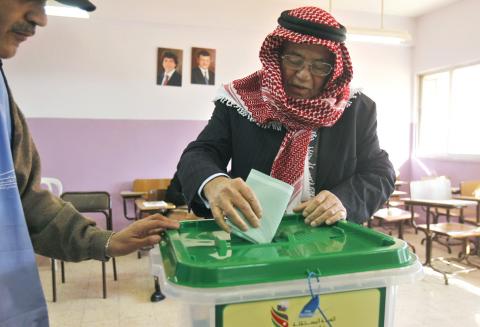
Photo: Reuters
The 2011 Arab Spring uprisings in the region set off a wave of demonstrations in Jordan, albeit much smaller than those that toppled leaders in Egypt, Libya, Yemen and Tunisia and devolved into a bloody civil war in Syria. Abdullah is trying to control the pace of change.
Jordanian Prime Minister Abdullah Ensour told reporters that the vote was a “a stepping stone, or a station, on the path of more vigorous, serious, real and genuine reforms,” as he cast his ballot in his northwestern hometown of Salt.
“More democracy is coming,” added Ensour, who is expected to tender his resignation to the king shortly after the vote as Jordan’s last appointed premier.
Officials said Ensour will remain a caretaker until parliament elects his successor.
However, government critics, led by the powerful Muslim Brotherhood, say the king’s moves do not go far or fast enough to end his monopoly on power.
The Islamist group is boycotting the vote, as are four smaller parties, including communists and Arab nationalists, on grounds that an electoral law introduced last year favored pro-king loyalists and undercut votes in its favor.
The Islamists’ frustration is growing because the Brotherhood has not been able to rally a large sector of the public to their side. Though there is anger over the economy, rising prices and corruption, many Jordanians also distrust the Brotherhood, eying its rise in Egypt and fearing it could grab power in Jordan and throw it into instability.
“It’s a national wedding in Jordan, with the bride being the new parliament,” said Amman housewife Basma Edwan, 32, as she enthusiastically cast her ballot, beaming a smile at photographers inside the polling room.
Outside of the Amman polling station, convenience store cashier Mohammed Abu-Summaqa, 21, said he will not be voting.
“Deputies will not be able to do anything for us because they are controlled by the king and Cabinet, so why should I vote?” he asked.


Through the noise of rushing papers and whirring belts at a print factory in Kyoto, two creators watch their photo essay come to life in broadsheet form — part of an effort to win new audiences in the age of artificial intelligence (AI). Despite the decline of the publishing industry, self-publication and handmade “zine” magazines are growing in popularity in Japan, reflecting the nation’s enduring love of paper in the digital era. While speaking to Agence France-Presse at the plant, his hands black with ink, one of the creators, Kazuma Obara, said: “I think [paper] is a medium that engages all five
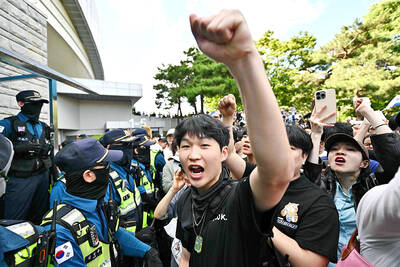
‘ABSURD MISTAKE’: The election commission said that there had been a failure to anticipate turnout after 14 polling stations ran short of ballot papers South Korean riot police yesterday cleared protesters from a Seoul polling station after a 35-hour blockade sparked by a shortage of ballot papers during local elections earlier this week. Wednesday’s election was the first nationwide vote since South Korean President Lee Jae-myung took office following the ouster of Yoon Suk-yeol over his short-lived martial law declaration. Lee’s ruling Democratic Party swept most races, but failed to flip the crucial Seoul mayoral seat. The South Korean National Election Commission apologized, blaming a failure to anticipate turnout after 14 polling stations in Seoul ran short of ballot papers. Some polling stations stayed open until 10pm to

France experienced its hottest spring on record, the French weather service said on Tuesday, after an exceptional early heat wave that also broke highs for the season in England and Wales. Meteo-France said the average nationwide temperature over March to May was 13.8°C — about 1.7°C above the norm, and surpassing records set in 2011 and 2020. “The warmest spring since records began in 1900,” it said in a bulletin. All three months were warmer than average, but the onset of an “unprecedented heatwave” late last month pushed the mercury to highs typically seen at the height of the summer. “Our country had never

A Sherpa guide was found crawling to base camp on Mount Everest a week after he went missing and was reunited with his family, who had given up hope he would return. Dawa Sherpa was last seen on Friday last week descending the mountain, but he did not reach base camp even though his client did. The pair were among the last climbers on the mountain as the climbing season came to an end and the route was dismantled. Dawa was located by a cleaning crew on Thursday morning as he was crawling down the snowy slopes around the Khumbu Icefall, just above


 RSS
RSS