


China’s religious affairs ministry has lashed out at the rampant commercialization of sacred places and temples in the country, including the practice of employing “fake monks” and fortune-tellers.
In a statement posted online, the State Administration for Religious Affairs, which oversees the country’s religious organizations, also criticized plans by some Buddhist and Taoist temples to raise funds by listing on the stock market.
“Temples shall not in any way engage in ‘stock’ or ‘joint venture’ activities,” the administration said in the statement dated Oct. 22.
Policies by the Chinese Communist Party (CCP) suppressing religion have been relaxed since the 1970s, leading to a rapid increase in pilgrimages and visits to temples. Religious organizations are still required to register with the government.
The State Administration for Religious Affairs picked out for particular criticism those “using the excuse of promoting traditional culture” to profit from devotees.
“There have been reports of non-religious sites employing fake monks … illegally setting up donation boxes to take religious donations, even threatening religious believers and tourists to cheat them out of money,” the statement said.
“These phenomena seriously violate the party’s policies towards religion, and national laws,” it added, listing other abuses, including pressuring tourists to buy expensive incense and illegal fortune-telling.
The Famen temple in northwest China is set to list on Hong Kong’s stock exchange next year, according to the Global Times daily, while Mount Putuo, a sacred Buddhist mountain, has announced plans to go public within three years.
Two fake monks wearing orange Buddhist robes were detained in Beijing in April after they were caught drinking alcohol on the city’s subway and checked into a luxury hotel with two women, local reports said at the time.

Through the noise of rushing papers and whirring belts at a print factory in Kyoto, two creators watch their photo essay come to life in broadsheet form — part of an effort to win new audiences in the age of artificial intelligence (AI). Despite the decline of the publishing industry, self-publication and handmade “zine” magazines are growing in popularity in Japan, reflecting the nation’s enduring love of paper in the digital era. While speaking to Agence France-Presse at the plant, his hands black with ink, one of the creators, Kazuma Obara, said: “I think [paper] is a medium that engages all five
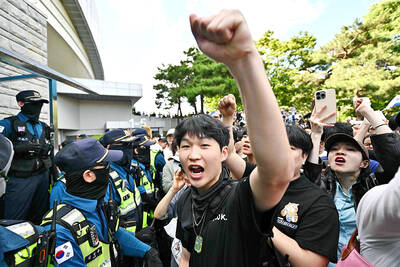
‘ABSURD MISTAKE’: The election commission said that there had been a failure to anticipate turnout after 14 polling stations ran short of ballot papers South Korean riot police yesterday cleared protesters from a Seoul polling station after a 35-hour blockade sparked by a shortage of ballot papers during local elections earlier this week. Wednesday’s election was the first nationwide vote since South Korean President Lee Jae-myung took office following the ouster of Yoon Suk-yeol over his short-lived martial law declaration. Lee’s ruling Democratic Party swept most races, but failed to flip the crucial Seoul mayoral seat. The South Korean National Election Commission apologized, blaming a failure to anticipate turnout after 14 polling stations in Seoul ran short of ballot papers. Some polling stations stayed open until 10pm to

Australian researchers have trained lab-grown brain cells on a silicon computer chip to play the 1990s shooter game Doom and said they are just scratching the surface of what the neurons could be capable of doing. It is the science-fiction work of biotech boffins at Cortical Labs, who researched and developed the technology that harnesses the workings of the brain’s networking system. Each so-called “biological computer” contains about 200,000 living human brain cells, grown from stem cells that were harvested from blood donations. Having mastered the simple computer game Pong, where a paddle is moved up and down to send a ball

France experienced its hottest spring on record, the French weather service said on Tuesday, after an exceptional early heat wave that also broke highs for the season in England and Wales. Meteo-France said the average nationwide temperature over March to May was 13.8°C — about 1.7°C above the norm, and surpassing records set in 2011 and 2020. “The warmest spring since records began in 1900,” it said in a bulletin. All three months were warmer than average, but the onset of an “unprecedented heatwave” late last month pushed the mercury to highs typically seen at the height of the summer. “Our country had never


 RSS
RSS