


Scientists are turning to genetic testing to see if they can prove the existence of the elusive hairy humanoid known across the world as bigfoot, yeti and sasquatch.
A joint project between Oxford University and Switzerland’s Lausanne Museum of Zoology is to examine organic remains that some say belong to the creature that has been spotted in remote areas for decades.
“It’s an area that any serious academic ventures into with a deal of trepidation ... It’s full of eccentric and downright misleading reports,” Bryan Sykes of Oxford’s Wolfson College said.
However, the team would take a systematic approach and use the latest advances in genetic testing, he added.
“There have been DNA tests done on alleged yetis and other such things, but since then the testing techniques, particularly on hair, have improved a lot due to advances in forensic science,” he said.
Modern testing could get valid results from a fragment of a shaft of hair, said Sykes, who is leading the project with Michel Sartori, director of the Lausanne museum.
Ever since a 1951 expedition to Mount Everest returned with photographs of giant footprints in the snow, there has been speculation about giant Himalayan creatures, unknown to science.
There have been eyewitness reports of the “yeti” or “migoi” in the Himalayas, “bigfoot” or “sasquatch” in the US, “almasty” in the Caucasus mountains and “orang pendek” in Sumatra.
Tests up to now have usually concluded that alleged yeti remains were actually human, he said, but that could have been the result of contamination.
“There has been no systematic review of this material,” Sykes said.
The project is to focus on Lausanne’s archive of remains assembled by Bernard Heuvelmans, who investigated reported yeti sightings from 1950 up to his death in 2001.
Other institutions and individuals are also being asked to send in details of any possible yeti material. Samples are to be subjected to “rigorous genetic analysis” and the results published in peer-reviewed science journals.
Aside from the yeti question, Sykes said he hoped the project would add to the growing body of knowledge on the interaction between humanity’s ancestors.
“In the last two years, it has become clear that there was considerable inter-breeding between Homo Sapiens and Neanderthals ... about 2 to 4 percent of the DNA of each individual European is Neanderthal,” he said.
One hypothesis is that yetis are surviving Neanderthals.
The joint project will take DNA samples from areas where there have been alleged sightings to see whether the Neanderthal DNA traces are stronger in the local population.
As for the project’s chances of success?
“The answer is, of course, I don’t know,” Sykes said. “It’s unlikely, but on the other hand, if we don’t examine it we won’t know.”

PARLIAMENT CHAOS: Police forcibly removed Brazilian Deputy Glauber Braga after he called the legislation part of a ‘coup offensive’ and occupied the speaker’s chair Brazil’s lower house of Congress early yesterday approved a bill that could slash former Brazilian president Jair Bolsonaro’s prison sentence for plotting a coup, after efforts by a lawmaker to disrupt the proceedings sparked chaos in parliament. Bolsonaro has been serving a 27-year term since last month after his conviction for a scheme to stop Brazilian President Luiz Inacio Lula da Silva from taking office after the 2022 election. Lawmakers had been discussing a bill that would significantly reduce sentences for several crimes, including attempting a coup d’etat — opening up the prospect that Bolsonaro, 70, could have his sentence cut to

A powerful magnitude 7.6 earthquake shook Japan’s northeast region late on Monday, prompting tsunami warnings and orders for residents to evacuate. A tsunami as high as three metres (10 feet) could hit Japan’s northeastern coast after an earthquake with an estimated magnitude of 7.6 occurred offshore at 11:15 p.m. (1415 GMT), the Japan Meteorological Agency (JMA) said. Tsunami warnings were issued for the prefectures of Hokkaido, Aomori and Iwate, and a tsunami of 40cm had been observed at Aomori’s Mutsu Ogawara and Hokkaido’s Urakawa ports before midnight, JMA said. The epicentre of the quake was 80 km (50 miles) off the coast of
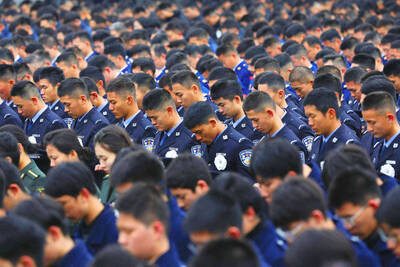
China yesterday held a low-key memorial ceremony for the 1937 Nanjing Massacre, with Chinese President Xi Jinping (習近平) not attending, despite a diplomatic crisis between Beijing and Tokyo over Taiwan. Beijing has raged at Tokyo since Japanese Prime Minister Sanae Takaichi last month said that a hypothetical Chinese attack on Taiwan could trigger a military response from Japan. China and Japan have long sparred over their painful history. China consistently reminds its people of the 1937 Nanjing Massacre, in which it says Japanese troops killed 300,000 people in what was then its capital. A post-World War II Allied tribunal put the death toll

A passerby could hear the cacophony from miles away in the Argentine capital, the unmistakable sound of 2,397 dogs barking — and breaking the unofficial world record for the largest-ever gathering of golden retrievers. Excitement pulsed through Bosques de Palermo, a sprawling park in Buenos Aires, as golden retriever-owners from all over Argentina transformed the park’s grassy expanse into a sea of bright yellow fur. Dog owners of all ages, their clothes covered in dog hair and stained with slobber, plopped down on picnic blankets with their beloved goldens to take in the surreal sight of so many other, exceptionally similar-looking ones.


 RSS
RSS