


Election authorities in Myanmar have postponed voting in three of 48 constituencies in the April 1 by-election because of what the military-backed government says are security concerns.
The postponement represents the first glitch in the upcoming poll, the first in which Nobel Peace Prize laureate Aung San Suu Kyi will be a candidate since the democracy icon was released from house arrest in 2010. The election is seen as an indicator of Myanmar’s tentative transition from direct military rule.
State television broadcast an announcement on Friday by the Election Commission that voting in three constituencies in Kachin state in northern Myanmar has been postponed as “security conditions are not conducive to conducting a free and fair by-election.”
It said voting would be held when security conditions have improved.
There is sporadic but sometimes fierce fighting in Kachin between government troops and ethnic Kachin rebels, who have long sought more autonomy and faced increased crackdowns this past year.
The April 1 by-elections are the first polls in which Aung San Suu Kyi’s National League for Democracy will be participating since boycotting a 2010 general election.
The US said on Friday it was withholding judgement on the postponement until it gets more information from authorities in Myanmar, also known as Burma. The US and other countries are watching the polls closely as they weigh whether to ease sanctions imposed against the former military regime.
“We have had concerns about the violence in Kachin [state],” US State Department spokeswoman Victoria Nuland told a news briefing in Washington. “We are seeking to understand what the Burmese intentions are so that the people of Kachin are not disenfranchised.”
The postponement of voting in Mogaung, Phakant and Bamaw is a blow to the Kachin autonomy movement because the former leader of the Kachin Independence Organization, Tu Ja, is running from Mogaung constituency as an independent candidate.
Kachin leaders who tried to form political parties to run in 2010 elections were barred from registering their political parties and were not allowed to run as independent candidates.
In 2010, the government also postponed the voting in several areas facing ethnic unrest, leaving several parliamentary seats still unfilled. Aung San Suu Kyi’s party won a 1990 general election, but was never allowed to take office. Its participation in the April vote — agreed to after the election law was changed to meets its objections — is seen as an endorsement of the reforms Burmese President Thein Sein has undertaken since taking office last year.
Thein Sein’s military-backed but elected government has also negotiated ceasefires with several ethnic guerrilla groups. However, it remains at odds with the Kachin, who live in the strategic area by the border with China.
National League for Democracy spokesman Nyan Win called the postponement surprising and disappointing, since the party considers the areas its strongholds. Aung San Suu Kyi campaigned in Mogaung and Bamaw last month
“I don’t see any security threats in these areas because I have been there,” he said.
Aung San Suu Kyi’s party has also complained of election irregularities, including deceased people still being listed on voting registries.


Through the noise of rushing papers and whirring belts at a print factory in Kyoto, two creators watch their photo essay come to life in broadsheet form — part of an effort to win new audiences in the age of artificial intelligence (AI). Despite the decline of the publishing industry, self-publication and handmade “zine” magazines are growing in popularity in Japan, reflecting the nation’s enduring love of paper in the digital era. While speaking to Agence France-Presse at the plant, his hands black with ink, one of the creators, Kazuma Obara, said: “I think [paper] is a medium that engages all five
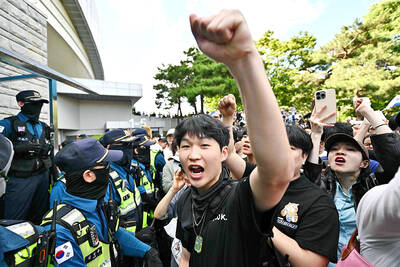
‘ABSURD MISTAKE’: The election commission said that there had been a failure to anticipate turnout after 14 polling stations ran short of ballot papers South Korean riot police yesterday cleared protesters from a Seoul polling station after a 35-hour blockade sparked by a shortage of ballot papers during local elections earlier this week. Wednesday’s election was the first nationwide vote since South Korean President Lee Jae-myung took office following the ouster of Yoon Suk-yeol over his short-lived martial law declaration. Lee’s ruling Democratic Party swept most races, but failed to flip the crucial Seoul mayoral seat. The South Korean National Election Commission apologized, blaming a failure to anticipate turnout after 14 polling stations in Seoul ran short of ballot papers. Some polling stations stayed open until 10pm to

France experienced its hottest spring on record, the French weather service said on Tuesday, after an exceptional early heat wave that also broke highs for the season in England and Wales. Meteo-France said the average nationwide temperature over March to May was 13.8°C — about 1.7°C above the norm, and surpassing records set in 2011 and 2020. “The warmest spring since records began in 1900,” it said in a bulletin. All three months were warmer than average, but the onset of an “unprecedented heatwave” late last month pushed the mercury to highs typically seen at the height of the summer. “Our country had never

A Sherpa guide was found crawling to base camp on Mount Everest a week after he went missing and was reunited with his family, who had given up hope he would return. Dawa Sherpa was last seen on Friday last week descending the mountain, but he did not reach base camp even though his client did. The pair were among the last climbers on the mountain as the climbing season came to an end and the route was dismantled. Dawa was located by a cleaning crew on Thursday morning as he was crawling down the snowy slopes around the Khumbu Icefall, just above


 RSS
RSS