


After traveling through Sri Lanka and India, US yoga teacher Aubrey Sacco decided to cap her six-month trip of a lifetime with a solo trek in Nepal’s majestic Himalayas.
The 23-year-old told her family she would be hiking in Langtang National Park, on the Tibetan border, and would check back with them in a few days. They never heard from her again.
Two years later, her mother has returned to the country, accusing Nepal of indifference to a case that has highlighted the dangers of women trekking alone in the world’s most famous mountain range.

Photo: AFP / CONNIE SACCO
“We have been to Nepal three times to meet with police officials to find out what they have done in investigating for my missing daughter,” Aubrey’s mother, Connie, said this week.
“It should not be our job to investigate this, it’s their job,” she said.
Aubrey was last seen in Langtang village on April 22, 2010. Villagers there initially told her parents she left in the afternoon, but some later changed their stories, saying they hadn’t seen her.
The Saccos accept that Aubrey might have died in an accident, but they fear the Nepalese authorities refuse to consider more sinister alternatives because any suggestion of a sex attacker at large could be devastating for tourism.
The family have cultivated local contacts, enlisted senators and congressmen in their home state of Colorado and even have the FBI working on the case, but they say the search is being hindered by “red tape” in Nepal.
A sweep of the area around Langtang at the time and subsequent searches have turned up no body and no avalanches were reported.
Lie detectors and sensing equipment that could locate a body — even after two years — have been made available through the US embassy, but have not yet been used by Nepali police, Connie Sacco said.
“This makes us suspicious that the government and police may not want to find out what happened to Aubrey,” said Sacco, who has asked for a meeting with Nepalese Prime Minister Baburam Bhattarai.
Nepalese police have defended their actions, saying they had searched the area thoroughly and had even sought help from witchdoctors.
Aubrey’s disappearance is one of a growing caseload of unsolved attacks and unexplained deaths in Nepal’s popular trekking areas.
Lena Sessions, 23, of the US, was hiking alone in December last year in the area where Aubrey went missing when a man wearing a black mask approached her with a tribal kukri knife and threatened her.
She told police she managed to escape after her assailant threatened to kill her if she did not submit to a sexual assault.
The incident occurred a week after a South Korean woman had been assaulted, also in Langtang National Park, and the US embassy now warns against hiking alone in Nepal, stating that two US women were attacked and seriously injured in 2010 on popular trails.
The British Foreign Office Web site also warns of “isolated incidences of rape” on trekking routes.
Sacco believes the attempted attack on Lena Sessions, Aubrey’s disappearance and other cases might be connected.
“There is a very bad man on the loose in the area where many women trekkers trek alone and where harm can come to the women and young girls of the villages,” she said.
In the recent assaults the women have lived to tell the tale, but several trekkers have not been so lucky.
In 2005 Celine Henry from France and, separately, Sabine Gruneklee from Germany disappeared while trekking on the fringes of the Kathmandu valley.
Gruneklee’s badly decomposed body was found in 2006, but Henry remains officially missing.
In the same year German trekker Kristina Kovacevic disappeared in the Everest region while trekking alone. Her body was later found in a ravine and police said she fell, but her family believe she was murdered by bandits.
The Trekking Agencies Association of Nepal said it was impossible to ascertain whether any of these cases were linked, but could not rule it out.
“People who come trekking in Nepal should take at least one person with them,” said Mahendra Singh Thapa, the association’s president.
Despite police claims to the contrary, Aubrey’s mother remains unconvinced that the authorities are doing enough to protect Western trekkers.
“The trekking season is here and this area is not safe,” she said.

Crowds in Bangladesh are flocking to snap photographs with an unlikely social media star — an albino buffalo with flowing blond hair nicknamed “Donald Trump” that is due to be sacrificed within days. Owner Zia Uddin Mridha, 38, said his brother named the 700kg bull over its flowing helmet of hair resembling the signature look of the US president. “My younger brother picked this name because of the buffalo’s extraordinary hair,” he said at his farm in Narayanganj, just outside the capital, Dhaka. Mridha said that a constant stream of curious visitors — social media fans, onlookers and children — have come throughout

It began as a satirical online project. Now millions of young people in India are flocking to it as an outlet for their frustration. A parody political party called the Cockroach Janta Party, with the insect as its symbol, has exploded across India’s social media by turning absurdist humor into protest. Memes and short videos mocking corruption, joblessness and political dysfunction have flooded social media sites, where millions of users are embracing the cockroach — known for its ability to survive harsh conditions — as a tongue-in-cheek symbol of endurance. The online movement’s rise has been unusually rapid. The Cockroach Janta Party (CJP)
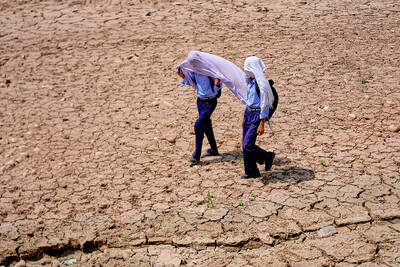
HOTTER: While Indians are accustomed to summer heat, climate change has caused northwestern India to warm faster than other parts of the country, an academic said Roads and markets have emptied during afternoons and some farmers have switched to nighttime work to avoid scorching temperatures as a heat wave grips large parts of India. The India Meteorological Department forecast maximum temperatures for yesterday of about 45°C in the capital, New Delhi, where authorities have opened temporary “cooling zones” to help people cope. The weather department warned that conditions would likely persist across several northern regions in the coming days, with temperatures staying well above seasonal averages. Authorities urged people to stay indoors during the hottest hours and take precautions against heat-related illnesses. India declares a heat wave whenever maximum temperatures

BIGGER ROLE: Beijing has said it maintains an impartial stance on the war in Ukraine, but by training Russian troops, China is far more involved than previously known China’s armed forces secretly trained about 200 Russian military personnel in China late last year, and some have since returned to fight in Ukraine, according to three European intelligence agencies and documents seen by Reuters. While China and Russia have held a number of joint military exercises since Moscow’s full-scale invasion of Ukraine in 2022, Beijing has repeatedly said that it is neutral in the conflict and presents itself as a peace mediator. The covert training sessions, which predominantly focused on the use of drones, were outlined in a dual-language Russian-Chinese agreement signed by senior Russian and Chinese officers in Beijing on


 RSS
RSS