


These days Mike Daisey is run off his feet.
“I don’t even have time to listen to my voicemail now. That’s a phenomenon I have not experienced before,” he said this weekend with an amazed laugh.
Perhaps he should not be so surprised. In the past two weeks, Daisey has gone from being a gifted, but obscure solo act in the US theater to the public face of a backlash against one of the iconic corporations of the 21st century.
Daisey’s latest work, The Agony and the Ecstasy of Steve Jobs, has triggered off a spasm of soul--searching about the sometimes appalling labor conditions in China under which many of the US’ most cherished products are made. Specifically, the shiny, sleek iPhones, i-Pods and iPads produced by Apple.
The Agony and the Ecstasy was devised after exhaustive research talking to exploited and abused workers in China, for almost 18 months. Daisey played to small but appreciative crowds across the US, winning critical praise, but stirring little trouble, not even with the target of his ire: Apple itself.
However, everything changed last month when a discussion and partial performance of Daisey’s monologue appeared on the National Public Radio show This American Life. It rapidly became the most downloaded episode of the show’s history and an online petition calling for Apple to reform its practices began. Within 48 hours, it attracted 140,000 names. Then the New York Times ran an exhaustive investigation of Apple’s supplier network in China that revealed industrial accidents, brutal working conditions and child labor. Suddenly, Apple’s Chinese supplier network was huge news.
Daisey is a man in intense demand. He has appearances lined up on CNN and other TV shows.
On his blog, he has been updating the story regularly and fending off criticism from Apple’s defenders, including comedian Stephen Fry and Forbes columnist Tim Worstall. Daisey is delighted, but exhausted, having been up until 5am the previous night composing a response to a public attack from Worstall.
“I am tired, but I am encouraged to see traction. The only way you can fight for a thing like this is when you know the truth is on your side,” he said. “It’s the first time maybe in a generation that the American theater has affected change.”
The play’s premise is simple enough. It blends Daisey’s own backstory as a nerdy geek who loved — and continues to love — Apple products with the story of how Jobs ran the company with a mix of tyranny and genius before he died last year.
However, it then heads into dark territory as Daisey recounts how he became obsessed with photographs that emerged from inside the giant Foxconn factory in which many Apple products are made.
His fascination with how his beloved gadgets were built ends up with a subversive trip to southern China and interviews with ordinary workers who describe the physically and mentally crippling conditions in which many toil.
On the trip, Daisey was stunned that he, as a playwright, was the one digging up the truth.
“I wanted journalists to tell the story. I am a monologuist and it’s not the same thing, but I had to act as a journalist,” he said.
Daisey is scathing about many of the journalists who cover Apple. He recites the story of one tech journalist who agreed to appear on a panel with him only to be contacted by Apple and warned off doing so.
“Apple has built an incredible institution of secrecy and people understand that when Apple threaten them, they mean it. Everyone knows that,” Daisey said.
As a performer, though, Daisey is immune.
Yet he confesses he still has a complex emotional relationship with the company. He still uses an iPhone and does not tell people to boycott the company, just spread the word about Chinese labor practices in the hope that they change.
Apple, for its part, says many of the stories emerging from China are not true and that it already is acting to monitor its suppliers’ behavior and bring in greater transparency.
Other defenders of the firm say that many other electronics firms are equally as culpable as Apple, if not more so.
For Daisey, that is not good enough.
“It is like watching a friend lose his way. It is hard to imagine the Apple of a generation ago making this ham-fisted error,” he said.

Through the noise of rushing papers and whirring belts at a print factory in Kyoto, two creators watch their photo essay come to life in broadsheet form — part of an effort to win new audiences in the age of artificial intelligence (AI). Despite the decline of the publishing industry, self-publication and handmade “zine” magazines are growing in popularity in Japan, reflecting the nation’s enduring love of paper in the digital era. While speaking to Agence France-Presse at the plant, his hands black with ink, one of the creators, Kazuma Obara, said: “I think [paper] is a medium that engages all five
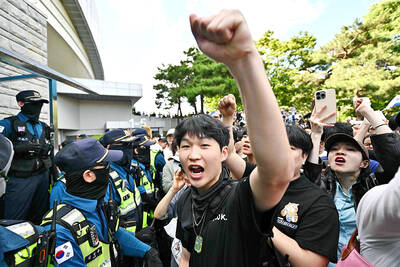
‘ABSURD MISTAKE’: The election commission said that there had been a failure to anticipate turnout after 14 polling stations ran short of ballot papers South Korean riot police yesterday cleared protesters from a Seoul polling station after a 35-hour blockade sparked by a shortage of ballot papers during local elections earlier this week. Wednesday’s election was the first nationwide vote since South Korean President Lee Jae-myung took office following the ouster of Yoon Suk-yeol over his short-lived martial law declaration. Lee’s ruling Democratic Party swept most races, but failed to flip the crucial Seoul mayoral seat. The South Korean National Election Commission apologized, blaming a failure to anticipate turnout after 14 polling stations in Seoul ran short of ballot papers. Some polling stations stayed open until 10pm to

Australian researchers have trained lab-grown brain cells on a silicon computer chip to play the 1990s shooter game Doom and said they are just scratching the surface of what the neurons could be capable of doing. It is the science-fiction work of biotech boffins at Cortical Labs, who researched and developed the technology that harnesses the workings of the brain’s networking system. Each so-called “biological computer” contains about 200,000 living human brain cells, grown from stem cells that were harvested from blood donations. Having mastered the simple computer game Pong, where a paddle is moved up and down to send a ball

France experienced its hottest spring on record, the French weather service said on Tuesday, after an exceptional early heat wave that also broke highs for the season in England and Wales. Meteo-France said the average nationwide temperature over March to May was 13.8°C — about 1.7°C above the norm, and surpassing records set in 2011 and 2020. “The warmest spring since records began in 1900,” it said in a bulletin. All three months were warmer than average, but the onset of an “unprecedented heatwave” late last month pushed the mercury to highs typically seen at the height of the summer. “Our country had never


 RSS
RSS