


The Russian government reacted furiously on Saturday to what it described as an unjustly lenient sentence in the case of a Pennsylvania couple who were originally charged with murder in the death of their seven-year-old son adopted from Russia.
The couple, Michael and Nanette Craver, were sentenced on Friday to four to 16 months in prison for involuntary manslaughter by Judge John Kennedy of the Court of Common Pleas in York, Pennsylvania. Because they had already spent almost 19 months in jail, they will not serve any more time.
RUSSIA’S FURY
The Russian government was enraged.
“The Cravers, who tortured the seven-year-old child to death, were released after staying a mere year-and-a-half under arrest,” Russian Foreign Ministry spokesman Alexander Lukashevich said on Saturday in a statement, according to the Interfax news service. “The court verdict is amazingly and flagrantly irresponsible.”
Russian officials said they were conducting their own investigation and might seek an arrest warrant for the couple.
The boy, Nathaniel Craver, died in 2009 from bleeding caused by a severe head injury. His adoptive parents said he had serious emotional and mental problems that had caused him to repeatedly hurt himself. They said the injury that caused his death occurred when he fell and hit his head on a wood stove.
Pennsylvania authorities said the parents had abused and neglected the boy. Expert witnesses testified that he had fetal alcohol syndrome, but it was not clear whether that played any role in his death.
A jury acquitted the Cravers of murder, but concluded they were negligent and responsible for the death. They were convicted in September of involuntary manslaughter and freed pending sentencing.
Kennedy, in ordering that the couple serve no more jail time, said he did not believe that they posed a danger to the community, or that a stiffer sentence would serve as an example for others.
MITIGATING FACTORS
He also said that given their ages — Michael Craver is 47 and Nanette Craver is 56 — he did not believe they would become parents again.
In 2003, the Cravers adopted Nathaniel, who was born Vanya Skorobogatov, along with his twin sister. The sister has been living with an aunt in the US.
Prosecutors asked Kennedy to order that the Cravers have no unsupervised contact with her until she turns 18, but the judge said he would leave such decisions to child welfare officials.
Lukashevich said the parents were directly responsible for the boy’s death.
“They brutalized the child, brought him to exhaustion and inflicted a heavy head injury on him that proved to be fatal,” he said.
Russia is one of the largest sources of adopted foreign children in the US, a relationship that came under scrutiny last year after a seven-year-old boy arrived alone at a Moscow airport after being sent back by his adoptive mother in Tennessee. She said she could not handle what she said were his severe emotional problems.
SAFEGUARDS
In July, US Secretary of State Hillary Rodham Clinton and her Russian counterpart, Sergey Lavrov, signed a bilateral agreement on adoptions that both sides said they hoped would ease tensions.
The agreement, which must still be ratified by the Russian parliament, provides safeguards, including restrictions on agencies that can participate in the adoption of any child not going to relatives.

Through the noise of rushing papers and whirring belts at a print factory in Kyoto, two creators watch their photo essay come to life in broadsheet form — part of an effort to win new audiences in the age of artificial intelligence (AI). Despite the decline of the publishing industry, self-publication and handmade “zine” magazines are growing in popularity in Japan, reflecting the nation’s enduring love of paper in the digital era. While speaking to Agence France-Presse at the plant, his hands black with ink, one of the creators, Kazuma Obara, said: “I think [paper] is a medium that engages all five
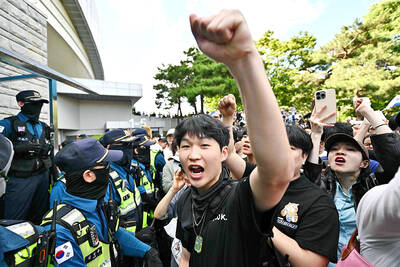
‘ABSURD MISTAKE’: The election commission said that there had been a failure to anticipate turnout after 14 polling stations ran short of ballot papers South Korean riot police yesterday cleared protesters from a Seoul polling station after a 35-hour blockade sparked by a shortage of ballot papers during local elections earlier this week. Wednesday’s election was the first nationwide vote since South Korean President Lee Jae-myung took office following the ouster of Yoon Suk-yeol over his short-lived martial law declaration. Lee’s ruling Democratic Party swept most races, but failed to flip the crucial Seoul mayoral seat. The South Korean National Election Commission apologized, blaming a failure to anticipate turnout after 14 polling stations in Seoul ran short of ballot papers. Some polling stations stayed open until 10pm to

Australian researchers have trained lab-grown brain cells on a silicon computer chip to play the 1990s shooter game Doom and said they are just scratching the surface of what the neurons could be capable of doing. It is the science-fiction work of biotech boffins at Cortical Labs, who researched and developed the technology that harnesses the workings of the brain’s networking system. Each so-called “biological computer” contains about 200,000 living human brain cells, grown from stem cells that were harvested from blood donations. Having mastered the simple computer game Pong, where a paddle is moved up and down to send a ball

France experienced its hottest spring on record, the French weather service said on Tuesday, after an exceptional early heat wave that also broke highs for the season in England and Wales. Meteo-France said the average nationwide temperature over March to May was 13.8°C — about 1.7°C above the norm, and surpassing records set in 2011 and 2020. “The warmest spring since records began in 1900,” it said in a bulletin. All three months were warmer than average, but the onset of an “unprecedented heatwave” late last month pushed the mercury to highs typically seen at the height of the summer. “Our country had never


 RSS
RSS