


Bullet holes pock the vault door and empty display boxes litter the showroom floor of Abidjan’s Museum of Civilization, robbed of 100 ancient artifacts under the cover of deadly conflict in April.
“A piece of our history has been wiped out,” museum director Silvie Memel Kassi said of the collection’s lost crown jewels, some dating back to the 17th century, that may now be melted for the gold.
“It is a huge loss,” she said.
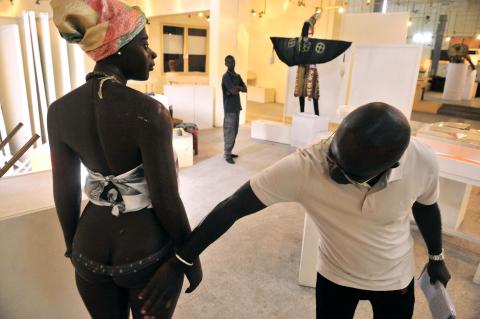
Photo: AFP
Worth an estimated 3 billion CFA francs (US$6.5 million), but irreplaceable, the looters made off with masks, sabers, crowns and gold-handled fly swatters — objects described by the museum as “authentic, unique and rare.”
“I had dreamed of leaving a museum of reference for future generations,” Zoko Djowa, the museum’s curator for the past 30 years and just months from retirement, said bitterly as he walked around the devastation.
Opened by the then-French administration in a white, colonial-style building in 1942, the museum could not have been worse placed during the conflict that engulfed Ivory Coast’s economic capital after a disputed election in November last year.
In Plateau, the neighborhood housing the presidential palace, the building also borders Camp Gallieni army headquarters and came under fire from both sides to the four-month conflict.
Fighting ended on April 11 with the arrest of former Ivorian president Laurent Gbagbo, who sparked the conflict by refusing to concede defeat to now-President Alassane Ouattara.
Shelling left a large hole in the museum facade.
Inside, the shattered state of the exhibition hall would break the heart of any art lover hoping to see the once rich collection of artifacts telling the story of the peoples of Ivory Coast.
Bullet marks have been left on the double glass that used to enclose sabers used by the royal Agni people from the east of the country.
Glass display boxes lie strewn on the floor, empty.
In the middle of the room; the massive, hundred-year-old skeleton of an elephant — the national emblem — towers over the few masks and statuettes left of the once proud collection.
Among the items lost: pendants worn by the central Baule people in the seventeenth century, statuettes of the western We and northern Senufo tribes, crowns and fly swatters with solid gold handles from the central and coastal regions, and sacred masks from the Dan people in the west.
While the pillagers failed to reach most of the estimated 11,000 items locked up in vaults, they did make off with the museum’s flagship collection.
“All of Ivory Coast” was exhibited there, Memel Kassi said in her small office, surrounded by traditional masks.
Each of the stolen objects “taught us something about its culture, its civilization, its beliefs,” she said.
Without holding out much hope, the museum has issued a search notice for the plundered items through the cross-border policing organization Interpol and urged the public to help.
However, chances of recovering the items are slim, said Jules-Evariste Toa, a communication professor at the University of Abidjan.
“One can melt the gold or start a private collection. We fear never to see the items again,” the once-regular museum visitor said.
Now closed to the public, the museum — which has seen its visitor numbers dwindle in recent years — will have to stretch its meager 76,000 euro (US$109,000) budget to cover vital refurbishment and security improvements.
“We need an alarm system and weapons,” museum security guard Jean-Claude Agniman said.
However, by far the worst consequence of the looting, Ivorians say, is the loss of patrimony invaluable to helping forge a common national identity as the nation embarks on reconstruction after a decade of crises and tensions.
“Ivory Coast is losing its points of reference with the disappearance of these pieces,” said Ivorian poet and writer Paul Ahizi, describing the theft as “a desecration of the spirit of [our] ancestors.”
“The country will have a problem defining its own identity and spirituality,” he said.

‘CROSSING THE LINE’: China’s embassy in Seoul criticized US Forces Korea Commander General Xavier Brunson, asking if his ‘hostile’ remarks were authorized by Washington South Korea and the US are in talks over recent public remarks by the commander of US Forces Korea, Seoul’s presidential office said yesterday, after the comments drew sharp criticism from China. In a recent podcast interview, US Forces Korea Commander General Xavier Brunson described South Korea as “the dagger in the heart of Asia” from China’s east coast, prompting the Chinese embassy in Seoul to say that he had “truly crossed the line.” The interview came amid growing speculation that Washington might seek to expand the role of US Forces Korea in countering the growing regional influence of China, a key

SEEKING ORDER: Rodrigo Paz said that ‘anyone who wants to destroy the nation will have to deal with this president and the full force of the constitution’ Bolivian President Rodrigo Paz on Wednesday said that the nation was at a “breaking point” after nearly a month of protests that have caused shortages of food, fuel and medicine. Paz, who took office six months ago amid the worst economic crisis there in four decades, is battling a groundswell of fury over his policies. The political capital, La Paz, has been besieged by low-income workers and members of the indigenous majority calling for his resignation. “The country needs order and is reaching breaking point,” the 58-year-old said at a public event in La Paz, renewing his appeal for dialogue. On Tuesday, the Bolivian

Through the noise of rushing papers and whirring belts at a print factory in Kyoto, two creators watch their photo essay come to life in broadsheet form — part of an effort to win new audiences in the age of artificial intelligence (AI). Despite the decline of the publishing industry, self-publication and handmade “zine” magazines are growing in popularity in Japan, reflecting the nation’s enduring love of paper in the digital era. While speaking to Agence France-Presse at the plant, his hands black with ink, one of the creators, Kazuma Obara, said: “I think [paper] is a medium that engages all five

Australian researchers have trained lab-grown brain cells on a silicon computer chip to play the 1990s shooter game Doom and said they are just scratching the surface of what the neurons could be capable of doing. It is the science-fiction work of biotech boffins at Cortical Labs, who researched and developed the technology that harnesses the workings of the brain’s networking system. Each so-called “biological computer” contains about 200,000 living human brain cells, grown from stem cells that were harvested from blood donations. Having mastered the simple computer game Pong, where a paddle is moved up and down to send a ball


 RSS
RSS