


Ukraine’s national dish of pork fat is a dense, white, chewy treat that can become an acquired taste. However, a new restaurant transforms the traditional dish, molding it into kitsch edible sculptures and even “sushi.”
Pork fat is “a cult dish and we decided to turn it into a cult art object,” said Mark Zarkhin, the co-owner of the restaurant.
Known as salo in Ukrainian, the pork fat comes in numerous varieties, ranging from smoked to streaky to pure white blubber. It is often sprinkled with paprika and washed down with a shot of vodka.
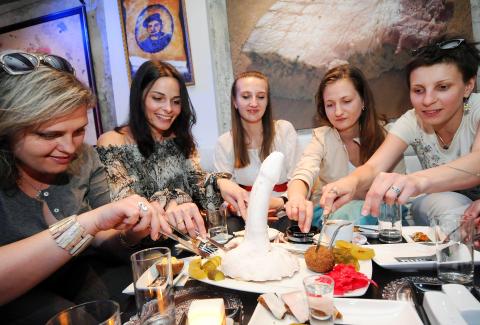
Photo: AFP
Named simply “Salo,” Zarkhin’s restaurant opened in June in the western city of Lviv and also markets itself as a museum of the lardy delicacy.
On the menu are kitsch offerings including a copy of the penis of Michelangelo’s David, stuffed with potato dumplings, and an anatomically accurate “Van Gogh’s Ear.”
There is even a local version of Japanese sushi — ubiquitous in Ukraine’s trendy restaurants — made from smoked pork fat.
Zarkhin, a businessman, says the restaurant mildly mocks the national love for salo.
“We are being ironic about ourselves and about our tastes,” he said.
However, he himself raves about the food’s versatility, insisting that it can be much more than a savory snack.
“People think of salo as either salty or smoked. They can hardly believe that this food can be more like cream. You add some ginger and cinnamon and it becomes a wonderful filling for chocolates,” he said.
The menu even offers desserts of whipped pork fat dipped in chocolate and a frozen “ice cream” dish based on actress Marilyn Monroe’s famous pout, called “Monroe’s Lips.”
The restaurant is aimed more at tourists than locals in the country’s poorer western region. Prices go up to 200 hryvnas (US$25) for the most expensive dish, David’s penis, which serves three.
The interior is scattered with objets d’art made from pork fat, including a model of a human heart, complete with a motor to simulate its beating — but without the blocked arteries likely to ensue from over-indulgence.
Visitors were enthusiastic about the restaurant.
“Wow, this is amazing,” said Maria Alexeyeva, who was visiting from Kiev with her sister Anna. “It’s very good and the interior is really cute. There’s nothing like this in Kiev.”
Zarkhin opened the restaurant together with a German artist of Ukrainian origin, Boris Berger, who came up with the idea.
“At the start, we weren’t sure this could be done,” he said. “Our chefs were also baffled ... but after three months of reflection, we finally got there.”
He is keen for the restaurant to become known as a gallery and has invited a series of artists to create sculptures from pork fat.
“Pork fat is a new material for art. Yes, it doesn’t last long, but neither does ice and it is used for sculptures all over the world,” he said.

‘CROSSING THE LINE’: China’s embassy in Seoul criticized US Forces Korea Commander General Xavier Brunson, asking if his ‘hostile’ remarks were authorized by Washington South Korea and the US are in talks over recent public remarks by the commander of US Forces Korea, Seoul’s presidential office said yesterday, after the comments drew sharp criticism from China. In a recent podcast interview, US Forces Korea Commander General Xavier Brunson described South Korea as “the dagger in the heart of Asia” from China’s east coast, prompting the Chinese embassy in Seoul to say that he had “truly crossed the line.” The interview came amid growing speculation that Washington might seek to expand the role of US Forces Korea in countering the growing regional influence of China, a key

SEEKING ORDER: Rodrigo Paz said that ‘anyone who wants to destroy the nation will have to deal with this president and the full force of the constitution’ Bolivian President Rodrigo Paz on Wednesday said that the nation was at a “breaking point” after nearly a month of protests that have caused shortages of food, fuel and medicine. Paz, who took office six months ago amid the worst economic crisis there in four decades, is battling a groundswell of fury over his policies. The political capital, La Paz, has been besieged by low-income workers and members of the indigenous majority calling for his resignation. “The country needs order and is reaching breaking point,” the 58-year-old said at a public event in La Paz, renewing his appeal for dialogue. On Tuesday, the Bolivian

Through the noise of rushing papers and whirring belts at a print factory in Kyoto, two creators watch their photo essay come to life in broadsheet form — part of an effort to win new audiences in the age of artificial intelligence (AI). Despite the decline of the publishing industry, self-publication and handmade “zine” magazines are growing in popularity in Japan, reflecting the nation’s enduring love of paper in the digital era. While speaking to Agence France-Presse at the plant, his hands black with ink, one of the creators, Kazuma Obara, said: “I think [paper] is a medium that engages all five

Australian researchers have trained lab-grown brain cells on a silicon computer chip to play the 1990s shooter game Doom and said they are just scratching the surface of what the neurons could be capable of doing. It is the science-fiction work of biotech boffins at Cortical Labs, who researched and developed the technology that harnesses the workings of the brain’s networking system. Each so-called “biological computer” contains about 200,000 living human brain cells, grown from stem cells that were harvested from blood donations. Having mastered the simple computer game Pong, where a paddle is moved up and down to send a ball


 RSS
RSS