


Cisco Systems, a maker of Internet routing gear, customized its technology to help China track members of the Falun Gong spiritual movement, according to a federal lawsuit filed last week by members of the movement.
The lawsuit, which relies on internal sales materials, also said that Cisco had tried to market its equipment to the Chinese government by using inflammatory language that stemmed from the Cultural Revolution.
The suit was filed on Thursday in US District Court for the Northern District of California in San Jose by the Human Rights Law Foundation on behalf of members of Falun Gong. It contends that Cisco helped design the controversial “Golden Shield” firewall that is used to censor the Internet and track opponents of the Chinese government. The lawsuit names several Cisco executives, including the chairman and chief executive, John Chambers.
It seeks unspecified compensatory and punitive damages and to enjoin Cisco from unlawful activity.
When evidence of the company’s activities in China became public in 2008 through a leaked PowerPoint presentation, Cisco disassociated itself from the marketing materials, stating that they were the work of a low-level employee. On Friday the company said in a statement that there was “no basis” for the allegations and that it intended to “vigorously” defend itself.
“Cisco does not operate networks in China or elsewhere, nor does Cisco customize our products in any way that would facilitate censorship or repression,” the company stated.
The suit claims that additional Cisco marketing presentations prove that it promoted its technology as being capable of taking aim at dissident groups.
In one marketing slide, the goals of the Golden Shield are described as to “douzheng evil Falun Gong cult and other hostile elements.”
Douzheng is a Chinese term used to describe the persecution of undesirable groups. It was widely used by the Chinese Communist Party in the Cultural Revolution.
The 52-page lawsuit describes the Golden Shield as a system intended to censor Internet traffic flowing into China, and to identify and monitor opponents of the Chinese government. The suit states that Falun Gong members who used the Internet were tracked by the Golden Shield and then apprehended.
Members of the group who were arrested were tortured, and one member was beaten to death, the lawsuit says. Another plaintiff who was arrested has since vanished, the suit claims, and is presumed to be dead.
The lawsuit challenges Cisco’s assertion that it did not help design the firewall system or customize technology that it sold to meet government surveillance and censorship requirements.
Terri Marsh, a lawyer for the Human Rights Law Foundation in Washington, said the group had compiled detailed information about Cisco’s role in the design of Chinese information centers that host Falun Gong database applications connected to network surveillance and tracking systems. This information will be disclosed in court during the discovery phase of the trial, Marsh said.
The lawsuit states that other documents lay out design suggestions to the Chinese Ministry of Public Security on how to pursue dissidents effectively.
The lawsuit is based on the Alien Torts Statute, a federal law that permits foreign nationals to bring lawsuits in US federal court claiming violations of international law. They also have brought charges under the Torture Victim Protection Act and under California state law.
The suit names three Falun Gong members, Ivy He, of Canada; Liu Guifu, of New York State; and Charles Lee, a US citizen who was arrested when he went to China in 2003 and was held until 2006. It also is brought on behalf of eight unidentified Chinese citizens, who include those who were tortured and killed or are missing.
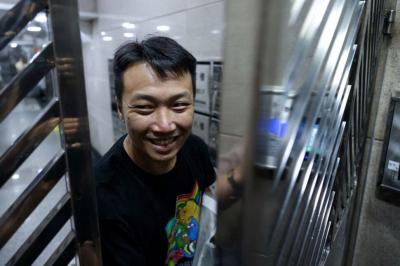
Four people jailed in the landmark Hong Kong national security trial of "47 democrats" accused of conspiracy to commit subversion were freed today after more than four years behind bars, the second group to be released in a month. Among those freed was long-time political and LGBTQ activist Jimmy Sham (岑子杰), who also led one of Hong Kong’s largest pro-democracy groups, the Civil Human Rights Front, which disbanded in 2021. "Let me spend some time with my family," Sham said after arriving at his home in the Kowloon district of Jordan. "I don’t know how to plan ahead because, to me, it feels
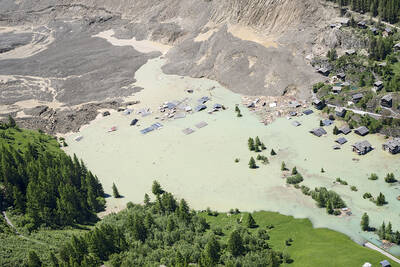
The collapse of the Swiss Birch glacier serves as a chilling warning of the escalating dangers faced by communities worldwide living under the shadow of fragile ice, particularly in Asia, experts said. Footage of the collapse on Wednesday showed a huge cloud of ice and rubble hurtling down the mountainside into the hamlet of Blatten. Swiss Development Cooperation disaster risk reduction adviser Ali Neumann said that while the role of climate change in the case of Blatten “still needs to be investigated,” the wider impacts were clear on the cryosphere — the part of the world covered by frozen water. “Climate change and

Poland is set to hold a presidential runoff election today between two candidates offering starkly different visions for the country’s future. The winner would succeed Polish President Andrzej Duda, a conservative who is finishing his second and final term. The outcome would determine whether Poland embraces a nationalist populist trajectory or pivots more fully toward liberal, pro-European policies. An exit poll by Ipsos would be released when polls close today at 9pm local time, with a margin of error of plus or minus 2 percentage points. Final results are expected tomorrow. Whoever wins can be expected to either help or hinder the
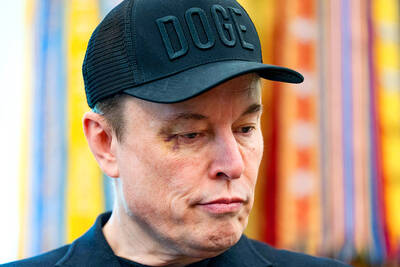
DENIAL: Musk said that the ‘New York Times was lying their ass off,’ after it reported he used so much drugs that he developed bladder problems Elon Musk on Saturday denied a report that he used ketamine and other drugs extensively last year on the US presidential campaign trail. The New York Times on Friday reported that the billionaire adviser to US President Donald Trump used so much ketamine, a powerful anesthetic, that he developed bladder problems. The newspaper said the world’s richest person also took ecstasy and mushrooms, and traveled with a pill box last year, adding that it was not known whether Musk also took drugs while heading the so-called US Department of Government Efficiency (DOGE) after Trump took power in January. In a


 RSS
RSS