


When Thida Win contracted HIV after selling her body on the Yangon streets, it was her fellow sex workers that she turned to, not Myanmar’s crumbling health service.
The Top project, run almost entirely by those in the sex trade, gave her treatment, a place to be herself away from the dual stigma of HIV and prostitution — and eventually a job.
“I am now a health worker for my community and I can forget I am positive. I am so proud to work for the programs, I will work for them for my whole life,” the 33-year-old said.
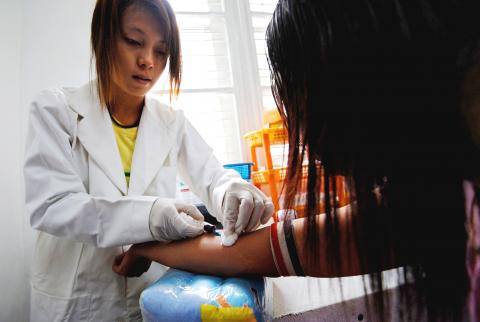
Photo: AFP
Top and similar projects are a vital resource in army-dominated Myanmar, where a chronically underfunded health service, large itinerant populations and poor education fuel one of Asia’s worst HIV epidemics.
“When I was diagnosed I was pregnant and they told me how to find a safe way for the baby. So the child is negative and I am so happy,” Thida Win said.
Nearly one in five of Myanmar’s estimated 60,000 sex workers were infected with HIV in 2008.
A UN report from August last year said legal constraints and discrimination made it hard to reach those in the trade, which is illegal. Surveys suggested police even used condoms as evidence for arrest.
Top founder and director Habib Rahman said providing a place free from taboos and letting people share their problems with contemporaries was a key aim for the project.
“Even the cleaner comes from the sex worker community, the counselors are also sex workers. That’s one of the reasons I decided to recruit from the community — because there should not be any stigma and discrimination,” he said.
Rahman said many women enter sex work without knowing about the risks.
“In general in Myanmar I do not think there is any sex education in school,” he said.
The project recruits former and current sex workers to help educate others about HIV, spreading the message from a position of trust within the community.
“We cannot tell anyone to stop selling sex even though they are positive, but what we do is tell them how they can keep healthy and protect the client by using condoms,” Rahman said.
He said Top’s part-time “peer educators,” who chose to continue in the sex trade, were encouraged to always use protection, while full-time employees were instructed to stop selling sex altogether.
HIV transmission in Myanmar occurs “primarily through high-risk sexual contact between sex -workers and their clients,” as well as men who have sex with men and their partners, according to the UN report.
It said while injecting drug users have the highest HIV prevalence, at 36 percent, they are also likely to pay for sex and “this interaction may refuel the sex-work-driven epidemic.”
Years of neglect by the ruling generals — Myanmar spent just 0.9 percent of its budget on health in 2007 — have left foreign donors facilitating most of the country’s HIV treatment.
A new government, which came into power after controversial elections in November last year, has raised hopes of more investment from overseas donors — but not the state, which is expected to spend around 20 percent of outlay on the army this year.
In 2009, the UN estimated 240,000 people in Myanmar were living with the virus and while there have been improvements, the situation remains worrying with prevalence rates the third-highest in Asia after Thailand and Papua New Guinea.
“The HIV epidemic in Myanmar is on a decreasing trend and among the key population groups it is also reducing — but it is still really quite high,” said Soe Naing of UNAIDS in Myanmar.
He said some state provision for HIV treatment does exist in big cities, “but of course the standards and situations are not ideal. People are reluctant to go to them because of privacy issues and quality.”
Top clinics provide everything from testing and counseling to routine medical care.
Last year, it gave treatment and consultation to 11,770 female sex workers and 10,727 men. It also accounted for 40 percent and 82 percent of all HIV tests for those groups respectively in the country.
The program, which was formed by Population Services International seven years ago, now employs 350 people — 95 percent of whom are from the sex worker community and men who have sex with men — in 19 towns and cities.
In Myanmar, where the US estimates around a third of people were below the poverty line in 2007, money worries are likely to continue to drive people into sex work.
Thida Win, who was still a university student when she first sold sex, said the financial burden of marriage and children only pushed her further into the trade.
“I got my degree with sex work, I supported my family very well with sex work,” said the chemistry graduate, who said her earnings still help support seven family members.

SPEAKING OUT: After Siranudh Scott’s allegations surfaced, celebrities and public figures took to social media to share their own experiences of sexual misconduct and abuse A high-profile alleged sexual abuse case within a wealthy Thai beer brewing family has prompted a wave of painful accounts from survivors of unconnected abuse in the conservative nation. Siranudh Scott, a member of the billionaire Thai family that founded the ubiquitous Singha beer brand, posted an emotional video this month accusing his elder brother Sunit of repeatedly abusing him when he was a teenager. Sunit, who is in his 30s, later denied the allegations in a video posted online, but Singha parent Boonrawd dismissed him from his executive role with the company on Tuesday last week. “I felt I needed to speak

SEEKING ORDER: Rodrigo Paz said that ‘anyone who wants to destroy the nation will have to deal with this president and the full force of the constitution’ Bolivian President Rodrigo Paz on Wednesday said that the nation was at a “breaking point” after nearly a month of protests that have caused shortages of food, fuel and medicine. Paz, who took office six months ago amid the worst economic crisis there in four decades, is battling a groundswell of fury over his policies. The political capital, La Paz, has been besieged by low-income workers and members of the indigenous majority calling for his resignation. “The country needs order and is reaching breaking point,” the 58-year-old said at a public event in La Paz, renewing his appeal for dialogue. On Tuesday, the Bolivian

‘CROSSING THE LINE’: China’s embassy in Seoul criticized US Forces Korea Commander General Xavier Brunson, asking if his ‘hostile’ remarks were authorized by Washington South Korea and the US are in talks over recent public remarks by the commander of US Forces Korea, Seoul’s presidential office said yesterday, after the comments drew sharp criticism from China. In a recent podcast interview, US Forces Korea Commander General Xavier Brunson described South Korea as “the dagger in the heart of Asia” from China’s east coast, prompting the Chinese embassy in Seoul to say that he had “truly crossed the line.” The interview came amid growing speculation that Washington might seek to expand the role of US Forces Korea in countering the growing regional influence of China, a key

Forecasters in Europe yesterday warned of exceptional heat as record temperatures driven by a “heat dome” push temperatures well above seasonal norms across the continent. The surge follows a record-breaking Monday, with France logging its hottest day in the month of May on record, its weather agency said, and the UK also posting unprecedented highs. A so-called “heat dome” of warm air from northern Africa trapped under a high-pressure system over western Europe is behind the high temperatures not usually seen until high summer. Restrictions on outdoor work were imposed in parts of Italy, beaches in southwest France filled earlier than usual and


 RSS
RSS