


Austrian job agent Christian Mitterdorfer smiles and shakes hands with Poles, hoping to entice them to work in his country, which opens its labor market to EU newcomers on Sunday.
“I have several hundred jobs available, even up to a thousand,” Mitterdorfer said in his booth at a job fair in the Polish city of Wroclaw.
Once feared by workforces in Austria as well as Germany, the proverbial Polish plumber is now being wooed as Vienna and Berlin seek to top up a shortage of skilled workers. EU agreements also require both nations to fully open their job markets to the bloc’s eastern workers as of Sunday, marking seven years since the EU’s 2004 “big bang” expansion bringing 10 mostly ex-communist states of eastern Europe into the fold.
It also happens to coincide with International Workers’ Day.
Worried about an influx of cheap skilled labor back in 2004, Germany and Austria slapped seven-year “transition periods” on their job markets, restricting access to workers from newcomer states.
As the ban expires, fear has turned into hope of attracting skilled east European workers who enjoy a reputation of getting the job done on time and done right.
Manning the booth of the AMS Austrian state employment office from the Voralberg region in western Austria, Mitterdorfer was competing for Polish job-hunters with labor agents from both Germany and non-EU Switzerland, which will also liberalize access to its job market on Sunday.
“Mainly we’re looking for technical specialists in the building, metal and electrical sectors as well as employees for the tourism sector and medical professionals,” Mitterdorfer said.
At the same time, Sandra Titkemeir of Germany was looking for customer friendly employees to work at the Merkur-Spielothek casino chain.
“We’re creating a lot of new jobs, but we can’t find enough qualified personnel in Germany,” Titkemeir said.
“Poles are very well qualified, they’re customer friendly, while Germans are more reserved ... and don’t want to work far from home,” she added.
New recruits can count on training courses and gross salaries ranging from 1,200 to 1,500 euros (US$1,750 to US$2,190) per month.
In Cottbus in eastern Germany, the Chamber of Commerce is hunting for service sector employees in neighboring Poland and is targeting young people with training programs.
Studying business in his hometown of Zielona Gora near Poland’s western border with Germany, 19-year-old Pawel Konieszka was spending two weeks in training at the Kaufhof department store in Cottbus.
He helps clients in the home appliances department in halting German.
“I’m very excited about it, I’m happy,” he said.
For many Poles, working abroad holds the promise of a better future. Even though Poland was the only EU state to record economic growth during the 2009 global recession and its economy continues to expand, joblessness recently reached 13 percent and young Poles are particularly hard hit.
“In Poland, salaries are low, but prices are high. My girlfriend and I want to go abroad not to roll in dough, but to live a normal life,” said Michal Barwicki, a mechanic in his twenties visiting the Wroclaw job fair.

Through the noise of rushing papers and whirring belts at a print factory in Kyoto, two creators watch their photo essay come to life in broadsheet form — part of an effort to win new audiences in the age of artificial intelligence (AI). Despite the decline of the publishing industry, self-publication and handmade “zine” magazines are growing in popularity in Japan, reflecting the nation’s enduring love of paper in the digital era. While speaking to Agence France-Presse at the plant, his hands black with ink, one of the creators, Kazuma Obara, said: “I think [paper] is a medium that engages all five
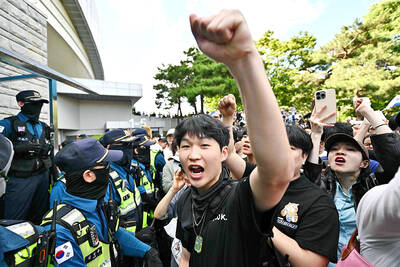
‘ABSURD MISTAKE’: The election commission said that there had been a failure to anticipate turnout after 14 polling stations ran short of ballot papers South Korean riot police yesterday cleared protesters from a Seoul polling station after a 35-hour blockade sparked by a shortage of ballot papers during local elections earlier this week. Wednesday’s election was the first nationwide vote since South Korean President Lee Jae-myung took office following the ouster of Yoon Suk-yeol over his short-lived martial law declaration. Lee’s ruling Democratic Party swept most races, but failed to flip the crucial Seoul mayoral seat. The South Korean National Election Commission apologized, blaming a failure to anticipate turnout after 14 polling stations in Seoul ran short of ballot papers. Some polling stations stayed open until 10pm to

Australian researchers have trained lab-grown brain cells on a silicon computer chip to play the 1990s shooter game Doom and said they are just scratching the surface of what the neurons could be capable of doing. It is the science-fiction work of biotech boffins at Cortical Labs, who researched and developed the technology that harnesses the workings of the brain’s networking system. Each so-called “biological computer” contains about 200,000 living human brain cells, grown from stem cells that were harvested from blood donations. Having mastered the simple computer game Pong, where a paddle is moved up and down to send a ball

France experienced its hottest spring on record, the French weather service said on Tuesday, after an exceptional early heat wave that also broke highs for the season in England and Wales. Meteo-France said the average nationwide temperature over March to May was 13.8°C — about 1.7°C above the norm, and surpassing records set in 2011 and 2020. “The warmest spring since records began in 1900,” it said in a bulletin. All three months were warmer than average, but the onset of an “unprecedented heatwave” late last month pushed the mercury to highs typically seen at the height of the summer. “Our country had never


 RSS
RSS