


The pro-Palestinian International Solidarity Movement (ISM) said yesterday it was distraught at news that an Italian member had been found murdered in the Gaza Strip.
Vittorio Arrigoni was found dead early yesterday morning, after a Salafist group posted a video of him online and threatened to kill him unless an unspecified number of their members were released by Gaza rulers Hamas.
Huwaida Arraf, a co-founder of the International Solidarity Movement, said she was shocked and horrified by news of Arrigoni’s murder.
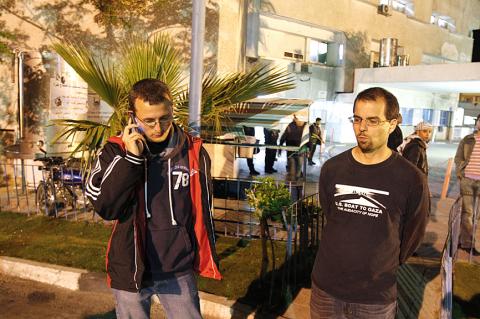
Photo: AFP
“I was in complete shock, not for a minute, I can’t even tell you I thought even one percent that they would hurt him, that they would end up killing him,” she said. “I spent the night crying.”
“Just thinking of the video of the last moments of life, in Gaza which he loved so much, that those were his last moments, was just really hard to swallow,” Arraf said.
The video posted on YouTube showed a bruised and bloodied Arrigoni, his eyes apparently covered with black duct tape and his hands bound behind his back.
His kidnappers identified themselves as belonging to a previously unknown group called The Brigade of the Gallant Companion of the Prophet Mohammed bin Muslima.
They demanded the release of “all our prisoners,” naming in particular an imprisoned jihadi leader called Sheikh Hisham al-Suedani and threatened to kill Arrigoni in 30 hours from 11am on Thursday.
Arraf said Arrigoni had been living on-and-off in the Gaza Strip since 2008, when he first arrived in the Palestinian territory on a boat chartered by the ISM.
In late 2008, he was arrested by Israeli troops while accompanying Palestinian fishermen off Gaza’s coast, and was deported. He later returned and had been living in Gaza City.
Arraf said Arrigoni, 36, was the last person she could imagine being targeted in Gaza.
“He’s been there since 2008. He’s very well-known, he lives among the people. He’s just got this dynamic, humanitarian -personality,” she said. “I even thought that whoever has him is going to see his humanity and just let him go so when I heard what happened to him I was totally shocked.”
Arrigoni, who had been a member of ISM since at least 2004, was in Gaza during Israel’s devastating December 2008 to January 2009 Operation Cast Lead and wrote a book about his time there, she said.
Arraf said ISM had never received threats from Palestinians, though two members of the organization were killed a few weeks apart in 2003 by Israeli troops in the Gaza Strip.
“There’d really never been any threats against ISMers in Gaza, especially not against him. The people in Gaza have really warmly welcomed ISM because we stand in solidarity with them,” she said.
Arraf said no decision had been made as to whether ISM activists in Gaza would leave, but that it would be up to volunteers on the ground.
“I personally don’t think it’s necessary that they leave, because this is such a random act, crazy people are acting against the will of the people,” she said.

‘CROSSING THE LINE’: China’s embassy in Seoul criticized US Forces Korea Commander General Xavier Brunson, asking if his ‘hostile’ remarks were authorized by Washington South Korea and the US are in talks over recent public remarks by the commander of US Forces Korea, Seoul’s presidential office said yesterday, after the comments drew sharp criticism from China. In a recent podcast interview, US Forces Korea Commander General Xavier Brunson described South Korea as “the dagger in the heart of Asia” from China’s east coast, prompting the Chinese embassy in Seoul to say that he had “truly crossed the line.” The interview came amid growing speculation that Washington might seek to expand the role of US Forces Korea in countering the growing regional influence of China, a key

SEEKING ORDER: Rodrigo Paz said that ‘anyone who wants to destroy the nation will have to deal with this president and the full force of the constitution’ Bolivian President Rodrigo Paz on Wednesday said that the nation was at a “breaking point” after nearly a month of protests that have caused shortages of food, fuel and medicine. Paz, who took office six months ago amid the worst economic crisis there in four decades, is battling a groundswell of fury over his policies. The political capital, La Paz, has been besieged by low-income workers and members of the indigenous majority calling for his resignation. “The country needs order and is reaching breaking point,” the 58-year-old said at a public event in La Paz, renewing his appeal for dialogue. On Tuesday, the Bolivian

Through the noise of rushing papers and whirring belts at a print factory in Kyoto, two creators watch their photo essay come to life in broadsheet form — part of an effort to win new audiences in the age of artificial intelligence (AI). Despite the decline of the publishing industry, self-publication and handmade “zine” magazines are growing in popularity in Japan, reflecting the nation’s enduring love of paper in the digital era. While speaking to Agence France-Presse at the plant, his hands black with ink, one of the creators, Kazuma Obara, said: “I think [paper] is a medium that engages all five

Australian researchers have trained lab-grown brain cells on a silicon computer chip to play the 1990s shooter game Doom and said they are just scratching the surface of what the neurons could be capable of doing. It is the science-fiction work of biotech boffins at Cortical Labs, who researched and developed the technology that harnesses the workings of the brain’s networking system. Each so-called “biological computer” contains about 200,000 living human brain cells, grown from stem cells that were harvested from blood donations. Having mastered the simple computer game Pong, where a paddle is moved up and down to send a ball


 RSS
RSS