


Ten people died when a regional passenger train collided with a goods train late on Saturday in eastern Germany, police and firemen said.
Up to 20 other people were seriously injured in the accident, which happened at Hordorf near Oschersleben, in the state of Saxony-Anhalt, firemen and police said. They gave differing numbers.
About 20 others suffered minor injuries, according to firemen. A total of 40 people were evacuated to hospitals, a police spokesman said.
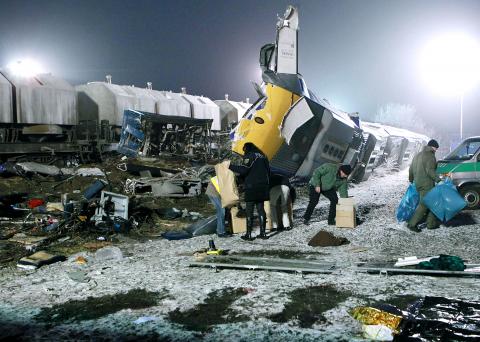
Photo: Reuters
Contrary to earlier reports from police the trains did not catch fire, according to fire service officials. The passenger train derailed and landed on its side.
No images of the accident scene were shown on German television in the hours following the drama.
More than 150 firemen, police and rescue workers were at the scene.
A few hours after the accident they were working under arc lights around the passenger train, according to a photographer at the scene. Several ambulances were waiting.
The regional train was the HarzElbeExpress (HEX) -traveling between Magdeburg and Halberstadt.
The causes of the accident were not immediately known, said Joerg Puchmueller, the northeast region spokesman for the Veolia Group, which runs the HEX line.
There is a single line running between Magdeburg and Halberstadt and maintenance work was scheduled for the night, the HEX Web site said.
Traffic was interrupted on the line and bus shuttles were set up, a HEX staff member said contacted by telephone.
The Veolia spokesman said the train had a capacity of about 100, but could not say how many were on board at the time of the collision.
The goods train also belonged to a private company.
Police set up an emergency number that could be called by families of the victims.
Germany has been hit by several deadly train accidents in the past few years.
In 2006, 23 people were killed and 10 injured when an experimental magnetic suspension Transrapid train crashed at 170 kph on a test track at Lathen in northwest Germany in a collision with an inspection vehicle.
In June 2003, six people died and 25 were injured in a frontal collision between two regional trains near Schrozberg in the southwest of the country.
However, the worst postwar train disaster occurred on June 3, 1998, when an InterCity-Express (ICE) high-speed train traveling from Munich in the south to Hamburg in the north hit a bridge and derailed, killing 101 and -injuring 88 at Eschede in northern Germany.
In August last year, 15 people were injured when an ICE high-speed train traveling from Frankfurt to Paris hit a garbage truck near Lambrecht in southwest Germany

‘CROSSING THE LINE’: China’s embassy in Seoul criticized US Forces Korea Commander General Xavier Brunson, asking if his ‘hostile’ remarks were authorized by Washington South Korea and the US are in talks over recent public remarks by the commander of US Forces Korea, Seoul’s presidential office said yesterday, after the comments drew sharp criticism from China. In a recent podcast interview, US Forces Korea Commander General Xavier Brunson described South Korea as “the dagger in the heart of Asia” from China’s east coast, prompting the Chinese embassy in Seoul to say that he had “truly crossed the line.” The interview came amid growing speculation that Washington might seek to expand the role of US Forces Korea in countering the growing regional influence of China, a key

Through the noise of rushing papers and whirring belts at a print factory in Kyoto, two creators watch their photo essay come to life in broadsheet form — part of an effort to win new audiences in the age of artificial intelligence (AI). Despite the decline of the publishing industry, self-publication and handmade “zine” magazines are growing in popularity in Japan, reflecting the nation’s enduring love of paper in the digital era. While speaking to Agence France-Presse at the plant, his hands black with ink, one of the creators, Kazuma Obara, said: “I think [paper] is a medium that engages all five

Australian researchers have trained lab-grown brain cells on a silicon computer chip to play the 1990s shooter game Doom and said they are just scratching the surface of what the neurons could be capable of doing. It is the science-fiction work of biotech boffins at Cortical Labs, who researched and developed the technology that harnesses the workings of the brain’s networking system. Each so-called “biological computer” contains about 200,000 living human brain cells, grown from stem cells that were harvested from blood donations. Having mastered the simple computer game Pong, where a paddle is moved up and down to send a ball

France experienced its hottest spring on record, the French weather service said on Tuesday, after an exceptional early heat wave that also broke highs for the season in England and Wales. Meteo-France said the average nationwide temperature over March to May was 13.8°C — about 1.7°C above the norm, and surpassing records set in 2011 and 2020. “The warmest spring since records began in 1900,” it said in a bulletin. All three months were warmer than average, but the onset of an “unprecedented heatwave” late last month pushed the mercury to highs typically seen at the height of the summer. “Our country had never


 RSS
RSS