


Shut up and don’t ask questions, or risk torture and even death: Such was the life under former Haitian dictator Jean-Claude “Baby Doc” Duvalier, survivors recall.
Duvalier, who took office in 1971 at the tender age of 19 from his father, Francois “Papa Doc” Duvalier, relied on thugs from the feared Tonton Macoutes to enforced the regime’s will.
Duvalier unexpectedly flew home on Jan. 16 after about 25 years in exile, throwing Haiti’s already volatile political scene into turmoil. The former “President for Life” ran the country with an iron fist until he was ousted by a popular revolt in 1986.
Liliane Pierre-Paul, a Haitian journalist, recalls the bleak life under Baby Doc.
“We didn’t have the right to protest or to gather, there was no freedom of speech or freedom of the press. We were under the regime’s full control,” Pierre-Paul said.
Reporters were muzzled, unions, student groups and political parties infiltrated by regime goons, she recalls. And yet it was not as bad as life under Papa Doc, who originally set up the Tonton Macoutes and ran Haiti between 1957 and 1971.
Children were taught to love the regime “from a very young age,” Pierre-Paul said. “All the children were conditioned. At school you could not say that you wanted to be president. If you said that your family would have problems.”
Under pressure from then-US president Jimmy Carter, Baby Doc was forced to soften the regime’s worst repressive policies and press restrictions were loosened.
“We took advantage of those openings to write stories,” said Pierre-Paul, despite pressure from the regime including police detention and legal summons.
However, the repression returned as soon as Carter left office. Pierre-Paul and other journalists with Radio Haiti were arrested and jailed.
“After five days, they created phony charges and accused me of being a terrorist,” she said.
Pierre-Paul was interrogated daily, tortured and sometimes forced to undress before prison guards.
After one month in prison she was expelled from Haiti.
“Politically, the regime was characterized by cracking down on all forms of opposition,” said Edouard Paultre, who was a student in the late 1970s.
“Summary executions, arbitrary detentions, kidnappings, disappearances ... the list of abuse is long,” said Paultre, who today is active in seeking to rebuild democracy in Haiti.
A prisoner’s worst fate was to be dragged off to Fort Dimanche — better known as Fort Death — a Port-au-Prince prison were inmates were routinely beaten and tortured.
The Tonton Macoutes “had the power of life or death over any citizen and their methods included murder, abduction, disappearances, private prisons, rape and torture,” said Gerard Alphonse Ferere, a professor emeritus of Saint Joseph University in Philadelphia, Pennsylvania.
Ferere, who was jailed and persecuted by Papa Doc, fled to the US in the 1960s. Today his work includes compiling a list of the Duvalier victims which can be seen on the Internet at www.fordi9.com/Pages/Chronicle.html.
“This is just a drop in the ocean, since there are more than 30,000 victims,” Ferere said.


Through the noise of rushing papers and whirring belts at a print factory in Kyoto, two creators watch their photo essay come to life in broadsheet form — part of an effort to win new audiences in the age of artificial intelligence (AI). Despite the decline of the publishing industry, self-publication and handmade “zine” magazines are growing in popularity in Japan, reflecting the nation’s enduring love of paper in the digital era. While speaking to Agence France-Presse at the plant, his hands black with ink, one of the creators, Kazuma Obara, said: “I think [paper] is a medium that engages all five
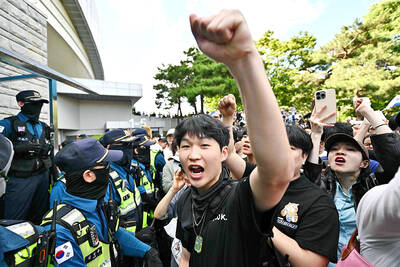
‘ABSURD MISTAKE’: The election commission said that there had been a failure to anticipate turnout after 14 polling stations ran short of ballot papers South Korean riot police yesterday cleared protesters from a Seoul polling station after a 35-hour blockade sparked by a shortage of ballot papers during local elections earlier this week. Wednesday’s election was the first nationwide vote since South Korean President Lee Jae-myung took office following the ouster of Yoon Suk-yeol over his short-lived martial law declaration. Lee’s ruling Democratic Party swept most races, but failed to flip the crucial Seoul mayoral seat. The South Korean National Election Commission apologized, blaming a failure to anticipate turnout after 14 polling stations in Seoul ran short of ballot papers. Some polling stations stayed open until 10pm to

France experienced its hottest spring on record, the French weather service said on Tuesday, after an exceptional early heat wave that also broke highs for the season in England and Wales. Meteo-France said the average nationwide temperature over March to May was 13.8°C — about 1.7°C above the norm, and surpassing records set in 2011 and 2020. “The warmest spring since records began in 1900,” it said in a bulletin. All three months were warmer than average, but the onset of an “unprecedented heatwave” late last month pushed the mercury to highs typically seen at the height of the summer. “Our country had never

A Sherpa guide was found crawling to base camp on Mount Everest a week after he went missing and was reunited with his family, who had given up hope he would return. Dawa Sherpa was last seen on Friday last week descending the mountain, but he did not reach base camp even though his client did. The pair were among the last climbers on the mountain as the climbing season came to an end and the route was dismantled. Dawa was located by a cleaning crew on Thursday morning as he was crawling down the snowy slopes around the Khumbu Icefall, just above


 RSS
RSS