


Rescue workers in Brazil braced for more rain yesterday as they struggled to reach areas cut off by massive floods and landslides that look certain to have killed more than 500 people.
In one of the country’s worst natural disasters, rivers of mud tore through towns in the mountainous Serrana region outside Rio de Janeiro, leveling houses, throwing cars atop buildings and stranding thousands of residents.
“What happened here is absurd. It looks like the war in Vietnam,” said Albertino Lazaro, 54, who took shelter in a gymnasium set up to house displaced families in the town of Teresopolis, where at least 223 people were killed.
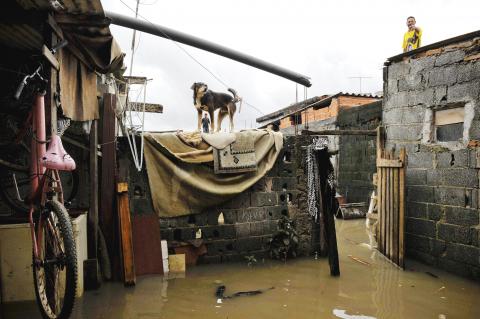
PHOTO: AFP
“It’s a lot better than being out there in the mud,” he said of the shelter as children played soccer among families sleeping on mattresses.
The death toll was 495 people, according to official tallies late on Thursday, but rescuers had yet to reach some of the worst-hit parts of Teresopolis, including one neighborhood where about 150 houses were believed to have been destroyed.
More than 13,500 people have been left homeless.
The flooding likely caused billions of US dollars in damage and has presented Brazlian President Dilma Rousseff with her first crisis only two weeks after she took office.
Beyond the loss of life and property, the damage from the rains could further boost food prices in parts of southeastern Brazil, a major concern for the government.
The Serrana region is an important producer of fruit and vegetables for the Rio area, but the floods have not affected Brazil’s main crops such as soy, sugar cane, oranges and coffee.
Rio, famed for its beaches and Carnival, will co-host soccer’s World Cup in 2014 and host the Olympics in 2016.
In Teresopolis, bodies had to be taken to a nearby church after the town’s morgue filled up. Officials showed pictures of the corpses to residents to identify family members.
In Nova Friburgo, a rural town first settled by Swiss immigrants, at least 214 people died. In Petropolis, once the summer residence for Brazil’s royal family, 40 people were killed, while at least 18 died in Sumidoro.
Rousseff, who has earmarked 780 million reais (US$460 million) in emergency aid, briefly visited the region to meet local officials. The government said it was sending 210 members of the Brazilian National Public Security Force to help identify bodies.
Hillsides and riverbanks in the area, about 100km north of Rio, collapsed after the equivalent of a month’s rain fell in 24 hours beginning on Tuesday night.
Rescuers worked to haul people from raging floodwaters and combed ruined homes for survivors, often finding only corpses.
However, a six-month-old baby was rescued from the rubble of a house, drawing thunderous cheers from residents.
One woman held a dog in the ruins of her house as surging water tore at the remaining walls. She grabbed a rope thrown from a nearby rooftop and was pulled to safety, but had to drop the dog into the vicious current.
“The situation is critical, but we have to advance. We can’t stop,” fire department colonel Jose Paulo Miranda said.
Landslides and flash floods are common in much of Brazil, often exposing poor planning and a lack of preventive action by authorities.
Rousseff told reporters that construction of housing in high-risk areas is “the rule in Brazil rather than the exception,” adding the lack of adequate housing policy contributed to the problem.

‘CROSSING THE LINE’: China’s embassy in Seoul criticized US Forces Korea Commander General Xavier Brunson, asking if his ‘hostile’ remarks were authorized by Washington South Korea and the US are in talks over recent public remarks by the commander of US Forces Korea, Seoul’s presidential office said yesterday, after the comments drew sharp criticism from China. In a recent podcast interview, US Forces Korea Commander General Xavier Brunson described South Korea as “the dagger in the heart of Asia” from China’s east coast, prompting the Chinese embassy in Seoul to say that he had “truly crossed the line.” The interview came amid growing speculation that Washington might seek to expand the role of US Forces Korea in countering the growing regional influence of China, a key

SEEKING ORDER: Rodrigo Paz said that ‘anyone who wants to destroy the nation will have to deal with this president and the full force of the constitution’ Bolivian President Rodrigo Paz on Wednesday said that the nation was at a “breaking point” after nearly a month of protests that have caused shortages of food, fuel and medicine. Paz, who took office six months ago amid the worst economic crisis there in four decades, is battling a groundswell of fury over his policies. The political capital, La Paz, has been besieged by low-income workers and members of the indigenous majority calling for his resignation. “The country needs order and is reaching breaking point,” the 58-year-old said at a public event in La Paz, renewing his appeal for dialogue. On Tuesday, the Bolivian

Forecasters in Europe yesterday warned of exceptional heat as record temperatures driven by a “heat dome” push temperatures well above seasonal norms across the continent. The surge follows a record-breaking Monday, with France logging its hottest day in the month of May on record, its weather agency said, and the UK also posting unprecedented highs. A so-called “heat dome” of warm air from northern Africa trapped under a high-pressure system over western Europe is behind the high temperatures not usually seen until high summer. Restrictions on outdoor work were imposed in parts of Italy, beaches in southwest France filled earlier than usual and

Australian researchers have trained lab-grown brain cells on a silicon computer chip to play the 1990s shooter game Doom and said they are just scratching the surface of what the neurons could be capable of doing. It is the science-fiction work of biotech boffins at Cortical Labs, who researched and developed the technology that harnesses the workings of the brain’s networking system. Each so-called “biological computer” contains about 200,000 living human brain cells, grown from stem cells that were harvested from blood donations. Having mastered the simple computer game Pong, where a paddle is moved up and down to send a ball


 RSS
RSS