


The principal dictator of Argentina’s 1976-1983 military junta, former Argentine president Jorge Videla, was sentenced to life in prison on Wednesday for crimes against humanity committed during his murderous “dirty war” against left-wing dissidents.
Videla, an 85-year-old former army general, who ruled between 1976 and 1981, had acknowledged his actions, but denied they were human rights violations, insisting he was an unjustly convicted “political prisoner.”
The sentencing judge, Maria Elba Martinez, described him as “a manifestation of state terrorism.”
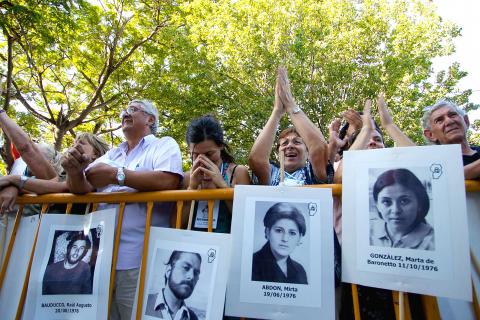
PHOTO: AFP
She ordered him incarcerated for the rest of his life in a Argentine federal penitentiary under civilian, not military, rules.
Another junta officer, General Luciano Menendez, 83, was also given a life term, added to other, identical sentences for human rights crimes carried out when he headed an army corp responsible for 11 provinces.
They were among 30 people — mostly police and military officers — tried for the junta’s atrocities. Sentences have ranged between six years and life behind bars.
Videla came to power at the head of the military junta after masterminding a 1976 coup that toppled the government of former Argentine president Isabel Peron.
The brutal regime was accused of making about 30,000 people “disappear,” including by throwing them from aircraft in night flights over the sea.
It operated 500 clandestine detention centers across the country where tens of thousands of people were held, many subjected to torture and death.
Argentina’s military government fell in 1983, a year after Videla’s successor, former Argentine -president Leopoldo Galtieri, waged an unsuccessful war against the UK for the Falkland Islands.
Videla’s trial began on July 2 with the ex-dictator acknowledging responsibility for “cruel” acts on his watch, but refusing to recognize the court.
In a pre-sentence hearing on Tuesday he repeated that position.
“I assume full responsibility ... My subordinates were only following orders,” he said.
“I claim the honor of victory and I regret the consequences,” Videla said, emphasizing he saw Argentina’s dirty war in the 1970s as a fight against “subversives.”
The charges against him included the abduction, torture and murder of 40 people, including a German student, Rolf Stawowiok, whose disappearance in 1978 prompted Berlin to ask for Videla’s extradition.
The former strongman was previously tried and sentenced in 1985 in Argentina to life in prison, but was pardoned five years later by then-Argentine president Carlos Menem.
A 2007 verdict finding Videla’s pardon unconstitutional set the scene for the new trial, which included charges that his regime stole babies from dissident prisoners.
At a separate trial on Tuesday, three former military officials of the regime each received life in prison for crimes against humanity, including “unlawful deprivation of liberty” and “aggravated torture.”
More than 130 people have been convicted of crimes committed during the military dictatorship, according to a report published last month, with dozens more currently on trial.

A new online voting system aimed at boosting turnout among the Philippines’ millions of overseas workers ahead of Monday’s mid-term elections has been marked by confusion and fears of disenfranchisement. Thousands of overseas Filipino workers have already cast their ballots in the race dominated by a bitter feud between President Ferdinand Marcos Jr and his impeached vice president, Sara Duterte. While official turnout figures are not yet publicly available, data from the Philippine Commission on Elections (COMELEC) showed that at least 134,000 of the 1.22 million registered overseas voters have signed up for the new online system, which opened on April 13. However,

EUROPEAN FUTURE? Albanian Prime Minister Edi Rama says only he could secure EU membership, but challenges remain in dealing with corruption and a brain drain Albanian Prime Minister Edi Rama seeks to win an unprecedented fourth term, pledging to finally take the country into the EU and turn it into a hot tourist destination with some help from the Trump family. The artist-turned-politician has been pitching Albania as a trendy coastal destination, which has helped to drive up tourism arrivals to a record 11 million last year. US President Donald Trump’s son-in-law, Jared Kushner, also joined in the rush, pledging to invest US$1.4 billion to turn a largely deserted island into a luxurious getaway. Rama is expected to win another term after yesterday’s vote. The vote would

ALLIES: Calling Putin his ‘old friend,’ Xi said Beijing stood alongside Russia ‘in the face of the international counter-current of unilateralism and hegemonic bullying’ Chinese President Xi Jinping (習近平) yesterday was in Moscow for a state visit ahead of the Kremlin’s grand Victory Day celebrations, as Ukraine accused Russia’s army of launching air strikes just hours into a supposed truce. More than 20 foreign leaders were in Russia to attend a vast military parade today marking 80 years since the defeat of Nazi Germany in World War II, taking place three years into Russia’s offensive in Ukraine. Putin ordered troops into Ukraine in February 2022 and has marshaled the memory of Soviet victory against Nazi Germany to justify his campaign and rally society behind the offensive,

CONFLICTING REPORTS: Beijing said it was ‘not familiar with the matter’ when asked if Chinese jets were used in the conflict, after Pakistan’s foreign minister said they were The Pakistan Army yesterday said it shot down 25 Indian drones, a day after the worst violence between the nuclear-armed rivals in two decades. Pakistani Prime Minister Shehbaz Sharif vowed to retaliate after India launched deadly missile strikes on Wednesday morning, escalating days of gunfire along their border. At least 45 deaths were reported from both sides following Wednesday’s violence, including children. Pakistan’s military said in a statement yesterday that it had “so far shot down 25 Israeli-made Harop drones” at multiple location across the country. “Last night, India showed another act of aggression by sending drones to multiple locations,” Pakistan military spokesman Ahmed


 RSS
RSS