


South African President Jacob Zuma has filed a US$700,000 defamation suit over a cartoon depicting him with his pants undone, preparing to rape a blindfolded, female figure symbolizing justice, a lawyer said.
Eric van der Berg, a lawyer for the Sunday Times, said on Tuesday that notice from the president’s lawyers had arrived at the paper’s Johannesburg offices on Monday.
The cartoon caused a storm when the Times published it in 2008, two years after Zuma had been acquitted of rape charges but van der Berg said Zuma had not followed up on threats to sue until now.
The lawsuit coincides with discussions about ruling party proposals that rights groups say may threaten media freedom.
Zuma’s African National Congress (ANC) party has proposed a secrets law that could jail reporters for publishing classified information. The party is also contemplating creating a media tribunal. The tribunal would be controlled by politicians and would have undefined powers to punish journalists for infractions that also are unclear. Both campaigns have stalled amid wide protest, but ANC leaders have not abandoned them.
The cartoonist Jonathan Shapiro, who signs his work Zapiro and is among the country’s best known political cartoonists, said he was “flabbergasted” that Zuma would go to court so long after the cartoon appeared. Shapiro said it would only serve to re-ignite public discussion about whether Zuma was trying to intimidate legal authorities in 2008.
“There will be a media circus around this,” Shapiro said. “Why he wants to give a cartoonist this kind of attention only he and his legal team know.”
Zuma is claiming 4 million rand (about US$570,000) for humiliation and degradation and 1 million rand for damage to his reputation. His spokesman, Zizi Kodwa, refused to comment on Tuesday.
The cartoon also showed Zuma’s political allies encouraging him as they held down a writhing, screaming figure with a sash identifying her as the “justice system.”
It appeared in the newspaper as Zuma’s political party led a protest campaign to have corruption charges dropped against him.
Zuma at the time was preparing to lead the ANC in general elections.
Prosecutors dropped the charges on the eve of the vote, and Zuma took office last year.
Buti Manamela, then a leader of the Young Communist League, filed a formal complaint about the cartoon before South Africa’s Human Rights Commission in 2008. The South African Communist Party leader was among the ANC allies depicted in the cartoon.
The commission concluded that the cartoon, while “probably offensive and distasteful,” did not violate Zuma’s constitutional right to dignity or constitute hate speech.
“The cartoon is a political expression, published in the public interest, and as such, deserves heightened protection,” the commission ruled. “It has, in fact, stimulated valuable political debate.” Shapiro said he is was confident of winning the case, which he said would also be a victory for freedom of expression.
Relations between the ANC and the media have been strained for years. The ANC has chafed at reporting on government corruption, and accuses many journalists of being biased against the party.
Reporters and rights watchdogs accuse the party of backsliding on freedoms that were won with the defeat of apartheid and are now enshrined in one of the world’s most liberal constitutions.
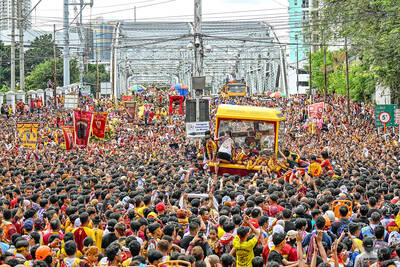
Tens of thousands of Filipino Catholics yesterday twirled white cloths and chanted “Viva, viva,” as a centuries-old statue of Jesus Christ was paraded through the streets of Manila in the nation’s biggest annual religious event. The day-long procession began before dawn, with barefoot volunteers pulling the heavy carriage through narrow streets where the devout waited in hopes of touching the icon, believed to hold miraculous powers. Thousands of police were deployed to manage crowds that officials believe could number in the millions by the time the statue reaches its home in central Manila’s Quiapo church around midnight. More than 800 people had sought

DENIAL: Pyongyang said a South Korean drone filmed unspecified areas in a North Korean border town, but Seoul said it did not operate drones on the dates it cited North Korea’s military accused South Korea of flying drones across the border between the nations this week, yesterday warning that the South would face consequences for its “unpardonable hysteria.” Seoul quickly denied the accusation, but the development is likely to further dim prospects for its efforts to restore ties with Pyongyang. North Korean forces used special electronic warfare assets on Sunday to bring down a South Korean drone flying over North Korea’s border town. The drone was equipped with two cameras that filmed unspecified areas, the General Staff of the North Korean People’s Army said in a statement. South Korea infiltrated another drone
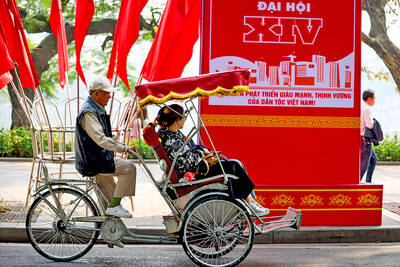
COMMUNIST ALIGNMENT: To Lam wants to combine party chief and state presidency roles, with the decision resting on the election of 200 new party delegates next week Communist Party of Vietnam General Secretary To Lam is seeking to combine his party role with the state presidency, officials said, in a move that would align Vietnam’s political structure more closely to China’s, where President Xi Jinping (習近平) heads the party and state. Next week about 1,600 delegates are to gather in Hanoi to commence a week-long communist party congress, held every five years to select new leaders and set policy goals for the single-party state. Lam, 68, bade for both top positions at a party meeting last month, seeking initial party approval ahead of the congress, three people briefed by

Cambodia’s government on Wednesday said that it had arrested and extradited to China a tycoon who has been accused of running a huge online scam operation. The Cambodian Ministry of the Interior said that Prince Holding Group chairman Chen Zhi (陳志) and two other Chinese citizens were arrested and extradited on Tuesday at the request of Chinese authorities. Chen formerly had dual nationality, but his Cambodian citizenship was revoked last month, the ministry said. US prosecutors in October last year brought conspiracy charges against Chen, alleging that he had been the mastermind behind a multinational cyberfraud network, used his other businesses to launder


 RSS
RSS