


Afghanistan’s most repressed ethnic group, the Hazaras, have used their vote in recent parliamentary elections to win themselves a political voice that could change their fate.
Throughout the war-shattered country’s history, Hazaras have occupied the bottom rung of society and as Shiite Muslims in a country dominated by Sunnis, were brutalized by a succession of rulers.
In post-Taliban Afghanistan, however, Hazaras are making democracy work for them and look likely to take 20 percent of the seats in the recent parliamentary poll.
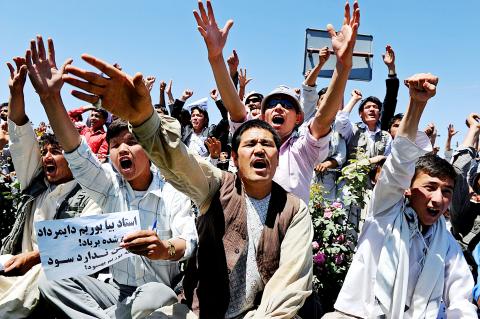
Photo: AFP
“Hazaras have always been repressed and abused by their rulers,” said Ahmad, a Hazara intellectual who refused to give his surname because of the political sensitivity of the issue.
“The new system, the democracy that we have had since the fall of the Taliban, is seen by Hazaras as a great chance to prove their existence,” Ahmad said.
Hazaras account for 10 percent to 15 percent of Afghanistan’s population, which is estimated to be 30 million, although there are official census data.
They dominate the country’s central highlands, a region surrounded by the conservative -Pashtuns, Afghanistan’s traditional rulers from the south and east, and the urbanized, liberal Tajiks in the north and west.
For most of the past 200 years, Hazaras — descendants of Mongol conqueror Ghengis Khan, whose hordes rampaged across the region in the 13th century — have been treated as second-class citizens, banished to low-status, low-income jobs.
Whenever Hazaras have risen against the repression, they have been brutally subdued by their Pashtun rulers, who sometimes massacred entire clans and then doubled taxes on others.
The Taliban, the ultra--conservative Islamists who ruled Afghanistan from 1996 to 2001, kept up the tradition and made abusing the Hazaras one of the defining points of their brutal regime.
However, since the Taliban were thrown out of power in a US-led invasion, the Hazaras have learned how to make the new system, a Western-backed democracy, work in their favor.
The Sept. 18 parliamentary poll, the country’s second since the end of the Taliban era, marked a significant milestone on the Hazaras’ rocky journey to equality.
Preliminary results show that Hazara candidates won more than 50 of the 249 seats in the lower house of parliament, the Wolesi Jirga.
“As a Hazara I’m absolutely satisfied with the results,” Ahmad said, reflecting the growing confidence of the Hazara community.
In southern Ghazni Province, which is dominated by Pashtuns and becoming more volatile as the Taliban-led insurgency drags into its 10th year, Hazaras won all 11 parliamentary seats.
Nonplussed Pashtun leaders have said the result was largely because of Taliban threats and harassment, which prevented them from voting.
Some Pashtun chieftains, frustrated by the outcome, had called for a re-run, an election official said on condition of anonymity, adding: “But that’s not going to happen under the law.”
Afghan President Hamid Karzai, himself a Pashtun, said recently he would be in favor of a re-run in Ghazni “for the sake of our national unity.”
Hazara parliamentarian Ibrahim Qasimi said: “Hazaras went out and used their right to vote. It’s because they believe in democracy, they like democracy and they like elections.”
“Their vote must be respected,” said Qasimi, who appears to have retained his Kabul seat.
“The time for war is over. We don’t think much about what happened in the past, we think about the future,” Qasimi added.
Hazaras, together with most non-Pashtun tribes, took up arms against the Taliban when the Islamists marched north from their stronghold of southern Kandahar in several raids between 1994 and 2001.
In late 2001, Hazara fought with the Northern Alliance, led the Tajik guerrilla leader Ahmad Shah Massoud, to help the US topple the Taliban, losing hundreds in the fighting.
Since that victory, the Hazaras have switched their energy to politics, now occupying several key Cabinet posts.


Through the noise of rushing papers and whirring belts at a print factory in Kyoto, two creators watch their photo essay come to life in broadsheet form — part of an effort to win new audiences in the age of artificial intelligence (AI). Despite the decline of the publishing industry, self-publication and handmade “zine” magazines are growing in popularity in Japan, reflecting the nation’s enduring love of paper in the digital era. While speaking to Agence France-Presse at the plant, his hands black with ink, one of the creators, Kazuma Obara, said: “I think [paper] is a medium that engages all five
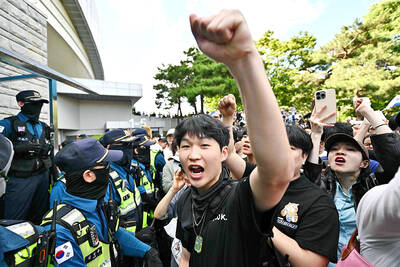
‘ABSURD MISTAKE’: The election commission said that there had been a failure to anticipate turnout after 14 polling stations ran short of ballot papers South Korean riot police yesterday cleared protesters from a Seoul polling station after a 35-hour blockade sparked by a shortage of ballot papers during local elections earlier this week. Wednesday’s election was the first nationwide vote since South Korean President Lee Jae-myung took office following the ouster of Yoon Suk-yeol over his short-lived martial law declaration. Lee’s ruling Democratic Party swept most races, but failed to flip the crucial Seoul mayoral seat. The South Korean National Election Commission apologized, blaming a failure to anticipate turnout after 14 polling stations in Seoul ran short of ballot papers. Some polling stations stayed open until 10pm to

France experienced its hottest spring on record, the French weather service said on Tuesday, after an exceptional early heat wave that also broke highs for the season in England and Wales. Meteo-France said the average nationwide temperature over March to May was 13.8°C — about 1.7°C above the norm, and surpassing records set in 2011 and 2020. “The warmest spring since records began in 1900,” it said in a bulletin. All three months were warmer than average, but the onset of an “unprecedented heatwave” late last month pushed the mercury to highs typically seen at the height of the summer. “Our country had never

A Sherpa guide was found crawling to base camp on Mount Everest a week after he went missing and was reunited with his family, who had given up hope he would return. Dawa Sherpa was last seen on Friday last week descending the mountain, but he did not reach base camp even though his client did. The pair were among the last climbers on the mountain as the climbing season came to an end and the route was dismantled. Dawa was located by a cleaning crew on Thursday morning as he was crawling down the snowy slopes around the Khumbu Icefall, just above


 RSS
RSS