


China has overtaken the US as home of the world’s fastest supercomputer. Tianhe-1A, named in honor of the Milky Way, is capable of sustained computing of 2.507 petaflops — equivalent to 2,507 trillion calculations — each second.
The US scientist who maintains the international rankings visited it last week and said he believed it was 1.4 times as fast as the former No. 1 — the Cray XT5 Jaguar in Oak Ridge, Tennessee. That topped the list in June with a rate of 1.75 petaflops a second.
The US is home to more than half of the world’s top 500 supercomputers. China had 24 in the last list, but has pumped billions into developing its computational ability in recent years.
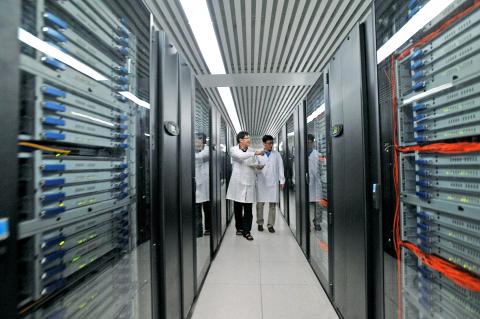
Photo: EPA
The machines are used for everything from modeling climate change and studying the beginnings of the universe to assisting airplane design.
Housed in the northern port city of Tianjin, near Beijing, Tianhe-1A was developed by the National University of Defense Technology.
The system was built from thousands of chips made by US firms — Intel and Nvidia — but domestic researchers developed the networking technology that allows information to be exchanged between servers at extraordinary speeds.
Tianjin’s weather bureau and the National Offshore Oil Corp data center are already using it for trial projects.
“It can also serve the animation industry and bio-medical research,” Liu Guangming, director of the National Center for Supercomputing, told the China Daily.
Tianhe-1A was in seventh place in the last rankings.
Its domestic rival Nebulae, housed in Shenzhen, was at that time ranked second, capable of sustained computing of 1.271 -petaflops a second.
The next set of rankings is due next week, but Jack Dongarra, the University of Tennessee computer scientist who oversees them, told the New York Times that Tianhe-1 “blows away the existing number one.”
Wu-chun Feng, a supercomputing expert and professor at Virginia Polytechnic Institute and State University, told the newspaper: “What is scary about this is that the US dominance in high-performance computing is at risk. One could argue that this hits the foundation of our economic future.”
Arthur Trew, a professor at Edinburgh University, who oversees the UK’s HECToR supercomputer, said the Sino-American battle to have the fastest device was not particularly significant.
“They are showing off with big machines — fine. It’s the underlying message that is important. The fact they are pumping this kind of money into building these machines in general is far more important ... Europe is being left behind,” he said.
“Having the computer is only half the battle. You have to use it, use it sensibly, and actually produce results. That requires software and brains and a lot of investment on top of the machine,” he said.
Scientists in the US are currently contemplating exascale computing — aiming to develop devices capable of performing a million trillion calculations a second.
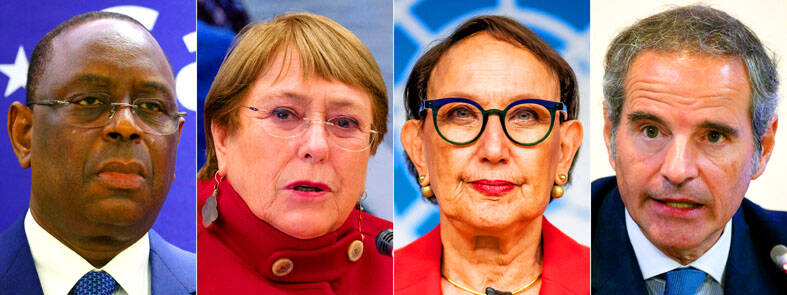
Four contenders are squaring up to succeed Antonio Guterres as secretary-general of the UN, which faces unprecedented global instability, wars and its own crushing budget crisis. Chile’s Michelle Bachelet, Argentina’s Rafael Grossi, Costa Rica’s Rebeca Grynspan and Senegal’s Macky Sall are each to face grillings by 193 member states and non-governmental organizations for three hours today and tomorrow. It is only the second time the UN has held a public question-and-answer, a format created in 2016 to boost transparency. Ultimately the five permanent members of the UN’s top body, the Security Council, hold the power, wielding vetoes over who leads the

South Korea’s air force yesterday apologized for a 2021 midair collision involving two fighter jets, a day after auditors said the pilots were taking selfies and filming during the flight and held them responsible for the accident. “We sincerely apologize to the public for the concern caused by the accident that occurred in 2021,” an air force spokesman told a news conference, adding that one of the pilots involved had been suspended from flying duties, received severe disciplinary action and has since left the military. The apology followed a report released on Wednesday by the South Korean Board of Audit and Inspection,

Young Chinese, many who fear age discrimination in their workplace after turning 35, are increasingly starting “one-person companies” that have artificial intelligence (AI) do most of the work. Smaller start-ups are already in vogue in Silicon Valley and elsewhere, with rapidly advancing AI tools seen as a welcome teammate even as they threaten layoffs at existing firms. More young people in China are subscribing to the model, as cities pledge millions of dollars in funding and rent subsidies for such ventures, in alignment with Beijing’s political goal of “technological self-reliance.” “The one-person company is a product of the AI era,” said Karen Dai

About 240 Indians claiming descent from a Biblical tribe landed at Tel Aviv airport on Thursday as part of a government operation to relocate them to Israel. The newcomers passed under a balloon arch in blue and white, the colors of the Israeli flag, as dozens of well-wishers welcomed them with a traditional Jewish song. They were the first “bnei Menashe” (“sons of Manasseh”) to arrive in Israel since the government in November last year announced funding for the immigration of about 6,000 members of the community from the states of Manipur and Mizoram in northeast India. The community claims to descend from


 RSS
RSS