


Empty gin and whisky bottles, crumpled beer cans and tattered food boxes are piled up after a rave in China — perhaps not so unusual, except that the garbage is on the fabled Great Wall.
The filthy remains of the full-moon techno party, which drew several hundred foreigners to one of the sections of the wall at Badaling, about 60km from Beijing, left Colombian tourist Francisco Garcia in a sad mood.
“It’s very bad for the environment,” Garcia said, summing up a major problem facing Chinese authorities — how to preserve the UNESCO World Heritage site while allowing visitors to take advantage of its majestic beauty.
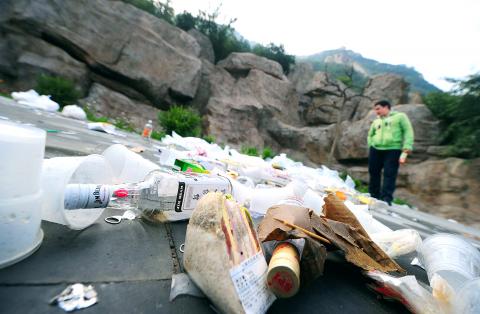
PHOTO: AFP
The sun rises, gently illuminating the impressive structure snaking over the hills. In a lookout tower, nine brightly colored tents have been set up for intrepid campers who spent the night in the early autumn chill.
“We’ve found nails in the Wall between the stones, put there by campers for their tents,” said Wang Xuenong (王學農), a former curator of the Shanhaiguan section of the wall, and a lecturer at Beijing’s Tsinghua University.
“There is no clear ban on sleeping on the wall,” he added.
William Lindesay, a Briton who has spent nearly a quarter-century working on wall conservation, says he thinks camping at a World Heritage site is simply “unacceptable.”
“People are relieving themselves all over it. In the past few months, I have come across big camping groups, pitching 10 or 15 tents and leaving their garbage from dinner and breakfast the following morning,” Lindesay said.
Parts of the wall — which welcomes 10 million visitors a year — are covered with graffiti, with names and phrases scrawled in English and French.
At Badaling, one of the most popular sections of the wall due to its proximity to the Chinese capital, “you have to walk several kilometers before you can find a brick that has not been carved into,” Lindesay said.
The Englishman — awarded one of Britain’s highest honors for his conservation work — says he fell in love with the Great Wall in 1987, at a time when China was still mainly closed to foreigners.
“I trekked 2,500km along the remains of the wall — 78 days of travel, with great difficulty, nine arrests and one deportation!” he said.
“For me, it was a turning point. I discovered that the wall is an amazing thing ... it is not only a building, it is a landscape,” said the 53-year-old, who was made an Officer of the Order of the British Empire.
Since 1998, he has taken groups of volunteers from his association, the International Friends of the Great Wall, to help remove hundreds of kilograms of garbage from the structure.
He then showed his photos of the destruction to the Beijing Municipal Administration of Cultural Heritage — to give them what he called a “wake-up call.”
“The garbage was just the tip of the iceberg — it was just highlighting that the Great Wall, an icon of China, a World Heritage site, was suffering from great neglect,” Lindesay said.
At Badaling, soaring tourism has led to an explosion in souvenir stalls, food counters and parking lots which detract from the beauty of the site. Elsewhere, factories have been built at the base of the wall.
The structure has been used for all sorts of events — from motorcycle jumping to catwalk shows — and as a backdrop for numerous television and film productions.
The wall, which runs through 11 provinces for a total of more than 8,800km, is not continuous but a series of sections built from the third century BC to the Ming Dynasty (1368-1644).
“It’s impossible to manage, there are too many provinces! There is no one department for the protection of the Great Wall,” Wang said.
Well before campers and ravers hit the wall, the structure suffered irreparable damage — first, pathways were cut through it for farmers, then came roads and railways. Local residents have stolen many a stone from it.
“Locals have built entire houses with stones from the wall,” Wang said.
Measures have been taken to limit the damage and some tourist amenities such as parking lots destroyed. Regulations now forbid any new construction within 500m of the site.
Lindesay says more must be done.
“Ordinary, slow government efforts are not good enough. There has to be a special effort, a directive from the central government that this is part of the national heritage,” he said.
“It’s a story of disappearing history. Once it’s gone, it’s gone,” he said.

When a hiker fell from a 55m waterfall in wild New Zealand bush, rescuers were forced to evacuate the badly hurt woman without her dog, which could not be found. After strangers raised thousands of dollars for a search, border collie Molly was flown to safety by a helicopter pilot who was determined to reunite the pet and the owner. A week earlier, an emergency rescue helicopter found the woman with bruises and lacerations after a fall at a rocky spot at the waterfall on the South Island’s West Coast. She was airlifted on March 24, but they were forced to

CONFIDENCE BOOSTER: ’After parkour ... you dare to do a lot of things that you think only young people can do,’ a 67-year-old parkour enthusiast said In a corner of suburban Singapore, Betty Boon vaults a guardrail, crawls underneath a slide, executes forward shoulder rolls and scales a steep slope, finishing the course to applause. “Good job,” the 69-year-old’s coach cheers. This is “geriatric parkour,” where about 20 retirees learned to tackle a series of relatively demanding exercises, building their agility and enjoying a sense of camaraderie. Boon, an upbeat grandmother, said learning parkour has aided her confidence and independence as she ages. “When you’re weak, you will be dependent on someone,” she said after sweating it out with her parkour classmates in suburban Toa Payoh,

Chinese dissident artist Gao Zhen (高兟), famous for making provocative satirical sculptures of former Chinese leader Mao Zedong (毛澤東), was tried on Monday over accusations of “defaming national heroes and martyrs,” his wife and a rights group said. Gao, 69, who was detained in 2024 during a visit from the US, faces a maximum three-year prison sentence, said his wife, Zhao Yaliang (趙雅良), and Shane Yi, a researcher at the Chinese Human Rights Defenders group which operates outside the nation. The closed-door, one-day trial took place at Sanhe City People’s Court in Hebei Province neighboring the capital, Beijing, and ended without a

‘TOXIC CLIMATE’: ‘I don’t really recognize Labour anymore... The idea that you can implement far-right ideas in order to stop the far right is nonsense,’ a protester said Tens of thousands of people on Saturday marched through central London to protest against the far right, weeks ahead of local elections and six months after Britain saw one of its largest far-right demonstrations. Organized by hundreds of civic groups, including trade unions, anti-racism campaigners and Muslim representative bodies, Saturday’s Together Alliance event was billed as the biggest in UK history to counter right-wing extremism. A separate pro-Palestinian march had also converged with the main rally. While organizers claimed 500,000 had turned out in total, the police gave a figure of about 50,000. Protesters carrying placards with slogans such as


 RSS
RSS