


Trying to smooth over recently rocky relations before he visits Washington, Chinese President Hu Jintao (胡錦濤) told aides to US President Barack Obama yesterday that he wants to see healthy and stable ties between the two countries.
The meeting between Hu and a White House economic policy official and deputy national security adviser was unusual because the Chinese president rarely meets with visitors ranked lower in diplomatic protocol.
It underscored Hu’s desire to move ahead in relations after months of discord over trade imbalances, Chinese currency policies and US arms sales and military maneuvers.
“China looks positively on the fresh progress made in China-US relations, and we are willing to work together with the United States in promoting the advance of healthy and stable China-US relations,” Hu told US National Economic Council director Lawrence Summers and Deputy National Security Adviser Thomas Donilon.
Hong Kong’s South China Morning Post also reported yesterday, citing unnamed Chinese diplomats, that the governments had agreed to resume the talks between the China and US militaries that Beijing suspended earlier this year in a pique over US weapons sales to Taiwan.
US National Security Council spokesman Mike Hammer said Donilon and Summers had “productive, detailed, and wide ranging discussions with Chinese officials” and that the visit, which concluded yesterday, “advanced the goal of strengthening the US-China relationship.”
Hammer said in a statement that the advisers had “candid exchanges on a wide range of issues touching on bilateral and international issues,” including North Korea and Iran.
As permanent members of the UN Security Council, China and the US have frequently locked horns over how to persuade Iran and North Korea to give up their nuclear programs, with Washington tending to favor sanctions and Beijing advocating dialogue and diplomatic means.
Other economic and security issues also were raised, Hammer said, but gave no specifics.
Addressing the security and economic spats that have dragged down relations was at the heart of Summers and Donilon’s three days of meetings in Beijing.
With an anemic economy and his Democratic Party under pressure in upcoming congressional elections, Obama is hoping for Beijing concessions on exchange rate policies that critics say keep the Chinese currency low in value, thereby subsidizing Chinese exports and contributing to high US unemployment and voter dissatisfaction.
Hu, in the meantime, is trying to strengthen his political hand ahead of a delicate Chinese Communist Party leadership transition and maintain the popularity of his government with people grown used to high rates of economic growth in part buoyed by trade with the US.
A White House visit — earlier offered by Obama and reiterated by Donilon this week — would be a boost for Hu in the highly symbolic, ceremony-centric world of Chinese politics.
US officials have said that Hu is likely to visit Washington in January, though dates are still being discussed.
In his meeting with the US officials, Hu noted Obama’s trip to Beijing last November and said “relations have on the whole maintained healthy development thanks to the efforts of both sides.”
Beyond the positive tone, it was unclear whether substantive compromises were reached during the trip.
On Tuesday, the Chinese Ministry of Foreign Affairs rejected US pressure on China’s currency policies, saying Beijing will set the pace of any reforms.
“Exchange rate reform can’t be pressed ahead under external pressure,” said Jiang Yu (姜瑜), a foreign ministry spokesman.
Still, senior Chinese officials talked of ending the public carping that has contributed to the souring atmosphere in recent months.
“Quiet and in-depth dialogue is better than loud haranguing,” State Councilor Dai Bingguo (戴秉國) told Summers and Donilon on Tuesday.
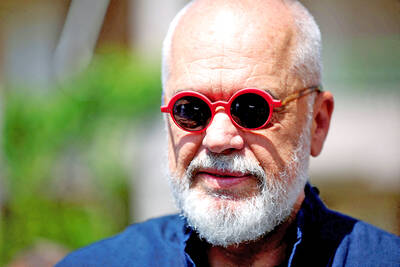
FRAUD ALLEGED: The leader of an opposition alliance made allegations of electoral irregularities and called for a protest in Tirana as European leaders are to meet Albanian Prime Minister Edi Rama’s Socialist Party scored a large victory in parliamentary elections, securing him his fourth term, official results showed late on Tuesday. The Socialist Party won 52.1 percent of the vote on Sunday compared with 34.2 percent for an alliance of opposition parties led by his main rival Sali Berisha, according to results released by the Albanian Central Election Commission. Diaspora votes have yet to be counted, but according to initial results, Rama was also leading there. According to projections, the Socialist Party could have more lawmakers than in 2021 elections. At the time, it won 74 seats in the
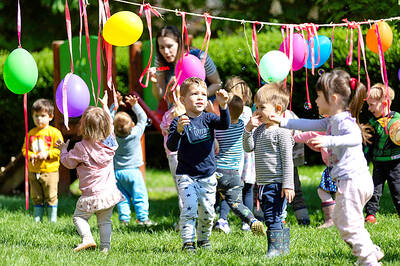
A Croatian town has come up with a novel solution to solve the issue of working parents when there are no public childcare spaces available: pay grandparents to do it. Samobor, near the capital, Zagreb, has become the first in the country to run a “Grandmother-Grandfather Service,” which pays 360 euros (US$400) a month per child. The scheme allows grandparents to top up their pension, but the authorities also hope it will boost family ties and tackle social isolation as the population ages. “The benefits are multiple,” Samobor Mayor Petra Skrobot told reporters. “Pensions are rather low and for parents it is sometimes

CONTROVERSY: During the performance of Israel’s entrant Yuval Raphael’s song ‘New Day Will Rise,’ loud whistles were heard and two people tried to get on stage Austria’s JJ yesterday won the Eurovision Song Contest, with his operatic song Wasted Love triumphing at the world’s biggest live music television event. After votes from national juries around Europe and viewers from across the continent and beyond, JJ gave Austria its first victory since bearded drag performer Conchita Wurst’s 2014 triumph. After the nail-biting drama as the votes were revealed running into yesterday morning, Austria finished with 436 points, ahead of Israel — whose participation drew protests — on 357 and Estonia on 356. “Thank you to you, Europe, for making my dreams come true,” 24-year-old countertenor JJ, whose
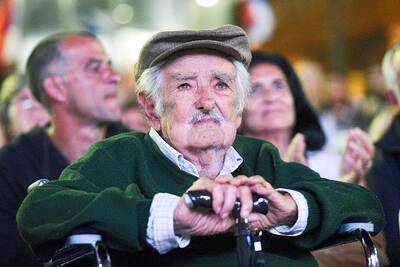
CANCER: Jose Mujica earned the moniker ‘world’s poorest president’ for giving away much of his salary and living a simple life on his farm, with his wife and dog Tributes poured in on Tuesday from across Latin America following the death of former Uruguayan president Jose “Pepe” Mujica, an ex-guerrilla fighter revered by the left for his humility and progressive politics. He was 89. Mujica, who spent a dozen years behind bars for revolutionary activity, lost his battle against cancer after announcing in January that the disease had spread and he would stop treatment. “With deep sorrow, we announce the passing of our comrade Pepe Mujica. President, activist, guide and leader. We will miss you greatly, old friend,” Uruguayan President Yamandu Orsi wrote on X. “Pepe, eternal,” a cyclist shouted out minutes later,


 RSS
RSS