


A decision by a British oil company to start drilling wells in “iceberg alley” off Greenland has been described as “completely irresponsible” by environmental groups in the light of BP’s problems in the Gulf of Mexico.
Cairn Energy said it had begun the first of four exploration wells on the Alpha prospect in Arctic waters of up to 500m after receiving permission from the Greenland government.
Greenpeace said the move was wrong, not least because Cairn was a relatively small company with no harsh-conditions drilling experience that had made its name discovering oil onshore in India.
“We think it is completely irresponsible for Cairn to proceed with these operations when the US, Canada and Norway have imposed tough new restrictions on deepwater drilling until lessons can be learned about what exactly went wrong in the Gulf,” said Mads Flarup Christensen, secretary general of Greenpeace Nordic.
“Drilling in these kinds of waters is very sad. It shows the way the oil industry is being forced into the last frontiers by trying to exploit tar sands and deep water,” he said.
Greenpeace has written to Greenland’s Prime Minister Kuupik Kleist, urging him to call a halt to the Cairn drilling program, but admits there is little sign of its request being granted. The green group believes the country is overlooking the risks because it is desperate to find new income sources, having recently won political independence from Denmark.
The wildlife charity WWF is also concerned about the Arctic drilling.
“The Gulf of Mexico is the world’s center of drilling technology with thousands of engineers and immense resources in terms of boats, planes, control equipment and manufacturing facilities — and even here it is proving immensely difficult to handle the tragic events of the Gulf of Mexico blowout,” said Dan Barlow, WWF’s head of policy.
“It is time for countries to recognize that offshore drilling with current technology and response capability poses unacceptable risks in the Arctic, where conditions are far more extreme. The consequences of such an event in the cold climate would lead to a persistence of ecological damage over many decades.”
Cairn management recently visited the Greenland capital of Nuuk to reassure the public that it would stick to the highest possible safety standards in line with an agreement signed with the government.
“Security has always been the most important in everything we do and so we want it to continue,” commercial director Simon Thomson said.
The company said last night that it had put in place a very wide-ranging plan for dealing with all kinds of emergencies — including the use of two drilling units so a second could drill a relief well instantly if needed. A spokesman said the company had worked in depths of water twice as deep when it was in the Bay of Bengal and was employing staff with plenty of hard-weather experience.
Jorn Skov Nielsen, director of the bureau of minerals and petroleum in Greenland, said Cairn would be working to the highest possible standards — considerably higher than was required of BP in the Gulf:
“These are standard wells, not deepwater ones, but they will still be drilled to the strongest Norwegian rules and under plans we have developed over the last 10 years,” Nielsen said.
Concerns about offshore work have been high since the Deepwater Horizon rig working for BP blew up, leaving the US with its worst ever oil spill. BP and Washington are waiting to hear from a series of investigation teams exactly what went wrong and who, if anyone, was to blame. The incident caused US President Barack Obama to block any new deepwater wells being drilled, though this ruling has been challenged in the US courts.
The new EU commissioner for energy, Gunther Oettinger, said this week that there should be no deepwater drilling in the North Sea, a move that has infuriated the UK oil industry.
The commission has no direct jurisdiction over British offshore waters and the UK government is unlikely to listen to this advice. Energy secretary Chris Huhne has already doubled the number of oil industry inspectors and said many more safety checks will take place in the future.

PARLIAMENT CHAOS: Police forcibly removed Brazilian Deputy Glauber Braga after he called the legislation part of a ‘coup offensive’ and occupied the speaker’s chair Brazil’s lower house of Congress early yesterday approved a bill that could slash former Brazilian president Jair Bolsonaro’s prison sentence for plotting a coup, after efforts by a lawmaker to disrupt the proceedings sparked chaos in parliament. Bolsonaro has been serving a 27-year term since last month after his conviction for a scheme to stop Brazilian President Luiz Inacio Lula da Silva from taking office after the 2022 election. Lawmakers had been discussing a bill that would significantly reduce sentences for several crimes, including attempting a coup d’etat — opening up the prospect that Bolsonaro, 70, could have his sentence cut to

A powerful magnitude 7.6 earthquake shook Japan’s northeast region late on Monday, prompting tsunami warnings and orders for residents to evacuate. A tsunami as high as three metres (10 feet) could hit Japan’s northeastern coast after an earthquake with an estimated magnitude of 7.6 occurred offshore at 11:15 p.m. (1415 GMT), the Japan Meteorological Agency (JMA) said. Tsunami warnings were issued for the prefectures of Hokkaido, Aomori and Iwate, and a tsunami of 40cm had been observed at Aomori’s Mutsu Ogawara and Hokkaido’s Urakawa ports before midnight, JMA said. The epicentre of the quake was 80 km (50 miles) off the coast of
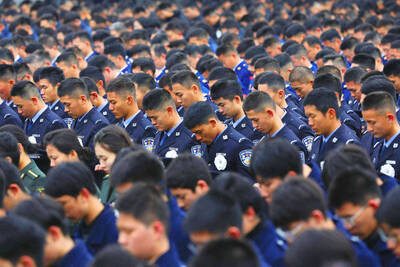
China yesterday held a low-key memorial ceremony for the 1937 Nanjing Massacre, with Chinese President Xi Jinping (習近平) not attending, despite a diplomatic crisis between Beijing and Tokyo over Taiwan. Beijing has raged at Tokyo since Japanese Prime Minister Sanae Takaichi last month said that a hypothetical Chinese attack on Taiwan could trigger a military response from Japan. China and Japan have long sparred over their painful history. China consistently reminds its people of the 1937 Nanjing Massacre, in which it says Japanese troops killed 300,000 people in what was then its capital. A post-World War II Allied tribunal put the death toll

A passerby could hear the cacophony from miles away in the Argentine capital, the unmistakable sound of 2,397 dogs barking — and breaking the unofficial world record for the largest-ever gathering of golden retrievers. Excitement pulsed through Bosques de Palermo, a sprawling park in Buenos Aires, as golden retriever-owners from all over Argentina transformed the park’s grassy expanse into a sea of bright yellow fur. Dog owners of all ages, their clothes covered in dog hair and stained with slobber, plopped down on picnic blankets with their beloved goldens to take in the surreal sight of so many other, exceptionally similar-looking ones.


 RSS
RSS