


Japan yesterday indicted a New Zealand anti-whaling activist from the US-based Sea Shepherd Conservation Society who boarded a harpoon ship in Antarctic waters in February.
Peter Bethune “was indicted on five charges — trespassing, causing injuries, obstructing commercial activities, vandalism and carrying a weapon,” a spokeswoman at Tokyo District Court said.
Bethune scaled the whaling fleet’s security ship the Shonan Maru II from a jet ski before dawn on Feb. 15, allegedly carrying a knife, which was used to cut a guard net as he boarded the ship.
Bethune was also captain of the Sea Shepherd’s powerboat the Ady Gil, which was sliced in two in a collision with the Shonan Maru II in January, when the group was harassing the Japanese whaling fleet.
Bethune had said he planned to make a citizen’s arrest of the ship’s captain Hiroyuki Komiya for what he said was the attempted murder of his six crew, and to present him with the bill for the futuristic trimaran. Instead he was detained, taken to Japan and formally arrested on March 12.
Prosecutors allege he injured a Japanese whaler by hurling a bottle of butyric acid which smashed aboard the Shonan Maru II on Feb. 12. The Sea Shepherds describe the projectiles as rancid butter stink bombs.
If found guilty of inflicting bodily harm, he could face up to 15 years in prison, while trespass can carry a three-year jail term.
The Sea Shepherds, who have urged Australian Federal Police to prosecute the captain and crew of the Shonan Maru II over the collision which led to the sinking of the Ady Gil, described Bethune as a “political prisoner.”
“These charges are bogus, and Sea Shepherd Conservation Society questions the credibility of the entire Japanese judicial system for entertaining such absurdities,” the group’s Australian director Jeff Hansen said.
The new charges were “a further slap in the face to the international community and proof that Japan will continue to do what it wants regardless of international law or public opinion,” he said in a statement.
“Illegal whaling operations in the Southern Ocean Whale Sanctuary and the detention of a political prisoner: These things clearly reflect the blatant abuse of and political corruption within Japan’s domestic judicial system,” he said.
The leader of the Australian Greens, Senator Bob Brown, called for the Japanese whalers to face charges for endangering lives.
“It is absolutely unjust that Captain Pete Bethune is facing up to 15 years in prison in Japan,” he said.
This is the latest chapter in the battle between environmentalists and Japanese whalers, who use a loophole in a 1986 international moratorium on whaling to hunt whales in the name of “scientific research.” Japan maintains that whaling has been part of its culture for centuries, and does not hide the fact that the whale meat ends up in shops and restaurants.
Australia has threatened to take Tokyo to the International Court of Justice unless it ceases its annual whale hunts in Antarctica by November.
Canberra this week also expressed alarm at growing support for a plan to allow limited commercial whaling, saying it could not accept the proposal before the International Whaling Commission.

Kehinde Sanni spends his days smoothing out dents and repainting scratched bumpers in a modest autobody shop in Lagos. He has never left Nigeria, yet he speaks glowingly of Burkina Faso military leader Ibrahim Traore. “Nigeria needs someone like Ibrahim Traore of Burkina Faso. He is doing well for his country,” Sanni said. His admiration is shaped by a steady stream of viral videos, memes and social media posts — many misleading or outright false — portraying Traore as a fearless reformer who defied Western powers and reclaimed his country’s dignity. The Burkinabe strongman swept into power following a coup in September 2022

TRUMP EFFECT: The win capped one of the most dramatic turnarounds in Canadian political history after the Conservatives had led the Liberals by more than 20 points Canadian Prime Minister Mark Carney yesterday pledged to win US President Donald Trump’s trade war after winning Canada’s election and leading his Liberal Party to another term in power. Following a campaign dominated by Trump’s tariffs and annexation threats, Carney promised to chart “a new path forward” in a world “fundamentally changed” by a US that is newly hostile to free trade. “We are over the shock of the American betrayal, but we should never forget the lessons,” said Carney, who led the central banks of Canada and the UK before entering politics earlier this year. “We will win this trade war and
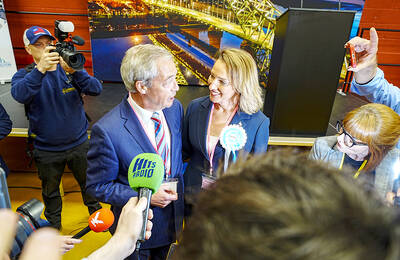
‘FRAGMENTING’: British politics have for a long time been dominated by the Labor Party and the Tories, but polls suggest that Reform now poses a significant challenge Hard-right upstarts Reform UK snatched a parliamentary seat from British Prime Minister Keir Starmer’s Labor Party yesterday in local elections that dealt a blow to the UK’s two establishment parties. Reform, led by anti-immigrant firebrand Nigel Farage, won the by-election in Runcorn and Helsby in northwest England by just six votes, as it picked up gains in other localities, including one mayoralty. The group’s strong showing continues momentum it built up at last year’s general election and appears to confirm a trend that the UK is entering an era of multi-party politics. “For the movement, for the party it’s a very, very big

‘BODIES EVERYWHERE’: The incident occurred at a Filipino festival celebrating an anti-colonial leader, with the driver described as a ‘lone suspect’ known to police Canadian police arrested a man on Saturday after a car plowed into a street party in the western Canadian city of Vancouver, killing a number of people. Authorities said the incident happened shortly after 8pm in Vancouver’s Sunset on Fraser neighborhood as members of the Filipino community gathered to celebrate Lapu Lapu Day. The festival, which commemorates a Filipino anti-colonial leader from the 16th century, falls this year on the weekend before Canada’s election. A 30-year-old local man was arrested at the scene, Vancouver police wrote on X. The driver was a “lone suspect” known to police, a police spokesperson told journalists at the


 RSS
RSS