


Doctors are launching a major clinical trial in the search for a long-term treatment for peanut allergy after children suffering from the condition were treated successfully for the first time.
Researchers at Addenbrookes hospital in Cambridge will begin the £1 million (US$1.55 million) government-funded immunotherapy trial next month after a pilot study showed children who had a severe reaction to peanuts could be desensitized.
The therapy is the most promising development yet in doctors’ search for a long-term treatment for the allergy, which affects 4 percent of British schoolchildren.
Children who suffer a reaction to peanuts can experience a constriction of the airways, breathing trouble, asthma, itching and swelling. Unlike some other childhood allergies, peanut sensitivity rarely recedes with time.
About one in 10 reactions is serious.
The hospital has recruited 104 children who will be randomly assigned to receive the therapy or join a control group for three years. Children receiving the therapy will be given a small amount of yogurt with 1mg of peanut flower mixed in each day.
GOING NUTS
Over time, the quantity of peanut flower will be increased to the equivalent of five peanuts a day, a process designed to desensitize their immune systems to the nuts.
In the pilot, 21 of 23 children aged between seven and 17 were effectively desensitized to peanuts and were able to eat food containing the nuts without suffering any reaction.
Two of the children now only take the yogurt with peanut flour once a week to maintain their tolerance.
“This is going to be the largest trial of its kind in the world and it should give us a definitive idea of whether it works and whether it’s safe,” said Andrew Clark, a consultant in pediatric allergy at the hospital.
Food allergy is responsible for the majority of anaphylactic shock in children and has increased by 20 percent in Western countries in the past 10 years.
Families involved in the pilot said the therapy changed their lives.
‘DRAMATIC’
“It’s dramatic,” Clark said. “Before they were checking every food label every time they ate food. They would worry it would cause a reaction or even kill them, but now they can go out and eat curries and Chinese food and they can eat everyday snacks and treats.”
“For their birthday they can have chocolate cake and chocolates without any fear of reactions. Our real motivation is to try to develop this as a clinical treatment that we could spread to the rest of the country,” Clark told the American Association for the Advancement of Science meeting in San Diego.
Researchers said children may need to receive the immunotherapy for two to three years, after which it may be possible for them to stop without losing their tolerance.
Clark said the therapy was at the research stage and required intensive clinical oversight to ensure it was safe.
“It must not be tried at home outside the research setting,” he said.
A previous trial in the 1990s, which used injections rather than consumed peanut flour, produced serious side effects.

PARLIAMENT CHAOS: Police forcibly removed Brazilian Deputy Glauber Braga after he called the legislation part of a ‘coup offensive’ and occupied the speaker’s chair Brazil’s lower house of Congress early yesterday approved a bill that could slash former Brazilian president Jair Bolsonaro’s prison sentence for plotting a coup, after efforts by a lawmaker to disrupt the proceedings sparked chaos in parliament. Bolsonaro has been serving a 27-year term since last month after his conviction for a scheme to stop Brazilian President Luiz Inacio Lula da Silva from taking office after the 2022 election. Lawmakers had been discussing a bill that would significantly reduce sentences for several crimes, including attempting a coup d’etat — opening up the prospect that Bolsonaro, 70, could have his sentence cut to

A powerful magnitude 7.6 earthquake shook Japan’s northeast region late on Monday, prompting tsunami warnings and orders for residents to evacuate. A tsunami as high as three metres (10 feet) could hit Japan’s northeastern coast after an earthquake with an estimated magnitude of 7.6 occurred offshore at 11:15 p.m. (1415 GMT), the Japan Meteorological Agency (JMA) said. Tsunami warnings were issued for the prefectures of Hokkaido, Aomori and Iwate, and a tsunami of 40cm had been observed at Aomori’s Mutsu Ogawara and Hokkaido’s Urakawa ports before midnight, JMA said. The epicentre of the quake was 80 km (50 miles) off the coast of
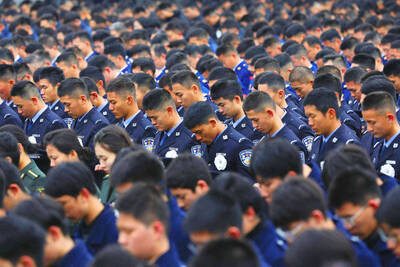
China yesterday held a low-key memorial ceremony for the 1937 Nanjing Massacre, with Chinese President Xi Jinping (習近平) not attending, despite a diplomatic crisis between Beijing and Tokyo over Taiwan. Beijing has raged at Tokyo since Japanese Prime Minister Sanae Takaichi last month said that a hypothetical Chinese attack on Taiwan could trigger a military response from Japan. China and Japan have long sparred over their painful history. China consistently reminds its people of the 1937 Nanjing Massacre, in which it says Japanese troops killed 300,000 people in what was then its capital. A post-World War II Allied tribunal put the death toll

A passerby could hear the cacophony from miles away in the Argentine capital, the unmistakable sound of 2,397 dogs barking — and breaking the unofficial world record for the largest-ever gathering of golden retrievers. Excitement pulsed through Bosques de Palermo, a sprawling park in Buenos Aires, as golden retriever-owners from all over Argentina transformed the park’s grassy expanse into a sea of bright yellow fur. Dog owners of all ages, their clothes covered in dog hair and stained with slobber, plopped down on picnic blankets with their beloved goldens to take in the surreal sight of so many other, exceptionally similar-looking ones.


 RSS
RSS