


The invasion of Iraq was illegal, a senior government lawyer told the Chilcot inquiry into the Iraq War on Tuesday.
Sir Michael Wood, legal adviser to the Foreign Office in the run-up to the invasion, said he “considered that the use of force against Iraq in 2003 was contrary to international law.”
“In my opinion, that use of force had not been authorized by the [UN] security council and had no other legal basis in international law,” he said in a witness statement to the inquiry.
Wood told the inquiry panel that Jack Straw, the foreign secretary before and during the Iraq War, remarked that international law was “pretty vague” and offered a certain amount of leeway. When Wood disagreed, Straw said he was being “dogmatic.”
Wood’s opinion of the illegality of the war was echoed by Elizabeth Wilmshurst, the government lawyer who was the only British civil servant to resign over the Iraq War.
In a statement to the inquiry, released ahead of her appearance on Tuesday afternoon, Wilmshurst said the invasion was not only illegal, but would damage the reputation of the UK as a law-abiding nation.
Declassified documents released by the inquiry show that Wood warned ministers three months before the invasion that it was not certain if military action would be legal.
In a letter to the office of the then-attorney general Peter Goldsmith, dated Dec. 9, 2002, Wood wrote that a “first view” of security council resolution 1441, passed the previous month, did not authorize the use of force.
He went on to write that a “second view” could be taken that the resolution did offer a “conditional authorization” for military action, but he warned there were “possible difficulties” with this argument.
Goldsmith was scheduled to appear before the inquiry yesterday, with questions set to focus on why he changed his view that the conflict did not break international law.
Three days before the March 20, 2003, invasion, Goldsmith told parliament that the use of force was legal on the basis of resolutions previously passed by the UN.
Declassified documents and evidence given to the inquiry into Britain’s role in the war, however, showed that Goldsmith had not given such explicit advice just 10 days earlier.
Critics of the war have long suspected that Goldsmith was pressured into changing his mind by then-prime minister Tony Blair.
Notes of a telephone call between Straw and Goldsmith shortly after resolution 1441 was passed indicated that he was not “optimistic” it could be used to justify military action should Iraq breach its terms.
“He was in fact pessimistic as to whether there would be a sound legal basis in such a situation for the use of force against Iraq,” the note said.
As late as March 7, 2003, when he gave detailed advice to Blair, he cautioned that a second UN resolution was the safest course of action.
By March 13, two days after a meeting with Blair and his team, Goldsmith had decided this second resolution was no longer necessary.
“The Attorney General confirmed that, after further reflection, he had come to the clear view that on balance ... there was a lawful basis for the use of force without a further resolution beyond resolution 1441,” a note by one of Goldsmith’s senior aides said.

Through the noise of rushing papers and whirring belts at a print factory in Kyoto, two creators watch their photo essay come to life in broadsheet form — part of an effort to win new audiences in the age of artificial intelligence (AI). Despite the decline of the publishing industry, self-publication and handmade “zine” magazines are growing in popularity in Japan, reflecting the nation’s enduring love of paper in the digital era. While speaking to Agence France-Presse at the plant, his hands black with ink, one of the creators, Kazuma Obara, said: “I think [paper] is a medium that engages all five

‘CROSSING THE LINE’: China’s embassy in Seoul criticized US Forces Korea Commander General Xavier Brunson, asking if his ‘hostile’ remarks were authorized by Washington South Korea and the US are in talks over recent public remarks by the commander of US Forces Korea, Seoul’s presidential office said yesterday, after the comments drew sharp criticism from China. In a recent podcast interview, US Forces Korea Commander General Xavier Brunson described South Korea as “the dagger in the heart of Asia” from China’s east coast, prompting the Chinese embassy in Seoul to say that he had “truly crossed the line.” The interview came amid growing speculation that Washington might seek to expand the role of US Forces Korea in countering the growing regional influence of China, a key
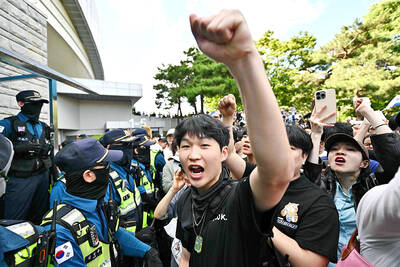
‘ABSURD MISTAKE’: The election commission said that there had been a failure to anticipate turnout after 14 polling stations ran short of ballot papers South Korean riot police yesterday cleared protesters from a Seoul polling station after a 35-hour blockade sparked by a shortage of ballot papers during local elections earlier this week. Wednesday’s election was the first nationwide vote since South Korean President Lee Jae-myung took office following the ouster of Yoon Suk-yeol over his short-lived martial law declaration. Lee’s ruling Democratic Party swept most races, but failed to flip the crucial Seoul mayoral seat. The South Korean National Election Commission apologized, blaming a failure to anticipate turnout after 14 polling stations in Seoul ran short of ballot papers. Some polling stations stayed open until 10pm to

Australian researchers have trained lab-grown brain cells on a silicon computer chip to play the 1990s shooter game Doom and said they are just scratching the surface of what the neurons could be capable of doing. It is the science-fiction work of biotech boffins at Cortical Labs, who researched and developed the technology that harnesses the workings of the brain’s networking system. Each so-called “biological computer” contains about 200,000 living human brain cells, grown from stem cells that were harvested from blood donations. Having mastered the simple computer game Pong, where a paddle is moved up and down to send a ball


 RSS
RSS