


FBI agents have questioned some of the young Americans arrested in Pakistan as US investigators gather evidence that could lead to a conspiracy charge against them, a US official and another person familiar with the case said on Friday.
Agents are working to see if there is enough evidence to charge any of the five Muslim students with conspiracy to provide material support to a terrorist organization, the two people said.
They spoke on condition of anonymity because they were not authorized to discuss the investigation.
Officials in both countries expect the five, who are from the Washington area, to be deported back home. But Pakistan may hold them long enough for US prosecutors to prepare charges, and there was no immediate indication how long that might take.
Intelligence officials in Islamabad said yesterday the five have been taken to a facility for terror suspects in the eastern city of Lahore, a major base for Pakistani military and intelligence where they face further questioning.
A police official in the Pakistani town of Sargodha, Tahir Gujar, confirmed yesterday the men were no longer there. Two intelligence officials said they were taken to Lahore. They spoke on condition of anonymity because they were not authorized to speak to media.
While Pakistani officials have said the men admitted trying to connect with militant groups, an FBI note sent to US lawmakers on Thursday evening said the bureau had “no information linking them to terrorist organizations.” That FBI note did not address whether the students attempted to join some terrorist group.
The other possible charge — and one that could be more difficult to bring — would be conspiracy to maim or kill people overseas.
“If they had reached an agreement amongst themselves and were pursuing an opportunity to train or fight with what they knew to be a foreign terrorist organization, then that would be a crime,” said Pat Rowan, the former head of the Justice Department’s national security division.
Making that case would depend greatly on what the men say to FBI agents — and whether any evidence or incriminating statements gathered by Pakistani police would meet US legal standards.
“Where one needs to be at least a little skeptical is that that will translate into the sort of evidence that can be used in an American courtroom,” Rowan said.
Statements made by Americans to police overseas can be used against them in a US trial, as long as the statements weren’t coerced. Another key source of evidence could be the men’s computers, on which Pakistani police say they found maps of areas where terrorists operate.
Across the US, there has been a flurry of cases against alleged homegrown terror threats, but so far the situation of the five young men who went to Pakistan is most similar to a case in Boston, where investigators say two young men repeatedly tried and failed to join terror groups overseas.
In that case, the men were rejected by both the Taliban and Lashkar e Tayyiba in Pakistan, and later efforts to sign up with groups in Yemen and Iraq also failed, prosecutors said. The charges against those two include conspiracy to provide material support to terrorists.
In both that case and the new one, the men apparently were drawn to militant messages on the Internet.
On Friday, local Muslim leaders gathered at the mosque where the five young men prayed in Alexandria, Virginia, just across the Potomac River from Washington. The five participated in youth activities at the small mosque that operates out of a converted single-family home in a residential neighborhood.
Mahdi Bray, executive director of the Muslim American Society Freedom Foundation, accused militants of manipulating young men through online videos and writings.
“We are determined not to let religious extremists exploit the vulnerability of the emotions of our children through slick, destructive propaganda,” Bray said.
Pakistan authorities say the five young men used the social networking site Facebook and the Internet video site YouTube to try to connect with extremist groups in Pakistan.
When they arrived in Pakistan, they allegedly took that effort to the street.
They were reported missing by their families more than a week ago after one of them left behind a farewell video showing scenes of war and casualties and saying Muslims must be defended.

Eleven people, including a former minister, were arrested in Serbia on Friday over a train station disaster in which 16 people died. The concrete canopy of the newly renovated station in the northern city of Novi Sad collapsed on Nov. 1, 2024 in a disaster widely blamed on corruption and poor oversight. It sparked a wave of student-led protests and led to the resignation of then-Serbian prime minister Milos Vucevic and the fall of his government. The public prosecutor’s office in Novi Sad opened an investigation into the accident and deaths. In February, the public prosecutor’s office for organized crime opened another probe into

RISING RACISM: A Japanese group called on China to assure safety in the country, while the Chinese embassy in Tokyo urged action against a ‘surge in xenophobia’ A Japanese woman living in China was attacked and injured by a man in a subway station in Suzhou, China, Japanese media said, hours after two Chinese men were seriously injured in violence in Tokyo. The attacks on Thursday raised concern about xenophobic sentiment in China and Japan that have been blamed for assaults in both countries. It was the third attack involving Japanese living in China since last year. In the two previous cases in China, Chinese authorities have insisted they were isolated incidents. Japanese broadcaster NHK did not identify the woman injured in Suzhou by name, but, citing the Japanese
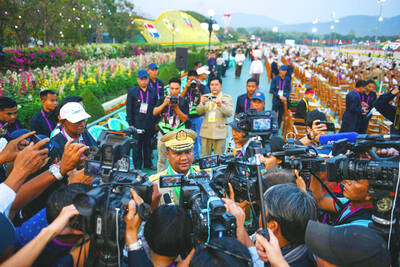
RESTRUCTURE: Myanmar’s military has ended emergency rule and announced plans for elections in December, but critics said the move aims to entrench junta control Myanmar’s military government announced on Thursday that it was ending the state of emergency declared after it seized power in 2021 and would restructure administrative bodies to prepare for the new election at the end of the year. However, the polls planned for an unspecified date in December face serious obstacles, including a civil war raging over most of the country and pledges by opponents of the military rule to derail the election because they believe it can be neither free nor fair. Under the restructuring, Myanmar’s junta chief Min Aung Hlaing is giving up two posts, but would stay at the
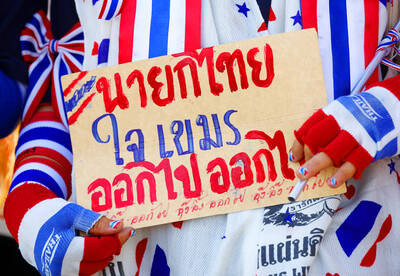
YELLOW SHIRTS: Many protesters were associated with pro-royalist groups that had previously supported the ouster of Paetongtarn’s father, Thaksin, in 2006 Protesters rallied on Saturday in the Thai capital to demand the resignation of court-suspended Thai Prime Minister Paetongtarn Shinawatra and in support of the armed forces following a violent border dispute with Cambodia that killed more than three dozen people and displaced more than 260,000. Gathered at Bangkok’s Victory Monument despite soaring temperatures, many sang patriotic songs and listened to speeches denouncing Paetongtarn and her father, former Thai prime minister Thaksin Shinawatra, and voiced their backing of the country’s army, which has always retained substantial power in the Southeast Asian country. Police said there were about 2,000 protesters by mid-afternoon, although


 RSS
RSS